Monday, September 26, 2005

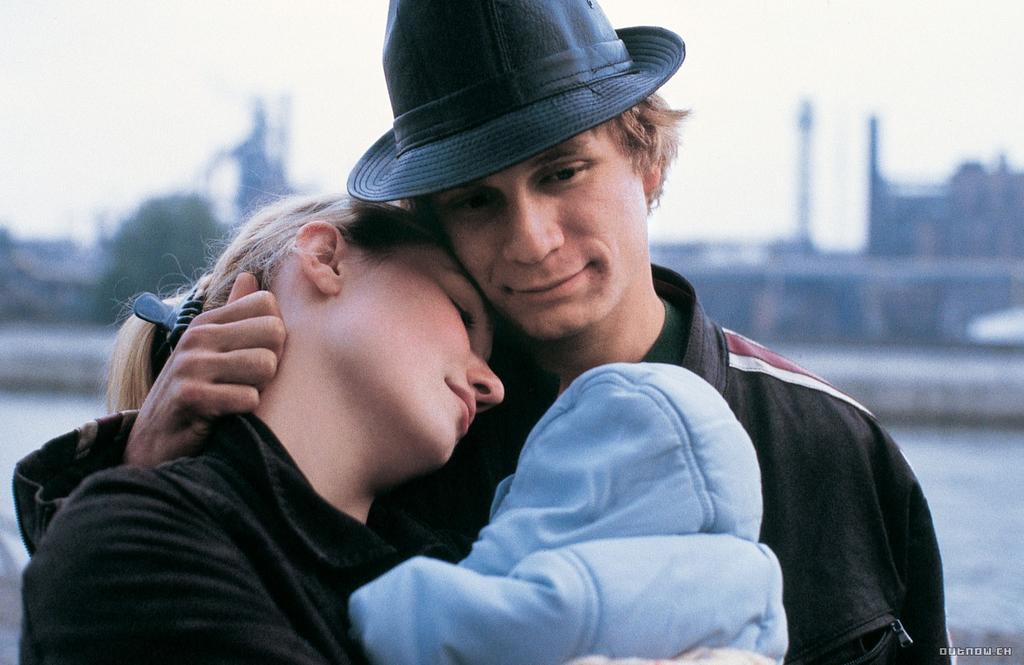
New Film: L'Enfant (The Child)

Jean-Pierre and Luc Dardenne's Cannes Palme d'Or winner, L'Enfant (The Child), deserves perhaps the highest praise that can be bestowed upon a work of art -- that it is true. To make this claim is not to suggest that it speaks from a right perspective or that it possesses a style that commensurately depicts its setting; rather, to say that L'Enfant is true is to acknowledge the verisimilitude of its psychological description. From this its viewpoint is to be judged, not vice versa.


That viewpoint, a Jamesian Christianity (as in the works-driven epistle), extends the logic of the brothers' previous masterpiece, The Son (2002). If the earlier film manifested an artisanal purity in the singularity of its purpose, both narratively and formally, the latter is a far messier affair, consistent with the titular adult lead's indirect path to salvation. His is not an easy attainment of maturity founded upon self-actualization, but is instead a reaffirmation of The Son's earlier claim that man is to be judged by his actions. It is not enough for one to be contrite in their words; genuine behavior modification must follow. That this is so is not simply a matter of a divine calculus but is instead reflective of self-absorption's power to destroy the lives of others, whether it is the emotional destruction of Sofia after he sells their newborn child or Bruno's abandonment of his weakened adolescent protege after a robbery. This is the true meaning of 'love thy neighbor.'

Of course, the film's inclusion of the theft and the subsequent theme of redemption through imprisonment reference the brothers' most consistent source, Robert Bresson, and particularly Pickpocket (1959) -- just as their Rosetta (1999) refashioned Mouchette (1967). (So too there exaggerated use of sound and extreme reduction of depth of field.) In this way, they continue to be the master's most loyal followers, updating his inimitable cinema with their own Jamesian variation. Moreover, the film's absence of arc befits their own revision in L'Enfant: it is no longer the struggling saint but instead the sinner who is now the subject of their allegory -- a Child, helpless without the love of his Father.

Saturday, September 24, 2005

New Film: The Weeping Meadow

There are anachronisms and then there are anachronisms. If in the past I have found it necessary to praise a director like Clint Eastwood for a technique more at home in 1962 than in its own age, I have done so with the feeling that for someone like him, form was only a means to an end. For Eastwood, style was (and is) never its own justification, but can be rather something to detract from the urgency of his narratives. To someone like Eastwood, modifications in form, rather than indicating some sort of aesthetic progress, possessed a danger in their potential to obscure his artistic intentions. At the same time, these same purposes were never themselves static, but instead experienced remolding in the image of their own particular moments. In short, while his technique stayed the same, his thought was evolving.

At first glance, Theo Angelopoulos might strike one as the same sort of figure. After all, The Weeping Meadow, whatever else it is, is a film from a different stylistic moment. Nonetheless, the ideas contained in The Weeping Meadow show the director's evolution from a Marxist historicism, focusing almost exclusively on Greek history (The Travelling Players, 1975), to a more existential consideration of Balkan realities (Ulysses' Gaze, 1995). Yet, there is one important difference between the aforementioned Eastwood and Angelopoulos: whereas invisibility of style is Eastwood's ultimate end, Angelopoulos has long foregrounded his own once dazzling technique. The problem is, it no longer seems as though the Greek auteur is utilizing his form to ask questions. If The Travelling Players established a fatal


continuity to the exigencies of Greek history, via a camera that moved from figure grouping to figure grouping, often bridging temporal discontinuities over the course of a single tracking shot, The Weeping Meadow's continued employment of this same style, minus its formally radical employment, fails to remain self-justified. If anything, The Weeping Meadow is a film that should have been made twenty-five plus years ago, considering its scant modifications of his own modernist form. (Sparing use of music psychologically is in fact the only reevaluation of Angelopoulos' Travelling Players' technique.) This is, in other words, a profoundly dated text. Of course,The Weeping Meadow has its moments of beauty -- which Angelopoulos, as always, never allow his spectators to forget -- but the ability to photograph a Greek landscape poetically loses some of its appeal as the film drags on toward the three hour mark. Its one thing to watch Angelopoulos reinvent the medium for four continuous hours in The Travelling Players; it's yet another thing to see him copying himself -- poorly -- for three.

So again, there are anachronisms and there are anachronisms. Unfortunately, a thirty-year late re-tread of late modernism is not exactly the most enticing variety. If anything, The Weeping Meadow reconfirms the necessity to understand films at the moment of their creation. If we can forgive a film like The Birth of a Nation (1915) for its aberrant politics (by today's standards) it is likewise important to understand the inadequacy of a film like The Weeping Meadow on the basis of its historical moment -- which unfortunately for the director ended long ago.

Friday, September 23, 2005

New Film: A History of Violence

*WARNING - THERE WILL BE SPOILERS FROM THE FIFTH PARAGRAPH ONWARD IN THIS ANALYSIS*

David Cronenberg's A History of Violence is to date the best English-language film of 2005. That it should be so will come as no surprise to anyone who has paid attention to the director's work over the last decade. To a film, there is perhaps no corpus in the Anglo-Saxon cinema during this time which has continued to examine the mysterious depths of personality in the way that Cronenberg's has. For the countless scores of movies that seek to awe and entertain us -- and make no mistake, Cronenberg does both -- here is a body of work that foremost seeks to ask the most essential of questions, what is it to be human? Indeed, a film like A History of Violence makes us wonder why all films don't attempt something similar, given the ease with which the visceral and the thought-provoking commingle within the film.

But of course A History of Violence is a rarity for Hollywood. Then again, as much as we sometimes like to pretend otherwise, a film like Cronenberg's has always been a rarity in Hollywood. Why does Alfred Hitchcock -- Cronenberg's most obvious influence in A History of Violence -- continue to engender such a cultish following? Because he was unique, because he was better than most... and so too is Cronenberg.

Like Hitchcock, Cronenberg adapts the default form of Hollywood classicism to suit his own idiosyncratic narrative ends. 'Adapt' (rather than adopt) as his form, at times, evinces its own consubstantial logic quite apart from the basic codes of Hollywood storytelling. Perhaps the best example of Cronenberg's narratological flexibility occurs in the opening scene in which two outsider hoods "check out" of their motel. With the camera remaining outside their crummy roadside accommodations, Cronenberg introduces us to these characters by making a very important discursive point: they are cold-blooded killers. This point, indeed, is not made until Cronenberg cuts for the first time as the character who had remained outside the entire time enters the motel office. Inside we see, along with the indifferent henchman, that his protege has executed the two motel workers. That Cronenberg maintained the spatial and temporal continuity of the earlier shot confirms what has already been suggested: that he entered the space with the sole purpose of murdering the pair; that it was not accidental, that his execution did not involve a struggle or any sort of in-the-moment rationalization (had there been a cut, on the other hand, either would have been structurally possible). If this is not enough, the gentleman now in the room proceeds to kill a little girl who spots him looking through a cooler -- an on-screen variation of what had been already established through a singluar stylistic choice.

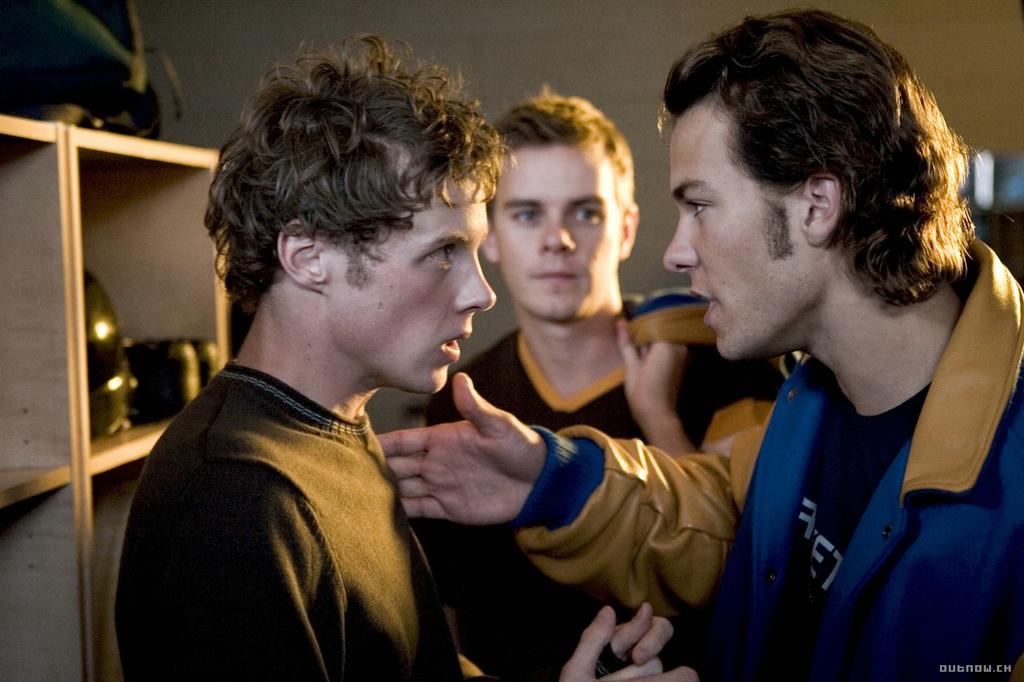
In the next shot we are introduced to the film's protagonists, Tom Stall (Viggo Mortensen), his beautiful wife (Maria Bello), his son and daughter. The screaming little girl is quickly reassured that there is no such thing as monsters as we are ominously introduced to this swath of small-town American perfection -- and their seemingly obvious future victimization. (Importantly, Cronenberg does not make fun of their ethos: visually he shows the natural beauty of the Midwest, while the couple's sexual life seems to indicate an uninhibited ideal.) However, before we get to this point, Cronenberg establishes the teenage son's victimhood -- to a high school bully -- giving us another character on whom we wish justice meted.

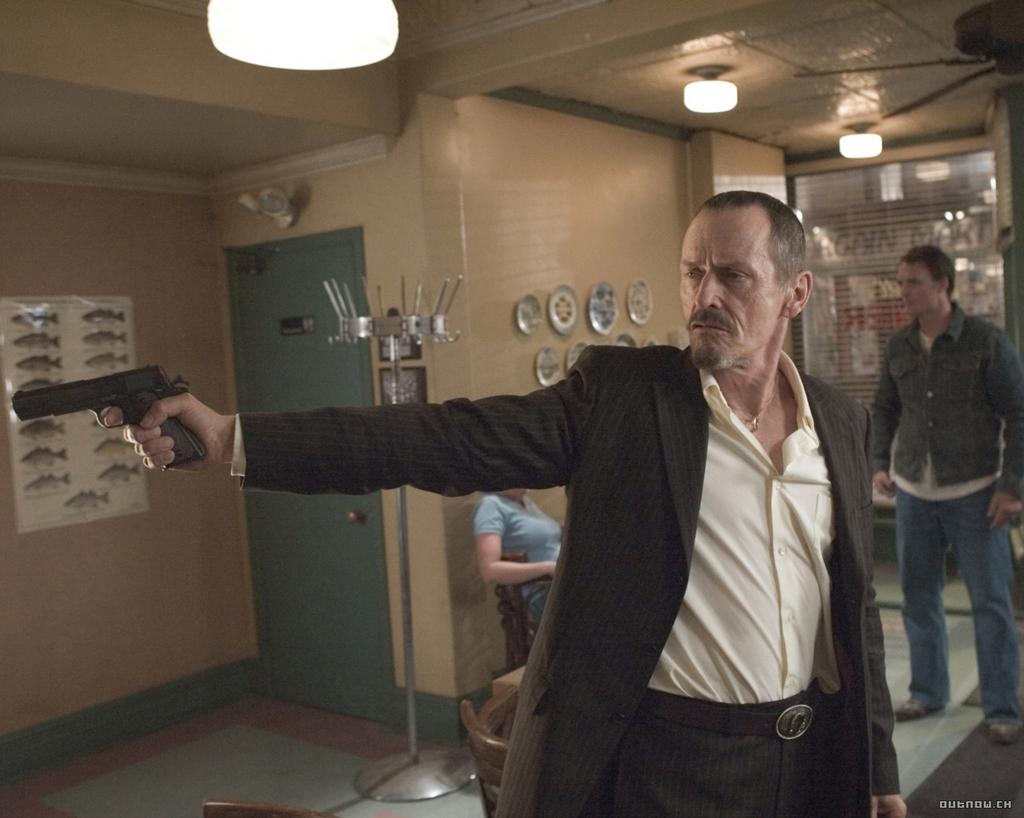
Subsequently, the two out-of-towners force their way into Tom's diner at closing time. Once it becomes clear that they are there to rob the establishment -- which we know will mean certain death for our protagonists -- and once one of the characters moves to rape the female waitress, Tom acts almost instinctively, killing the pair of assailants with breathless dexterity. Suffice to say that he is regarded as a hero and that we feel no sympathy for the dead, even if we might regret their physical pain (which Cronenberg carefully includes).

However, as any one who has ever seen a Cronenberg film knows, what follows is anything but straight narrative. Following Tom's heroic action, a mangled Ed Harris and a pair of his cronies arrive in the diner. Mr. Harris's character insists on calling Tom, Joey, which, for the naturalistic grace of Mortensen's performance, we find as odd as Tom evidently does. Regardless, the former persists, and Tom seems to have been thrust in a very Hitchcockian 'wrong man' scenario. As we soon learn, Harris is a mobster with a beef against this Joey who was responsible for carving up his face with barbed wire. Again, for those acclimated to the Cronenberg universe (think Spider, 2002) one begins to wonder if Tom is indeed Joey without knowing it -- that he is some kind of "schizo" as his wife wonders. Our answer comes shortly for this man who is strangely adept at killing, but who is nonetheless saved by his son at the last possible moment. (It is therefore implied that the young man might just share his father's violent acumen.)

The point is, whether or not Tom/Joey is aware of his past, that this violence exists within him, which is precisely where Cronenberg's big questions commence. Does Tom bare responsibility for Joey's past actions if he is not aware of them? Which is Tom/Joey's true personality? Can he be both of these people at once, and if so what makes him the person he is (if it is not a single personality)? Who is he, in other words, and what is it that makes him human if not a unified self?

Of course, there is another dimension in what would seem to be his suppressed former (perhaps true, though not necessarily) self: that there is violence living inside him. Indeed it is at this point that Cronenberg's film skips over any possible misreading as political allegory -- violence is a fact of life, or more precisely in the instance of this narrative, a former life. In fact, the history to which the title refers is that of Tom's self, a history which Cronenberg's narrative slight-of-hand shows to be in his everyman, and implicitly in all of us. That his physically timid son manifests the same violence (while finding a narrative causality in his genetics) reinforces the ubiquity of human violence. While it is true that Cronenberg is removing the too-perfect veneer of Middle America, it is of even greater importance that he is excoriating the illusory skin of human goodness. In this most perfectly ordered specimen there is untamed violence.

Wednesday, August 31, 2005

Quick take on Rossellini

Although Roberto Rossellini was indisputably one of the most influential of European directors, the fact that his influence was founded upon a philosophical or conceptual attitude rather than upon the imitation of stylistic devices or thematic preoccupations has meant that Anglo-American film historians in particular tend to pay little more than lip service to his achievement, when not ignoring it altogether. Yet such indifference constitutes a major injustice not merely to a director who redefined the parameters of the cinema but to one of the supreme "documenters," in any art form, of the latter half of the 20th century.

-Gilbert Adair

Roberto Rossellini is one of those curious figures in world cinema who seems to generate more respect than admiration. As Adair accurately points out, the reverence typically paid to the director is little more than tokenism. Certainly, his realist aesthetic -- location shooting, natural light, non-professional actors, longer-duration takes -- has benefited filmmakers of sparse means the world over. He is remembered as a figure of undeniable historical significance without being thought of as the equal to directors of a similar influence (such as Griffith, Renoir, Welles, Bresson, Godard). He certainly lacks the devotion many hold for his best-known countrymen, from Fellini to Antonioni to Bertolucci, among others. However, I would submit that he is at once their superior and the greatest of all Italian directors, without even making any allowance for his firm place in film history. This is to say that his corpus speaks for itself, outside of history, as one of the most beautiful and inspired that the medium has yet seen.

Yet, again he is underestimated. The reason for this, it would seem to me, is that Rossellini's style is too often considered for its historical circumstances, its facility for assimilation, and even for what he expresses through this style (or less opaquely, his themes) rather than for what this style says about the director's viewpoint. Indeed, it is in an examination of its conceptual genesis that a unity emerges to Rossellini's corpus, marking him as one of the medium's best.

Specifically, it seems to me that the key to appreciating Rossellini rests in his epistemological ideas. For Rossellini, the truth is evident on the surface of things. From his early, immediately post-war films (Rome, Open City [1945], Paisa [1946], Germany, Year Zero [1948]) to his Bergman cycle (including Stromboli [1950], Voyage in Italy [1953] and Fear [1954]), his historical recreations (The Flowers of St. Francis [1950] and The Rise to Power of Louis XIV [1966] among others) and more proper documentaries (such as India [1958]), what marks his entire body of mature work is a faith in humankind's perception of truth. Take the somewhat forgotten, small masterwork Fear: throughout the picture, Bergman's character attempts to conceal the truth of an adulterous affair. However, her body language belies the secret she is attempting to hide -- at one point her blackmailer asks rhetorically why she blushes, why her hands trembled and why she was so quick to give away her money. In other words, in spite of a shared Catholic faith with Robert Bresson, Rossellini departs from the Frenchmen (as well as from such directors as Michelangelo Antonioni, Wong Kar-wai, and even Eric Rohmer in Triple Agent [2004]) in the his view that psychology is discernible in gesture.

As it has been claimed, this basic understanding of the comprehensibility of truth is not limited in fact to the psychologically-intensive Bergman cycle, but manifests itself throughout his ouevre. The post-war texts offer their morals within the context (another key theme in Rossellini) of a war-ravaged Europe. In seeing the condition of Germany in the 1948 film, one understands the despair of the child protagonist. Surface reality discloses truth. Similarly, The Flowers of St. Francis, perhaps his greatest work, shows (key theme number three) the basic rhythm of a long-since extinct life -- a life lived absent of any goals other than the service of the Lord -- which as such reveals Christianity's distinct understanding of time; less abstractly, India proposes that its presentation of Indian life is sufficient to reveal essential truths of the nation.

In this basic understanding of epistemology, I would argue, Rossellini shows himself to be an artist seeking a form to express his ideas, not simply the innovator of a technique born of historical circumstance. It is in this consistency of viewpoint, manifesting itself in his form, that the beauty of his work becomes clear. Rossellini's cinema deserves to be appreciated not only for its historical value, but indeed for the beauty of its expression of content. In this lies its grace.

Saturday, August 27, 2005

Unheroic Martial Art Missteps

Upon the urging of a reader -- and for the Gaza piece which was posted on this site last night -- I have been asked to share my thoughts on what might be best described as a cycle of revisionist martial arts films made in the past five years. Since what I am about to say differs from his own opinion, and that of at least one other very knowledgeable friend's of mine, I hope this post will generate non-scatalogical disagreement in the comments section. So let me begin with a film that I viewed for the first time, belatedly, to offer as thoughtful an analysis as I could: Hero.

Zhang Yimou's Hero (2002), a revisionist martial arts epic starring Jet Li, Tony Leung, Maggie Cheung and Zhang Ziyi -- a veritable who's who of Chinese art cinema -- was itself only belatedly released in the U.S., more than two years after its completion. Of course, when it did finally hit screens, the Miramax co-production did exceedingly well at the box office, confirming the commercial promise of the record-breaking Crouching Tiger, Hidden Dragon (2000)While it goes without saying that box office success does not entail quality, it is still worth noting that few other foreign-language films have connected with American audiences the way that these films have. Ultimately, what strikes me about these martial art epics and parodies is the place that spectacle plays in their administration of pleasure. Upon its release, it seemed that much of the hype concerning Crouching Tiger, Hidden Dragon stemmed from the director's renunciation of computer effects in exchange for the wires that allowed the protagonists' to engage in combat on the tops of the trees. The exhilaration of flight, of soaring was key to the film's visceral impact, just as it is for Hero or Zhang's House of Flying Daggers (2004). There is a sense in each of these that the impossible is being depicted; the laws of nature are no longer impediments to these works of exceptional dexterity. Similarly it is this quality, dexterity, which fills the parodic work of Stephen Chow (Kung Fu Hustle, 2004): the impossible is euphorically brought to the screen, though it is here tempered by Chow's caustic wit and postmodern sensibility.

So, each's ability to produce a unique sensorial experience, to 'wow' its audience should be enough to commend these works, should it not? Well, with the exception of Crouching Tiger, Hidden Dragon (certainly overrated, but still pretty good) I would say it is now. Let us return to Hero.First, let us concede that there are certain spectacular scenes in the film: the zero gravity fighting, the cloud of arrows cutting through the sky, the absurd hand-to-hand combat abilities of the protagonists -- this is a film that has some "sick" action sequences, nobody will deny that. Surely, in fact, this is a film that follows the Sergio Leone (Once Upon a Time in the West, 1968, 'The Man with No Name' trilogy) model of genre revisionism -- which it references in its nameless protagonist: because it is a film about its genre, a mind-numbing, almost glib degree of skill is appropriate.

Yet, there is something to remember when one talks about a cinema that is inherently revisionist in its telos -- because it is a film about film history, it is inherently historic in its critique. In other words, for one of these films to possess merit at a critical level, it must come at a specific moment in the evolution of the genre. King Hu's revisionist martial arts classic A Touch of Zen(1969) does, the Leone films do, but it is hard to claim a similar importance for the Lee or Zhang films. (This was the same problem I had with Todd Haynes' hopelessly overrated Far From Heaven (2002): what exactly is the point of revising Sirk fifty years after the fact? And does the earlier film truly want for its recourse to subtext?) Okay, so these people defy the laws of nature, so women are particularly skilled in their films, so what? Neither genre revisionism nor feminism are exactly new to our critical discourse.

So we go searching for other qualities in these films. What we find in Zhang's films are a reactionary pro-Chinese sentiment propped up by its export exoticism. As with his Raise the Red Lantern (1991), Zhang seems to be directing his nationalist epics at an international art-house audience: Zhang doesn't stop at portraying his culture; he explains it to his non-acclimated audiences. Furthermore, Hero in particular belies a naivete when it comes to its political sentiments -- peace is held to be the noblest cause of all. In this, Zhang seems to support the acquiescences to a dictator so long as it means that one can go about their life unimpeded. Troubling sentiments for someone who lived through the Cultural Revolution and Tienamen.

While as a rule I advocate judging films not in what they say but in how they say it, works such as Hero emerge as something of an exception by virtue of the fact that their 'how' does not relate to their 'what.' It is not that Zhang's craft is invisible; quite the opposite, in fact. Rather, it is that the form is spectacle for its own sake and its political message, which is quite clear in Hero, is not integrated into the work's form. As such, a film like Hero requires precisely this mode of compartmentalized critique as this is how the various elements of its form relate to one another. It is on this basis that I criticize it and the other films mentioned, again save for Crouching Tiger.

Okay, so Kung Fu Hustle operates according to different laws itself, though I am no less unequivocal in my distaste for this much-hyped parody. If you want to know what sort of humor Chow employs, turn on Univision on a Saturday night, look for the cross-eyed dweeb staring at the buxom fake blonde, watch her scorn a number of hunky male model types for the wallflower, and there, in a nutshell, is the humor of Kung Fu Hustle's. Chow wraps this hopelessly over-the-top broadness in a cloak of postmodernism. And like Hero this gratuity adds up to nothing much at all.

Friday, August 26, 2005

Gaza Pullout, by Dr. X

While modesty, typically, is not one of my better virtues -- or something I possess in any form -- on the topic of the Gaza pullout I did feel a bit ill-suited to offer my commentary. So in my place, here is the mysteriously-christened Dr. X, a one-time resident of Israel and in my view, one of the most insightful people I know on the topic of Israeli-Palestinian relations. Please read his piece in its entirety -- the good Dr. offers an exceptionally well-reasoned analysis of the current situation and its future trajectory. (And a memo to the author: Dr. X, you have an open invitation any time you would like to turn this Tativille thing into a two person blog. You could write about things people actually care about and I'll stick to my speciality, irrelevancies.) Here it is:
Greetings fellow Tativille reader(s?)! Dr. X here. Ordinarily your eyes would be graced with the witty and insightful words of Michael J. Anderson. However, today's topic concerns Israel's pullout from the Gaza Strip, and since Mike prefers to eat his falafel in lower Manhattan rather than Kfar Darom, he followed his capitalist instincts and outsourced the job to me. So today I'll be playing the political version of a teenage East New Delhian calling myself "Jerome" and asking you if you would like to take advantage of our introductory long distance service prices. The good news is that as a two year resident of suburban Jerusalem (albeit nearly 10 years ago) I am more qualified to talk about Israeli politics than anyone you're likely to run into in the blogosphere. The bad news is that by "more" I mean "less," and by "blogosphere" I mean "average bum in the gutter."

Having said that, let me begin by observing that the Gaza pullout is a bold but partial step towards the development of a fully sovereign Palestinian state. The trouble with predicting the results of bold but partial steps is that they are equally fertile ground for eventual spectacular success and immediate spectacular failure. For instance, the development of limited institutions of rights and representation in the Anglo-Saxon world (the Magna Carta, the House of Commons) acted as progressive footholds for liberty, and helped to usher into existence the freest and most prosperous nations in human history. On the side of the spectrum, the deregulation of California's wholesale power markets (without the concurrent deregulation of retail power prices) led to record rolling blackouts and considerable backlash against deregulation. Perhaps in an alternate reality there is a California where energy companies were able to build more plants in the state; where low rainfall in the Pacific Northwest didn't cut the amount of available hydroelectric power; where a booming tech industry didn't put record demand on the power grid; where corrupt companies didn't realize that the regulated pricing structure could be played like a finely tuned fiddle. In that reality Californians are probably enjoying a fully deregulated market and the blissful lack of a Teutonic Gubernator. But in this reality what could have been the first step toward freer trade at home turned into a cautionary tale against liberalization.

The Gaza pullout has similar potential for success or failure. On the one hand it signals a willingness on Israel's part to take Palestinian territorial claims seriously. It will ostensibly improve freedom of movement within Gaza, remove barriers to Palestinians using their own private lands, and give the fledgling government a chance at proving its legitimacy. On the other hand, the Palestinians (especially the rabble rousers among them) will still have plenty to complain about. Land and sea barriers will likely prevent extensive commerce between Gaza and the world at large, perpetuating its 50% unemployment rate and abysmal per capita income. (Anyone who thinks that rotten domestic government can't inflame Arab hatred of Israel need look no further than Beirut or Damascus for a categorical rebuttal.) Moreover, the removal of the Gaza settlements represents only about 3.3% of settlers in the combined territory of the West Bank and Gaza Strip (and less than 2% if you include Jewish settlement in East Jerusalem). And while the good people of Gaza may be released from the heavy hand of the IDF, it is only to be replaced by the corrupt hand of the PA.

Thus, the worst fears of IsraelĂ‚’s most ardent Zionists may be realized. An autonomous (but by no means sovereign) Gaza Strip could give Palestinian extremists a safe haven for future terrorism while insufficiently undercutting the message that those extremists preach to their less zealous neighbors. Indeed, the recent launching of Qassam rockets into Israel from Gaza may well be a small taste of things to come. If this be the case, Israel's right wing will point to the pullout as "proof" that only force will ensure national security, and the peace process will likely be in a worse position than it was before (if such a thing is possible). If instead the Palestinians of Gaza are able to govern themselves and suppress the terrorists in their midst, the pullout will almost certainly be a significant stepping stone to a self-reliant state.

In the grand scheme of things, the Gaza pullout is unlikely to be the event that leads to Palestinian sovereignty if it is a success, and it is even less likely to lower the curtain on Palestinian sovereignty if it is a failure. Ironically, the day will come when Palestinians will very likely achieve full sovereignty with the whole-hearted support of the Israeli right. Simple demographic trends will see to that. The current population of Gaza and the West Bank is about 3,760,000 compared to Israel's 6,276,000. But the population growth rate in the Palestinian territories is a smoking 3.4%, compared to Israel's rather meager 1.2%. (Cue Mahmoud Abas wearing a Disco Stu jacket: "If these trends continue . . . heeeeeyyyyy.") Assuming these rates stay constant, Palestinians will make up 47% of the area's population in twenty years. In twenty-five years, they will be in the majority. Somewhere along the line Palestinians with no right to rule themselves will come to realize that they can rule themselves and the Israelis too if they are willing to unify the Territories with Israel proper. And if there's one thing the hard right in Israel would hate to see more than a sovereign Palestine, it is a Palestinian-controlled Israel.

While I still have a national audience, I would like to cling to my 15 minutes for another 30 seconds to dole out shame to both sides regarding the pullout. The PA's complaint that the pullout is unilateral is a complete non-sequitur unless we can understand it to mean they are upset that they can't claim the credit for it. Way to put your petty political ambitions above the good of your countrymen, gents. And the gut-wrenching sorrow of the Israeli people to be pulling their fellow-citizens out of their houses is nothing more than lewd hypocrisy. Last I checked there was no national soul searching when a Palestinian home was bull-dozed for the crimes of a family member, or a Palestinian family was impoverished when a security wall denied them access to their own property, or a "targeted retaliation" (read assassination) killed innocent Palestinian bystanders. Human tragedy is just that: human tragedy, regardless of whether the human involved wears a kaffiya or a yarmulke. If Israelis and Palestinians are unable or unwilling to recognize that fact, the prospects for peace between them (with or without Palestinian sovereignty) are dim indeed.

Friday, August 19, 2005

New Film: The 40-Year-Old Virgin & Grizzly Man

Judd Apatow's The 40-Year-Old Virgin does not hit screens without a certain amount of promise: after all, Apatow was the creator of the highly underrated television series "Undeclared" (2001), the follow-up to the exceptional "Freaks and Geeks" (1999), where he likewise worked in the capacities of both writer and director. Moreover, The 40-Year-Old Virgin seems to represent the belated break-through of its undeniably talented lead, Steve Carell, who has thus far shown brightest in his supporting roles in Anchorman (2004), as a correspondent on "The Daily Show," and most recently as America's answer to David Brent in NBC's remake of "The Office." While the latter may in fact come to fruition, The 40-Year-Old Virgin suffers most from its authorial viewpoint. To back-track, "Undeclared" is an under-appreciated series, to be sure, which hopefully will be remedied by its recent release on DVD, but this does not mean that it is without its deficiencies. Particularly, "Undeclared," like The 40 Year-Old-Virgin, showcases a lack of moral assessment when it comes to the sexual conduct of its character. If there is an ethos in Apatow's world -- of which "Freaks and Geeks" can be excluded on the basis that it is ultimately Paul Feig's creation -- it is that people will have sex, period. There is no moral reckoning based on abstract principles.

At this point, any viewer of The 40-Year-Old Virgin (or "Undeclared") might challenge this interpretation on the basis that Carell's character final contests that his prolonged virginity has found a meaning in his love for Trish (Catherine Keener, Being John Malkovich), leading them to a very family value-friendly consummation (in terms of its circumstances at least). Even so, up to this point, Carell's sojourn in the land of the untouched proceeded not from a moral calculus of his own but rather out of his particular romantic ineptitude -- he would have if he could have. In other words, Carell's character uses the convenience of his inadequacies to steak out a moral position: his virginity is an accident, meted by his peculiar character flaws. What all of this means is that Apatow has to find a way to redeem Carell, short of simply getting his character laid -- hence the recourse to a love of a lifetime, Firehouse-style.

On the level of conceit, what Apatow has on his hands is a sitcom plot, demanding a twenty-two minute narrative. At 110 minutes, our prolonged wait for Carell's loss of virginity might just resemble his own 40-year frustration. While Apatow deftly pulls off a Hitchcockian shift in audience desire -- we go from wanting to see the poor guy get some to hoping that he will not forsake his love for Trish -- he sure takes his time in getting there. When finally he does, we get one of the most singularly incompetent instances of cross-cutting I can remember in recent cinema -- somebody needs to bone-up on old Griffith. (Oh, and a memo to Judd, there is a difference between racism on-screen in 1915 and in 2005 -- you don't get the same pass that some of us are willing to extend to The Birth of a Nation, provided its very different social circumstances.) When you cut between two plot lines, conceivably to heighten tension and raise the possibility that things won't turn out the way we might like them to, it is best that they somehow intersect. Since it is Beth's (Elizabeth Banks) and not his apartment that they go back to, there is no danger that Trish will walk in on them, thereby deflating any potential for suspense in his use of a technique then generally connotes exactly that; the principle is so elementary, in fact, that one wonders how it is possible for a director with Apatow's experience to screw it up that badly.

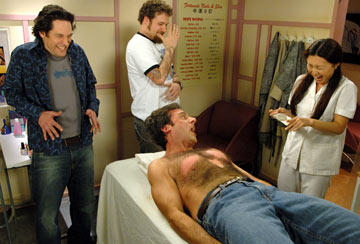
Really, though, it is not really Apatow's lack of a moral intelligence and his inadequate filmmaking that makes The 40-Year-Old Virgin frequently unpleasurable viewing. Instead, it is the film's unrelenting profanity and repetitiveness that truly tests the patience of its audience. The scene where Carell's chest hair is removed in one section after another seems to be the perfect metaphor for the viewer who might not automatically embrace Apatow's profane perspective. In the end, The 40-Year-Old Virgin shares its basic structure with another of this summer's most highly-anticipated comedy's, The Aristocrats: the same joke is repeated time and again, with only the slightest of modifications. What does Apatow call his act? The 40-Year-Old Virgin!
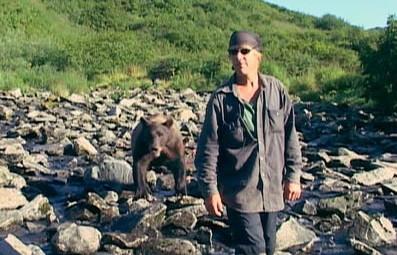
There is no similar limitation of scope to Werner Herzog's Grizzly Man, yet another major work from the poet laureate of ecological antagonism and civilizational abandonment. As the director himself puts it in his endlessly fascinating voice-over, nature is not the harmonious entity that the film's subject (and grizzly meal) Timothy Treadwell posits, but is instead characterized by "chaos, disharmony and murder." This is to say that in the story of Treadwell, Herzog has found a subject as comfortable in the director's archetypal universe as were Kaspar Hauser or Fitzcarraldo.

That story, of a man who has left civilization to record and protect Alaskan Brown Bears, only to himself to be devoured by one of the great creatures -- along with his girlfriend -- is presented in a series of home movies made by Treadwell and later assembled and narrated, with additional commentary footage and interviews, by Herzog. More than any other film in recent memory, Grizzly Man thus stands as a case study in the auteur theory: namely that the ultimate measure of a film consists not only in the text but in its extra-textual circumstances and relation to a broader corpus of work as well.

In other words, it gains value by virtue of its status within the director's body of work, which in this case is as a film that presents nature's passive indifference contraposed with a protagonist who thirsts for an escape from a cruel civilization. However it is precisely Treadwell's false, romanticized notions of the ecological other that precipitates his real-life killing: as one bumpkin-ish character notes, Treadwell seemed to treat these beasts as if they were human beings in bear suits rather than the soul-less creatures that Herzog himself memorably analyzes.

Indeed, Grizzly Man is filled with moments of such hermeneutical insight, showing not only the delusions of an individual who had been burnt one too many times by human order, but further of man's subjugation to the cosmos, particularly in this mode of existence. When Treadwell, in spite of his belief system, prays for divine intervention to save the creatures at a moment of ecological crisis, Herzog allows an interpretative space which would seem the only honest conveyance of a causality whose immaterial reality precludes a visual expression. This is to say that Herzog, in his clearly crafted re-presentation of the Treadwell story, does not simply tell, but indeed allows the viewer to contemplate the surfaces that comprise his art. In the end, the stare of the grizzly that Herzog fashions as disinterestedness -- surely the most reasonable explanation, mind you -- retains its inherent ambiguity by virtue of its surface materiality. This is a cinema, in other words, which could not exist in any other medium; this, we might observe, is the very opposite of Apatow's brand of comic filmmaking.