Saturday, April 28, 2012

"It's a Whole Different Business Now": Billy Wilder's Fedora (1978)

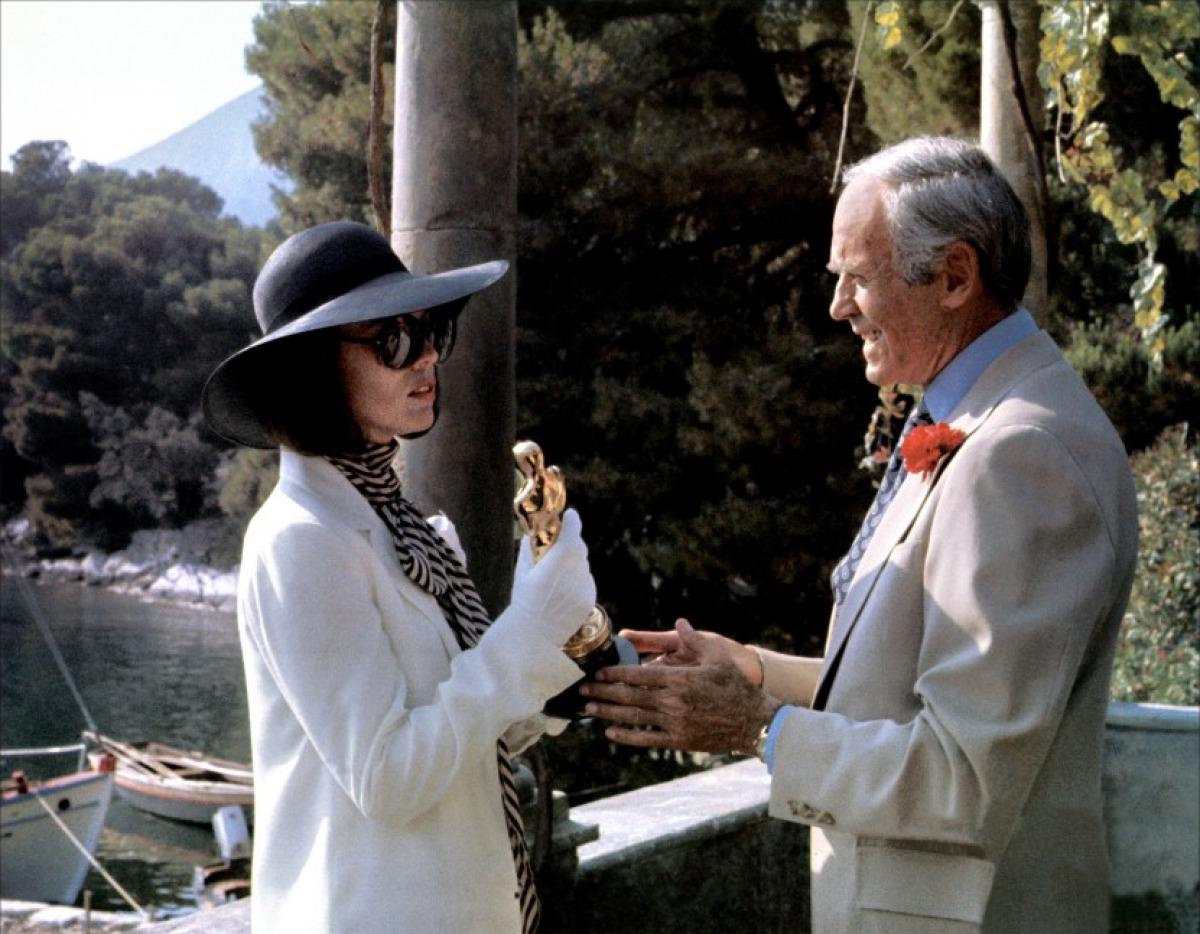
Produced a little more than a quarter-century after his Sunset Boulevard (1950) requiem for a long deceased silent art, Billy Wilder's penultimate Fedora (1978), from an I.A.L. Diamond and Wilder adaptation of a Thomas Tryon story, does the same for a no less historic classical Hollywood cinema. In fact, following a brief rear-projected death scene and television news montage, Fedora opens with the body of its eponymous heroine (Marthe Keller) lying in state, as parades of mourners come to glimpse and pay their last respects to one of the silver screen's greatest icons. Eulogizing star and also studio, Fedora is a funereal cinema, presided over, like Sunset Boulevard, by William Holden's first-act narration. Indeed, it is the era of Holden and not Swanson, Wilder and not Erich von Stroheim whose passing Fedora both depicts and signals - with the writer-director's feature exclusively financed by French and West German money, shot on location in these same nations and on the island of Corfu, and starring the Swiss born Keller (whose body-of-work spanned a number of national cinemas).

Flashing back two weeks from the opening Parisian-situated funeral, Holden's down-on-his-luck producer Barry "Dutch" Detweiler arrives on a sun-bleached Corfu in search of reclusive, retired screen star Fedora. As the spectator will soon learn, thanks to a subsequent flashback-within-the-flashback, Fedora and Dutch had a one-night stand decades earlier when the legendary screen beauty seduced the young assistant director after the latter was employed to cover her exposed nipples during an aquatic back-lot shoot at Metro. Through this Mediterranean setting, Wilder's film strongly recalls the director's under-appreciated, Amalfi-situated Avanti! (1972), as well as Jean-Luc Godard's deeply self-reflexive, Hellenic predecessor Contempt (1963). As Dutch attempts to contact the mysterious female lead - who, on the rare occasion of appearing in public, sports the same wide brimmed hat and dark sunglasses as Karen Black in Alfred Hitchcock's fine Family Plot (1976) - Wilder and cinematographer Gerry Fisher's lighting favors the over-saturated, blown-out look of the cemetery sequence in the aforementioned master's Vertigo (1958), not to mention the mid-1970s look of Hitchcock's final feature. The earlier masterpiece will especially prove cardinal to Fedora, however, with a mid-narrative plot reversal procuring a very similar reflexive interest in the production of the film's focal object of desire, namely that of the female film star, whether it is explicit as in Wilder's film or implicit as in Hitchcock's.

Dutch does manage to cross paths with Fedora shortly, where he discovers that his former lover has remained almost ageless in the three decades since their previous meeting. Reminding her of the past, Dutch mentions Metro-Goldwyn-Mayer, which prompts to Fedora to respond: "that's all gone now, isn't it?" Dutch, an independent producer, confirms that it is, noting that they sold the back-lot and auctioned everything off years ago. When consequently Dutch joins Fedora and the Countess Fedora Sobryanski (Hildegard Knef) at their prison-like estate (in another direct quotation from Wilder and Holden's previous collaboration), he admits that he needs Fedora to secure financing, noting that he has located tax shelter guys so long as she is willing to come out of retirement. Dutch rues the fact that "it's a whole different business now" and that "the kids with beards have taken over," in an acknowledgement of the new generation of "movie brats" that were at that very moment replacing the retiring and passing Hitchcock, Wilder, et al. As Fedora's male lead puts it, in conspicuous opposition to writer-director Wilder's preferred mode of filmmaking (both as director and previously as one of the industry's great screenwriters), "they don't need scripts; just give them a hand-held camera with a zoom lens." Fedora's complex, archly-baroque flashback structure - in this sense Wilder remains forever a product of the late 1940, early 1950s film noir moment, of the age of Sunset Boulevard that is - told in unrelentingly classical shot/reverse-shot decoupage stagings, preserves the earlier mode, which is to say the type of film practice that would come to a conclusion with the passing Wilder's artistic generation.

As Wilder and Diamond's screenplay puts it, "I guess time catches up with all of us." That is, all of us except for Fedora, as Dutch notes, who again looks no older than she did when they spent the night together on Santa Monica beach in 1947. The filmmakers' immediate explanation for Fedora's timelessness, which it should be added inverts Sunset Boulevard's presentation of Swanson and her fellow silent cinema cohorts, is the extensive, experimental plastic surgery that Doctor Vando (José Ferrer) has performed on the actress over the course of a number of years. In another flashback to the early 1960s, following the film's key mid-point reversal, the viewer sees Fedora's face wrapped in bandages that for the contemporary spectator may call to mind Pedro Almodóvar's The Skin I Live In (2010) synthetic variations, as will Fedora's scribblings of her name in one notebook sheet after another. To this end, it should be recalled that Almodóvar has cited Sunset Boulevard, Fedora's dialogic partner, as one of his favorite films, making the latter a plausible additional source of inspiration for the Spanish director's queer appropriation of Vertigo's human remodeling. Indeed, it would seem that Fedora no less than mediates The Skin I Live In's mannerist, post-plastic surgery take on Hitchcock's masterwork.

While Fedora ultimately cannot escape the ravages of time that likewise defeated her Sunset Boulevard predecessor Norma Desmond, she does manage to die young, so to speak at least, in the same fashion as those she calls the "lucky ones," Jean Harlow and Marilyn Monroe. Of course, to do so it takes a plot twist that this writer is not keen on spoiling. Suffice it to say that this move allows for the divesting of the person from the star persona she inhabits in a manner that is more classical though no less self-reflexive than Jacques Rivette's period Pirandelloism's. In this sense Fedora is a movie of its high modernist moment, even as it looks to the past, to a cinema whose death it was expounding in using its very form. Here again this career peak for Wilder becomes a film of an era, which is to say of the classical Hollywood cinema's sunset years.

For the moment, Fedora remains available in the United States only on out-of-print videocassette and laser-disc formats. However, rumor has it that Frank Tarzi's Olive Films has licensed a high-definition remastering of Wilder's 1978 picture for future home video release.

Monday, April 23, 2012

A Little Space All to Ourselves: Frank Borzage's Mannequin (1937)

A great silent director who was not martyred with the coming of sound and a great sound director who did not experience the late flowering upon which others of his generation built their critical reputations, Frank Borzage nonetheless can stand beside any of his Hollywood comrades in terms of the clarity of and his commitment to his specific view of the universe - which is to say, there was no one in Hollywood during the studio age who was any more an auteur than the great Borzage, despite what has felt, at times, his outsider status to the auteurist pantheon. Of course, the home video availability (or lack their of) of much of Borzage's better work has been one of the larger obstacles to his broader appreciation, with only the December 2008 release of the "Murnau, Borzage and Fox" box-set belatedly serving to right this historical wrong. A far more humble corrective, Warner Archive's 2009 addition of the director's Mannequin (1937, M.G.M.) on their direct-to-video format contributes not only another strong offering in the director's exceedingly rich Depression-era corpus, but also, quite conceivably, the most precise single articulation of the Borzagian worldview.

This definition occurs early in the director's Joan Crawford star-vehicle, with the Mannequin's Hester Street lead expressing both her feelings and Borzage's point-of-view to boyfriend Eddie Miller (Alan Curtis), as the two sit under the stars on a Coney Island beach: "look Eddie, here's a world," gesturing at the sand. "You and I have this little space all to ourselves; and what we feel for each other shuts out the rest, so what more do we need? That's all people have to fight for is a little place to themselves." Crawford's Jessie Cassidy makes this profession following the picture's opening glimpse into her depressing domestic life, where her long workday in a textiles factory is followed by the sound of screaming babies - as the camera carries her up the rickety staircase - sauerkraut and sausages and the cynical asides of her ne'er-do-well brother Clifford (Leo Gorcey); the boundlessly unlikable Clifford has no intention of finding a job of his own, intent instead to live off the hard labor of his older sister. Jessie dreams of three rooms of she and Eddie's own, which the latter succeeds in giving her after Jessie refuses to return to her family's flat following their incandescent starlit evening. In so doing, Jessie and Eddie become a married, post-Hays Code corollary to Spencer Tracy and Loretta Young's poor, live-in lovers in Man's Castle (1933, Columbia), the Borzage film from which Mannequin will draw most consistently.        

The director, however, begins to divide his characters on the basis of gender, with Eddie professing a greater economic ambition than his wholly devoted young wife, whom he enters in a chorus line to earn extra money while his career as a boxing manager remains stagnant. Borzage elegantly figures this disparity in the differing objects of Eddie and Jessie's gazes during their wedding-night dinner at a Lower East Side, Yiddish Chinese restaurant. As the young married couple dances during this semi-comic sequence, Eddie repeatedly glances at local millionaire John L. Hennessey (Spencer Tracy) while Crawford's Jessie moons at her new husband, never once diverting her attention from the man with whom she wishes to share a little piece of the world. Eddie indeed shows himself unworthy of Jessie's love, both in his lack of reciprocal affection and also in his small-time grifter's mentality. In his desire to get ahead the easy way, Eddie is expressly compared to Jessie's Pa (Oscar O'Shea), who responds to the former's complaints about the deficiency of "the system" by advising his son-in-law to go on "relief" - given that the government was unable to get him a job. It is worth noting that while Borzage remains a poet of the working poor, Mannequin explicitly relies upon a "supply-side" economic model for the picture's strikingly anti-Leftist final act.

As Eddie and Pa converse, lounging in echoing postures as they smoke in tandem in the Cassidy's modest Hester Street flat, Ma (Elisabeth Risdon) advises her married daughter to not waste her life (as she has, having cried herself to sleep for years) with a no-good husband much like her own; instead, Ma proposes that Jessie seek her happiness whatever this might mean, even if she must go about it alone. In this respect Mannequin introduces a generational specificity with the Progressive-cohort immigrant housewife encouraging her daughter, in proto-Feminist fashion, to break with the traditional conception of a woman's place (for which Pa advocates in the adjoining room). In this fashion, Mannequin additionally problematizes the Borzagian conceit as it identifies the limitations of the picture's (and the director's) romantic worldview, particularly when the feelings of the one are not shared by those of the other.

The Borzagian however does find consequent, perfected expression in Jessie's subsequent relationship with Hennessey, with the latter falling for the comely Mrs. Miller upon first seeing her at the Lower East Side eating establishment. Though unaware that she is still married when he discovers her subsequently in the "Gebhart Frolics," Hennessey nonetheless disregards Jessie's marital status, kissing the woman for whom he has orchestrated an elaborate series of parties inviting her 'Frolics' co-workers. Even at this still relatively early stage in the narrative, the spectator has already begun to switch allegiances to 'other man' Hennessey, who not only will provide Jessie all that she lacks materially, but far more importantly, he will give her the selfless love, a fundamentally Christian combination of agape and eros, that provides the core of the Borzagian worldview. Consequently, Mannequin encourages divorce as it taps into the broader de-sacrilization of marriage that spawned the concurrent 'comedy of remarriage' cycle. Borzage's offering perhaps might be classified instead as a romance - in the Shakespearean sense, only partially to echo Stanley Cavell's parallel taxonomy - of divorce.

In this respect, there is a certain anti-Roman Catholicism present in the Catholic Borzage's Mannequin, even if in the larger sense there are few Hollywood films that more fully articulate the faith's mode of being in the world. It is again the Irish-American Hennessey and his beloved who best exemplify this ideal: for the business magnate and his factory girl-cum-wife Jessie, love - and by implication, the family (here in micro-form) - takes consistent precedence over the concerns of the world, which is to say over those of money (to define the film in opposition to a more Protestant ethic). For example, when a newly divorced Jessie first arrives at Hennessey's office, the latter loses all interest in his substantial labor problems that his company faces, focusing his attention instead exclusively and unwaveringly on his visitor. Similarly, when the two spend their honeymoon alone in an Irish cottage, before the warm glow of the hearth in a picturesque, if kitschy definition of the same Catholic value system, it is Jessie now who seeks to block out the rest of the world by discarding a telegram that addresses her husband's financial problems. 

Ultimately, Hennessey experiences financial ruin, thanks to the ill-advised striking of his well-compensated employees. However, Jessie remains true at this most dire moment of crisis, even advising her now broke husband to sell the jewelry that he has purchased out of his deep affection. Indeed, it will only with be with their return to nothing that the Borzagian again comes into crystalline view, as a personal philosophy that, while reflective of the Great Depression and grounded in the American immigrant experience, nonetheless possesses the quality of the universal, a catholicity of the human. All that Borzage's lovers seek is a little space to themselves, the heaven that is referred to in the director's silent masterpiece (7th Heaven; 1927, Fox) and which is spied not in the stars above but in the shanty homestead below in the former's sound equivalent, Man's Castle.

Sunday, April 22, 2012

Special to Tativille: "Looking back on Man Bites Dog, 20 years later," by Jeremi Szaniawski

Few films are more deserving of the appellation ‘cult film’ than Rémy Belvaux, André Bonzel and Benoît Poelvoorde's Man Bites Dog (C’est arrivé près de chez vous), which went on to become the sensation of the 1992 Cannes film festival, taking three minor prizes home. A brilliant ‘mockumentary’, this senior film school project, midway between the Belgian documentary show Strip-Tease and its fly on the wall aesthetics, and the excesses of Henry, Portrait of a Serial Killer, makes abundant use of a very dark humor both in its over-the-top murder scenes and its memorable dialogues – which a whole generation of Belgian youth has come to know by heart.

Made on a shoestring budget and on 16mm black and white filmstock (additional scenes were subsequently shot for commercial release), and making deft use of the resources offered by subjective camerawork, Man Bites Dog transcends the paucity of its budget and highlights the complicity between audience and subject in fiction films and reality TV: a documentary film crew follows Ben, a charismatic and voluble serial killer. As the filmmakers come to know Ben’s normal side, his friends and family, they also become gradually involved in his horrible crimes. In an old factory, Ben kills several gang members. Forced to wear a neck brace following a boxing accident, he fails in an attempt to kill again, is identified and put to jail. The crew helps his escape, but it is too late—his family has been murdered by the mob. In the film’s conclusion, Ben, along with the entire crew, is shot in the old building where he had stashed his money.

The film invites us thus to partake in the everyday life of its infamous protagonist, in Poelvoorde’s life-defining performance as an endearing psychopath (a graduate of an art school, he did not originally destine himself to acting). In spite of his ugliness, he endows his character with the candid charm of a child, bringing a lot of appeal to the film. A larger than life figure, emotionally detached from his murders yet deeply connected to the viewer by virtue of his magnetism, Ben is a poet: in some ways he regards what he does not only as an eternal game, but also as an art, and revels in distilling darkly humorous words of wisdom (‘If you kill a whale, you get the environmentalists, Greenpeace and Jacques Cousteau on your back, but wipe out a school of sardines and you better believe you’ll get a canning subsidy!’) peppered with cinematic references, from Michèle Morgan and Jean Gabin to Philippe Noiret. Ben is indiscriminate in his discrimination: midgets, homosexuals, black people, old people, children, pregnant women, postmen and even close friends—all are good to become his next potential victim, or the grist for his comedic mill (‘Once I immersed the bodies of two Arabs in the liquid concrete of a column under construction... Facing Mecca, of course.’). His odious character serves a buffoon function: he proffers racial or sexist slur and we enjoy it and laugh at it by means of distancing sanction. Carrying on this modus operandi, Poelvoorde became one of the audience’s favorite comedic characters in subsequent years.

The mix of the film’s deadpan tone and its outrageous contents (and the fact that many actors, including Poelvoorde’s family, had no clue as to what they were involved in) makes the whole absurdly funny. Ben makes a living off of his victims’ money, but also kills for the fun of it: he relishes the opportunity of an original, creative crime, such as killing an old woman with cardiovascular problems by yelling at her—a means to save a bullet. Ben feels no remorse whatsoever, except when a family of ‘innocent people,’ murdered, yields no money. “Such things should not happen,” he says in all seriousness.

Beyond the dialogues, the dark humor, and the characters’ apparent levity, one clearly sees the reflection on voyeurism, the manipulation of the image and the complacency of the crew in intervening into the reality they film. Ben's violence becomes more and more random and motiveless (he even shoots an acquaintance in front of his friends during a birthday meal), his criminal frenzy motivated and matched by the crew’s insatiable desire to film more, both mutually fueling each other’s insanity.

The film strikes in its questioning of political correctness and how far we are willing to laugh at it all. At first mere observers, the crew begins to get more and more involved in the murders. For most viewers, the breaking point in this gradual participation of the crew in the subject of their film happens in the ‘night watch’ scene on New Year’s Eve, where the inebriated crew, hitherto merely accomplices of Ben, barges into an apartment and rapes a woman while Ben holds the husband at gunpoint, before both people are brutally murdered. The following morning, the camera dispassionately records the bloody aftermath: the woman, who might have been pregnant, eviscerated on the table, her husband shot in the head, naked on the kitchen counter. This scene, which pushes voyeurism to its very limits (and was edited out in several national releases of the film due to censorship concerns), also marks the beginning of the end for Ben, his subsequent decline accompanied by less and less laughter, and more and more reflective pause in the audience. The greatness of the film lies in its ability to balance out dark and cynical comedy with a profound statement on the stakes of cinema and voyeurism. It also highlights the intimate connection between cinema and death: during filming, two crew members are shot, their deaths later referred to as ‘occupational hazards’ by the director. And when they are called upon to help Ben, in his failed attempt to kill a postman, the crew stands back, resuming its non-participative stance, this refusal to kill paradoxically leading to the undoing of their subject and themselves.

The film in many ways brilliantly anticipated and riffed on what would become some of the most morally questionable aspects of present-day reality TV. It also weighed heavily on its real life makers, with Poelvoorde’s proclivity toward excess and violent outbursts very similar to his character’s, and Belvaux’s dark genius leading to his self-destruction. In 2007, the director committed suicide in murky circumstances, having never truly recovered from his debut/masterpiece. Just a few days prior, Poelvoorde, at that time France’s best-paid actor, had refused to help him financially. The actor, who by then had destroyed his wife Coralie’s health by mental abuse and a score of infidelities, descended into an ever deeper spiral of drug, alcohol and dangerous erratic behavior (including smashing his car through a wall while drunk driving, and running away), immuring himself more and more in solitude. Reality had become as sordid as the fiction that led to fame—minus the fun.

Great works of art do sometimes come with their accursed share, and Man Bites Dog—one of the best films of the 1990s—is no exception.

Jeremi Szaniawski is a graduate student at Yale. This essay (in a slightly edited form) is part of the Directory of World Cinema: Belgium, forthcoming later his year from Intellect Press.

Monday, March 26, 2012

New Film: Footnote (2011)

Joseph Cedar's distinctively writerly Footnote (Hearat Shulayim, 2011), recipient of the 'best screenplay' prize at last year's Cannes film festival, falls, for this writer at least, in that easily ignorable, unevenly pleasurable space between modernist art cinema and commercial product that in this country goes by the name 'independent.' A cinema of ideas before personal expression and individuation, of character typologies and an aggressive musical score that would not have been out-of-place in an Italian Miramax import from twenty years ago, Footnote would scream out for the same fate as yesteryear's long forgotten Oscar 'best foreign language' nominees were it not for Cedar's legitimate skill as a Lincoln Plaza hack. By creating brisk narrative art that is as involving and entertaining as it is well-made, Cedar transforms the potentially cloying markers of his idiom into concrete storytelling assets, positive embellishments rather than critical disqualifiers.

Cedar establishes the narrative system that so successfully guides Footnote in the picture's opening set-piece: off-camera, apparent voice-over narration, coupled with on-screen titles, introduces the spectator to a professor Shkolnik in a form that immediately recalls (to cite Tativille co-proprietor Lisa K.Broad) the "information-aesthetic" strategies of American indie maestro Wes Anderson and festival French correlate Arnaud Desplechin. With Shlomo Bar-Aba appearing first and most frequently over these opening shots, the spectator imagines the late middle-aged academic to be the subject of the voice-off, which a subsequent cut reveals to be diegetic rather than voiced over. However, when finally this introduction concludes, Eliezer's son Uriel (Lior Ashkenazi) rises, vacating the two-shot to give his acceptance speech, even as the very sullen Eliezer remains alone in the now unbalanced shot. This sequence provides not only a model for the film's systematic series of reversals showcasing Cedar's special aptitude for regulating and then undermining spectatorial expectation; it also foreshadows the film's principle dramatic development with an honor presumed to belong to the older more rigorous Talmudic scholar intended instead for his more fashionable, though less intellectually serious son. In this first example, Cedar's content admirably finds a formal analogue.

For this writer, who happens by profession to be an academic, though regretfully gifted with neither Eliezer's fortitude nor Uriel's fashion, Footnote likewise deserves credit for getting it right, for often comedically emphasizing the role of politics, particularly of the personal variety, and for insisting that success and meaningful work often have little to do with one another. Though apropos of the film's systematic reversals the viewer will come to see both Eliezer and Uriel differently over the course of the picture's duration, ultimately Cedar does seem to side more with the overlooked elder and again with his pursuit of knowledge as opposed to his son's impressionist approach and commensurate cult of personality. That Footnote once again is a film of ideas rather than conspicuous auteurist self-expression, of an essentially pre-modernist (even as it verges toward the post-modern) artfully manipulated narrative instead of outright formal reinvention, makes this allegiance all the more appropriate. In content as much as in form Footnote admirably belongs to the neglected middle. 

Friday, February 10, 2012

In Review: Life, and Nothing More... (1992)

Synopsis:

A few days after the devastating June 1990 Manjil-Rudbar earthquake that resulted in 40,000 fatalities and left 500,000 more homeless, a film director (Ferhed Kherdamend) and his son Puya (Buba Bayour) drive to the afflicted area in Northern Iran in search of Babek and Ahmad Ahmadpour, the stars of the unnamed filmmaker’s earlier feature, Where is the Friend’s House? (a 1987 release that was in reality directed by Abbas Kiarostami with the Ahmadpour’s starring).  As the father and son traverse the congested trunk highways and the treacherously steep dirt roads that lead to the village of Koker, they discuss a telecommunications tower and argue about the participants of a World Cup football match on the night of the quake; the boy and his father look on at the endless rows of survivors digging out from the mountains of rubble; and they ask various locals for directions to and news from the Ahmadpour’s Koker.  The film director and his son also give rides to a handful of the earlier film’s actors, each of whom they encounter traveling by foot.

Among these is an older gentleman who playfully objects to having been made up to look older for Where is the Friend’s House?.  The director and Puya pause in the old man’s village, with the former also conversing with newlywed Hossein (Hossein Rezai; this scene is replicated with Kherdamend and Rezai, as actors, playing the same roles in Kiarostami’s subsequent Through the Olive Trees, 1994) and the latter explaining to a bereaved mother that God was not the author of the deaths, the earthquake was.  After recommencing with their drive, the pair picks up another of the film’s actors, transporting the boy to his makeshift hillside home as he and Puya debate the World Cup final.  There, the film director inquires of a couple of pre-adolescent girls as to why they believe they survived, before leaving his son to watch a football match with his new acquaintances.  Once back on the road, the director learns that the Ahmadpour’s were just then spotted walking back to their village.  After giving a ride to yet another of his child actors, he speeds to reach the family in Koker, with his small hatchback struggling to climb the region’s hazardous inclines.  Following an aborted first attempt on the second of two towering hills, the film director reaches the top where he picks up a pedestrian who had aided him at the bottom of the ascent.  The two continue on with the film’s Vivaldi score reaching an uplifting crescendo as the picture fades to black.

Critique:

Conventionally considered the second of director Abbas Kiarostami’s undesignated ‘Koker trilogy,’ following Where is the Friend’s House? and preceding Through the Oliver Trees, Life,and Nothing More… (1992) positions itself between fact and fiction as it presents a Kiarostami-double “film director” in his search for Babek and Ahmad Ahmadpour, the child actors of Kiarostami’s (and his) feature Where is the Friend’s House?.  Though the film’s narrative, implicitly modeled on Kiarostami’s presumed real-life attempt to locate the Ahmadpour’s after the June 1990 Manjil-Rudbar earthquake, unfolds within a week of the tragedy, a greater temporal gap from the time of the earthquake to that of the shooting is belied by the autumnal colors that mimetically reinforce the mass casualties (e.g. the death) afflicting the region.  In this way, the film maintains a looser relationship to its stated temporal coordinates, and thus to the reality it is presenting, than is stipulated by the narrative.  Enough time has intervened to call into question whether the results of Kiarostami’s search – parallel to the ‘film director’s’ – were as uncertain as they were made to appear.

All of this is to say that Life, and Nothing More… is only made to look like a documentary masquerading as a fiction film.  In reality, Life, and Nothing More… is a fiction film that looks like a documentary pretending to be a fiction film.  Kiarostami’s subsequent Through the Olive Trees usefully clarifies Life, and Nothing More…’s deceptive ontological status: by virtue of the multiple takes of the 1994 film’s reconstruction of the film director-Hossein encounter in Life, and Nothing More…, the spectator is asked retrospectively to identify the earlier film’s identical scene as a construct, with the labor involved in its production – the crew behind the camera, and conceivably, multiple takes – erased from the resulting film.  Ultimately, Life, and Nothing More… is fiction to its narratological core, even if the objects of the filmmaker’s quest and their physical environment present a historical reality.    

In this latter respect, Life, and Nothing More… does document, even if it cannot claim the status of documentary.  Though the destruction is not as new as the spectator is made to believe, nor does everything he or she sees constitute a single day of filming, which is in both instances to say ‘though the film is fiction,’ the contents of the mise-en-scène once again belong to the regime of non-fiction.  This is the destruction wrought by the Manjil-Rudbar earthquake in northwest Iran.  These are the people whose houses have been destroyed and their loved ones lost.  This is the work that they must now perform as they seek to dig out one obliterated village after another.  Hence, it is a film populated by demonstratives, to use the linguistic term, even as it retains the fictional valence that distinguishes the picture from the documentary mode.  Kiarostami’s film combines these two modes, no less than the director’s previous, documentary-form Close-Up (1990), forging a double-helix of fact and fiction that everywhere underlies the work.  As such, Life, and Nothing More… becomes the confirmation of André Bazin’s realist film program, which itself sought to emphasize moments of non-fiction within narrative cinema’s fictional frames. 

It is unsurprising then that Life, and Nothing More… shares much of its aesthetic with the 1950s work of Bazinian exemplar Roberto Rossellini: for instance, as in Rossellini’s fount of post-war cinematic modernism, Voyage in Italy (1954), Life, and Nothing More… favors long takes of the surrounding landscapes shot through the speckled windows of moving automobiles.  Though rural landscapes were certainly present in Where is the Friend’s House? and modes of transport (a car, bus, motorcycle) featured prominently in the urban Close-Up, Life, and Nothing More… combines the two to produce an idiom that would help to define Abbas Kiarostami’s cinema throughout the 1990s – the era, at the time of this writing, of his greatest international repute.  Throughout this decade, Kiarostami alternates between wordless compositions shot through the windshields of his moving automobiles; figural close-ups of his protagonists conversing inside; and longer compositions of the vehicles snaking through hilly terrain, with his performers’ conversations remaining audible, even when their vehicles become miniscule in contrast to the surrounding landscapes.

Indeed, Kiarostami’s “unfinished” aesthetic crystallizes in the last of these strategies, with their powerful use of concealed spaces, as it does further in a narrative that invites its viewers to complete the dramatic arc[i]: in Life, and Nothing More…, Kiarostami leaves the filmmaker’s reunion with the Ahmadpour’s unseen, and thus open to viewer speculation, not that Kiarostami doesn’t suggest an ending in his spritely choice of music (along with the visual hint he provides in a group of tiny figures – the Ahmadpour’s? – walking across a distant horizon).  It is finally in this gap between absence and presence, as in the film’s slippery navigation of fact and fiction, where Kiarostami’s achievement is manifest.


Life, and Nothing More…

English Title: Life, and Nothing More…/And Life Goes On…
Original Title: Zendegi va digar hich…
Country of Origin: Iran
Production Company: Kanoon (Institute for the Intellectual Development of Children and Young Adults)
Director: Abbas Kiarostami
Producer: Ali Reza Zarin
Screenplay: Abbas Kiarostami
Director of Photography: Homayoun Payvar
Editor: Abbas Kiarostami
Music: Antonio Vivaldi
Sound Recording: Abbas Kiarostami and Changiz Sayyad
Runtime: 91 mins.
Genre: Drama/Art House
Color: Color
Year:1992

For additional pieces by this author on Abbas Kiarostami and the Iranian cinema, please check out Directory of World Cinema: Iran, Parviz Jahed, ed. (Chicago: Intellect for The University of Chicago Press, 2012). 

[i] See Abbas Kiarostami’s “An Unfinished Cinema,” printed for the Centenary of Cinema, Paris, 1995: http://www.dvdbeaver.com/film/articles/an_unfinished_cinema.htm.

Tuesday, January 31, 2012

New Film: Miss Bala & Mission: Impossible - Ghost Protocol

Premiering in the Un Certain Regard section of the 2011 Cannes Film Festival and released on a very limited basis in one of the leanest month on the U.S. theatrical schedule, Gerard Naranjo's Miss Bala bears witness both to the formal experimentation characteristic of the former and to the semi-exploitation orientation of the latter. Naranjo and cinematographer Mátyás Erdély bring an exceedingly fluid long-take aesthetic to Miss Bala's border world of Narco wars and beauty pageants, staging the film's on-going flow of action and the frequently disrobed body of the film's ex-model lead, Stephanie Sigman, in a graceful choreography of contiguous on and off-camera spaces.

Among the most memorable of Naranjo and Erdély's one-take tours de force is an early, off-balance composition in a nightclub powder-room that commences with Miss Baja hopeful Laura Guerrero (Sigman) standing alone in the right half of a static, divided frame. Suddenly, a para-military hit crew repels down the wall that splits the image, filling the empty middle distance in the left half; as the assassins check the toilet stalls on the same side of the composition, Laura crouches down into a nearby corner with the camera accordingly following, reframing the female lead in a far more constricted full. As Laura cowers, exposed to the gang against the wall, the spectator is made to focus (along with the protagonist) on the off-camera field, cued in not only to Laura's frightened reactions directed toward the previously visible space, but also to the sounds that inscribe the continuous, out-of-the-frame action.

Within this exemplary passage, Miss Bala's navigation of objective and subjective states emerges, with Laura's point-of-view ultimately articulated in the tight re-framing that occurs along with her attempt to escape view. Earlier, when she first arrives at that same Millennium night spot, the filmmakers' camera moves independent of character motivation, only joining Laura consequently as the apparatus propels forward in the same direction as the striding lead. In so doing, Naranjo provides an approximation but not a literalization of Laura's phenomenological experience. Though the camera is outside Laura, it effectively doubles here perception.

Elsewhere, to return to the economy of revelation and concealment that defines Miss Bala's registration of spaces, Laura's later escape from the bathroom occurs at the moment of her sudden reappearance in the upper recesses of the re-framed interior, climbing through a distant window. In so doing, Naranjo retroactively calls attention to the fact that Laura's dramatic act has been occurring off-screen all along, with the particularities of this mobile framing a matter of authorial imposition. The camera's point-of-view in this passage is that of an author who willfully leaves his heroine and her subjective experience only to treat her dramatic exit as an unexpected visual punctum moments later.

While Miss Bala's achievement might just be most conspicuously formal ultimately, it does still effectively inscribe the personal toll of the War on Drugs on the film's unwitting protagonist, providing a harrowing narrative of the variety of abuses she experiences - both on and off-camera, with the latter no less moving than the former - as well as a plausible account of how the under-class Tijuana native becomes a getaway driver and mule for the narcotics syndicate. Miss Bala is indeed her fundamentally tragic and contemporary story, even when Naranjo's exceptional visual set-pieces momentarily obscure this fact.

Mission: Impossible - Ghost Protocol (2011), master animator Brad Bird's live-action debut, from a screenplay by Josh Applebaum and André Nemec, dispels any questions of its director's facility for or fitness to the composited photographic medium with a work that not only plays to the form's visceral strengths - this is the so-called action thrill ride at its, well, most thrilling; Ghost Protocol is one of the few comparatively deserving films at the top of the domestic box office charts - but also one that manages to reflexively incorporate the new-to-the-director technology back into the tension-filled set-pieces themselves. With respect to the latter, Ethan (Tom Cruise) and Benji's (Simon Pegg) manipulation of a screen inside the Kremlin in an effort to provide the photo-real illusion of a space, rather than the space itself, crisply encapsulates the film's composited CGI form in a manner that partially recalls Ratatouille's (2007) allegorization of computer animation in its non-human creator. Ever the auteur, Bird again showcases his self-consciousness in producing an analogy to the specific medium of his production.

Bird's authorship is even more prominent in Ethan's superhuman feats, running up and down the world's tallest building - obsessed with numbing heights, Ghost Protocol gets the most out of the composite digital form's ability to make these moments photo-real - or simply punching his way out of a Russian prison without a moment to spare. The more obvious and fruitful point-of-reference for Ghost Protocol accordingly is Bird's Pixar masterpiece The Incredibles (2004), with which it likewise shares its relatively corny and occasionally topical sense of humor - Cruise's failed marriage and Jeremy Renner's homosexuality both receive narrative cameos - a sidekick in Benji who seems to suggest a partial re-imagining of pre-Syndrome Buddy Pine or perhaps Dash, and most notably, an acknowledgement of global terrorism, which thanks to Ethan's persistent unwillingness to give in, is ultimately curtailed - though not at the precise moment that Ethan declares the "Mission Accomplished!" In Bird's world, as in our own, the threat will only later be neutralized.

Saturday, January 21, 2012

Special to Tativille: "Sunset cul-de-sac? (The Artist)," by Jeremi Szaniawski

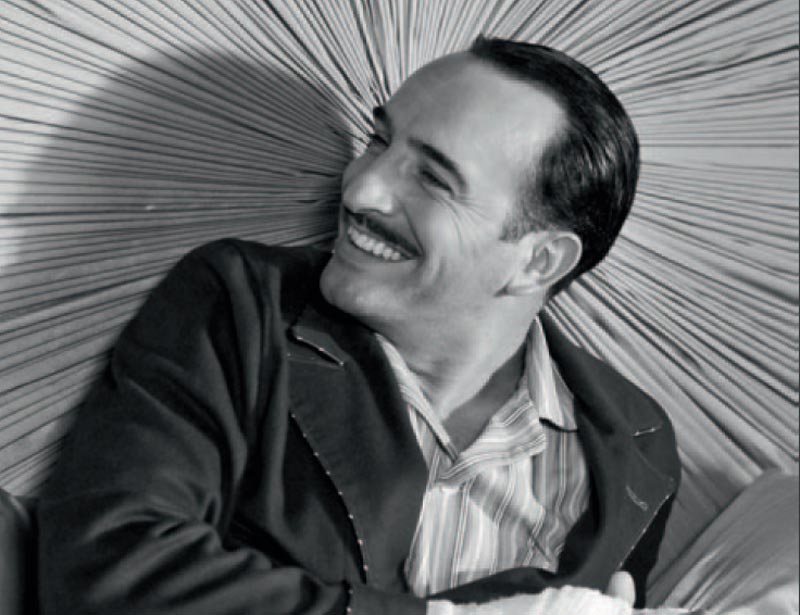
In 1927, Hollywood silent film star George Valentin (Jean Dujardin) unwittingly helps launch the career of smitten—and ambitious—dancer and starlet Peppy Miller (Bérénice Bejo). Little does Valentin know that the advent of sound film will soon render him obsolete, while Miller will become the new darling of his former studio. Valentin refuses to embrace the talkies, is driven to bankruptcy by the 1929 crash, and fails to conquer the box office with his final, self-financed silent film. Even so, his fall is halted by Miller’s financial support and care. But can the actor, given his resistance to new technology, ever make a comeback?

Grounded both in the tradition of melodramatic narratives and actual cinema history (the fall of its hero inspired by the similar fates of silent stars John Gilbert or Douglas Fairbanks, Jr.), set in an era of economic depression and technological shift in the film industry, The Artist (2011) could scarcely have been made at a more sadly appropriate moment. Therein however lies the suspicious aspect of an apparently sincere celebration of the first golden age of cinema, arriving at a time when most theaters around the world are trading 35mm for digital projection—and those who can’t afford the new technology can go quietly out of business. In this context, there is something almost sacrilegious, yet also painfully logical, about the inconsequential levity of the film, just as there is great irony about watching it in any format other than 35mm. To be sure, the deliberate softness and graininess of its cinematography are only done full justice on this soon-to-be-defunct format.

The film’s script itself clearly allegorizes the shift to digital and the loss it implies. Following a fire at Valentin’s home in which all his films are burned, Miller takes the only can of film that he salvaged from the fire, only to realize that it is a discarded scene of their one appearance on the screen together: his silent love declaration to the young woman. Such a diegetic moment, it is clear, would not have been possible in the digital age. In another scene, Valentin finds all his belongings carefully collected from pawnshops and at auctions by Miller, stored in a room of her Beverly Hills mansion, evoking the preservation and potential subsequent oblivion implied by digital storage.

There is nothing far-fetched about these observations. Director Michel Hazanavicius has a knack for using pastiche to comment on the present day situation, as attested to by his marginally amusing OSS 117 series—a parody of the 1960s James Bond franchise which criticizes French racism and bigotry (and like The Artist, also stars Dujardin). With this latest effort he has surpassed himself in terms of high concept: opting to make a silent film about the early years of talkies, instead of a sound film about the twilight of the silent cinema. Yet this explicit, inverted nod to Singin' in the Rain (1952) somewhat condemns the film to being an ironic, postmodern palimpsest, or, worse, falling into the derivative category of the spoof.

In earnest, one would love to love The Artist, which, at its best, is extremely endearing melodrama pastiche. But in spite of its seductively reconstructed universe, its script is glib and many scenes overly indulgent. In a way, the film as a whole replicates the self-congratulatory, hammy nature of its lead protagonists—but also, beyond their narcissism, their unlikely boneheaded likeability. With the added exoticism brought about by the revisiting of Hollywood by French eyes, and with French actors (this Gallic input providing the final joke of the film—and the founding argument behind Valentin’s resistance to sound technology: his thick French accent), one would gladly embrace the cheerful silliness of it all, had the film not been so incoherent in its referencing of film history.

The Artist is rife—of course—with quirky references to silent cinema techniques, and amusingly plays with the inversion of silence for sound (and these instances are by far preferable to Ludovic Bource’s often arch score). But for a film investigating the moment in time when the cinematic medium reached its apex in terms of visual plasticity and poetry, it displays a painful lack of coherence and purity: the film haphazardly blends visual quotes from King Vidor, Fritz Lang, FW Murnau, Fred Niblo, Sergei Eisenstein and Frank Borzage silent classics with shots straight out of 1940s cinema, most notably the dinner-table montage scene from Citizen Kane (1941). Elsewhere, the film references even the late 1950s: Valentin watches scenes from his own films on his home projector, inescapably evoking Gloria Swanson in Sunset Boulevard (1950); a nightmare scene evokes Wild Strawberries (itself an homage to silent cinema; 1957); and the soundtrack rather counter-productively quotes Bernard Herrmann’s ‘Scène d’amour’ from Vertigo (1958) in one protracted key sequence.

While the first part of the film is brisk and well paced, the second half tends to indulge more in this gratuitous quoting of silent classics, slowing down the plot’s progression with repetitious moments, so that the film’s own professed love of cinema proves to be its undoing. This does not detract, however, from its cast’s unquestionable charm (and, in Dujardin’s case, innate physicality), with Bejo resurrecting some of the young Joan Crawford’s sex appeal and pizzazz, and the score of Hollywood actors in bit parts (John Goodman, James Cromwell, Penelope Ann Miller, Ed Lauter, Malcolm McDowell) providing a very solid supporting cast to the action, emphasizing the self-referential nature of the film. Here, one should point out Goodman’s excellent performance as a partly debonair, partly tyrannical studio executive, and, even better, the little dog Uggie, quite irresistible as Valentin’s faithful sidekick both on and off screen, running to its master’s rescue in another borrowing from a classic cinema trope.

Silent cinema has already been revived in the post-silent period century (Aki Kaurismäki’s Juha [1999] a fine example), and it is a good thing that this film should receive wide acclaim, but let us not be fooled: if the film reaches its target, it is only by mistake. A telling anecdote dates from the early 2000s, when the mercurial producer Thomas Langmann (son of Claude Berri), furious that Guillaume Canet turned him down on a project, went up to the actor’s apartment and punched a guest of Canet’s who had the misfortune of opening the door, mistaking the unfortunate man for the actor—not knowing even, perhaps, what the actor he wanted for one of his projects actually looked like. Much like Langmann, The Artist lacks genuine refinement and taste, and further discernment, and confuses what it is willing to celebrate (silent cinema) for what it ends up producing, namely a pastiche potpourri of Hollywood classic cinema. In spite of appearances, and the obvious encyclopedic amount of documentation that went into reconstructing the universe of the film, The Artist’s authors know a lot about the look of early and classic cinema, but ultimately very little about the essence of the fine object they quote with such zeal. If the paraphernalia, costumes and visual charm of the silent era are certainly present here, the philosophy that elevates cinema to an art form is all but missing, and the freshness of the times is only recreated with a strong scent of formaldehyde, beautified with naively smiling clichés, tongue rooted firmly in cheek. It seems as though to the authors of The Artist, silent cinema was merely this warm and fuzzy, but ultimately somewhat stupid, panache-filled but immature art form. So that the bittersweet melancholy the film elicits, beyond the kitschy mish-mash of iconic imagery, has more to do with the death of a medium than the revived glory of melodramas of yore. Sunset Boulevard has become Sunset dead-end, or cul-de-sac, as the French call it. But it is a pretty nook all the same, and bric-a-brac has its charm, too. Warned that it is that (and, again, an obituary) that they are looking at, many should still go and enjoy the undeniable qualities of The Artist.

The author wishes to thank Michael Cramer and Marcelline Block for their help copy-editing this piece.