Tuesday, October 4, 2011

The 49th New York Film Festival: Le Havre & Twenty Cigarettes

Adorned by metronomically regular swatches and vast fields of blues and cyans, reds and yellows, Aki Kaurismäki's Le Havre (2011) proceeds not only along a comfortable narrative trajectory of humanistic resistance and proletariat solidarity in the face of aggressive immigration-law enforcement, but also according to a rigorously formalist path dedicated to the application and manipulation of the aforementioned color schema. With Kaurismäki establishing his palette from the opening Gaullist noir set-piece, albeit in the micro form of the poster art that hangs behind the film's abundantly charitable, if equally roguish lead, Marcel Marx (André Wilms; pictured left), Le Havre progresses fugue-like with one or more of the primary hues consistently serving as the visual dominant in each of the successive set-ups. In a back-alley of the Normandy port city as the canary yellow credits roll, for example, a greengrocer's light blue facade opposes a deep crimson bakery (the location and color field patterning, not to mention the Euro-African subtext, all call to mind Jacques Demy's total art opus, The Umbrellas of Cherbourg, 1964). According to the same visual logic, when Le Havre's fugitive child Idrissa (Blondin Miguel; pictured right) first appears in the back of a docked freight container, his dark sweater happens to feature red and blue patterning, even as he sports a long-sleeved yellow shirt beneath. And much later, when Kaurismäki opts for a pillow shot of the port itself, the mist rises from the water in an all-encompassing sapphire that the filmmaker and cinematographer Timo Salminen exclusively cut with a dusting of glowing golden lights - and a single illuminated dapple of red near the left edge of the frame.

Kaurismäki thus invites his spectator to read his work in primarily visual terms, attending first to the color continuities in his mise-en-scène, and then, once his schema is established with overwhelming regularity, to those moments of variation where the absence of even one absent hue provides reason for notice. One such instance occurs with Mrs. Marx, Arletty's (Kati Outinen) hospitalization. Here, Kaurismäki initially withholds yellow from his visual field - with Macel's single rose providing the composition's red splash; it is only with the latter's delivery of Arletty's yellow dress that the film's palette is brought to its completion, which as it happens occurs in conjunction with a major narrative revelation. In fact, though Kaurismäki's strategies display a familial relation to Pedro Almodóvar's mannerism, Le Havre does alternately utilize its palette with an eye to the film's narrative subject: even more than the work's primary tones, Kaurismäki's marked introduction of black-and-white to dress his law enforcement officials procures a distinctive metaphorical value, as it suggests a strict, insufficiently flexible and compassionate legal morality. Consequently, the film's more vibrant palette retrospectively secures its own, inverted signification, as a poetic emblem of the bohemian value system that defines the Finnish maestro's latest. Le Havre indeed represents Kaurismäki working at the peak of his filmmaking powers.

James Benning's Twenty Cigarettes (2011) progresses according to the same theme-and-variation visual logic as Kaurismäki's latest, albeit without its narrative armature. Rather, the Structuralist filmmaker's latest presents another in a series of minimalist, one-take countdowns depicting an eponymous subject: here, the duration required by twenty on-screen smokers to complete a single cigarette. Benning's libertarian-spirited work finds its interest in the differences that the act itself emits - that is, in how the cigarette is held, the manner in which the smoke is exhaled and so on - as well as in the faces themselves, the intractable canvases that have come to replace the filmmaker's landscapes. Benning presents each of his multi-ethnic 'performers' before visually congruent, unfortunately on-the-nose backgrounds that combine with his human figures to produce totalizing spatial fields. If Twenty Cigarettes thus suggests the possibility of an important new direction for Benning, that is in his movement from landscape to face, the filmmaker's HD latest is in every other sense a minor achievement, the product of spare moments plotted and captured during Benning's itinerant globe-trotting. Twenty Cigarettes is a smoke-break in Benning's rich body of work.

Janus Films will begin its limited release of Le Havre on October 21, 2011, while The New York Film Festival will screen Twenty Cigarettes once as part of its "Views from the Avant-Garde" series, Sunday, October 9 at 9:00 PM.

Saturday, October 1, 2011

The 49th New York Film Festival: Once Upon a Time in Anatolia

Nuri Bilge Ceylan's Once Upon a Time in Anatolia (Bir zamanlar Anadolu'da, 2011), from a screenplay by the director, his wife Ebru Ceylan and Ercan Kesal, arrives at the forty-ninth installment of the New York Film Festival as one of the year's most singularly ambitious works of film art, presenting a synthetic portrait of the bi-continental Turkish nation that the filmmaker constructs from the tissue of a series of European and Middle Eastern high-modernist master works. Following a pre-credit sequence that visually establishes both the obscurity of a number of Ceylan's images, as well his predilection for narratively emphatic zooms and push-ins, the director's latest transitions to the rolling, late autumnal landscapes of rural Anatolia. A small automotive caravan enters the frame, slowly motoring over the dirt roads that cut across the twilight hillsides. As the conversing figures inside become audible to the spectator, the vehicles remain perhaps miles from the camera at times, thereby replicating the visual idiom that Abbas Kiarostami developed throughout the 1990s. In this instance, Ceylan draws foremost on the apex of this strategy, The Wind Will Carry Us (1999), which likewise will produce conspicuous consequent citations in a frontal, medium close-up glance into a mirror and in the aleatory on-screen movements of a rolling apple as it is descends toward its final resting place in small creek. With the fallen piece of fruit joining others of its kind, Ceylan effectively visualizes the tension between fate and chance, while suggesting  a landscape populated with more dead like the body for which the party, as it happens, is searching.

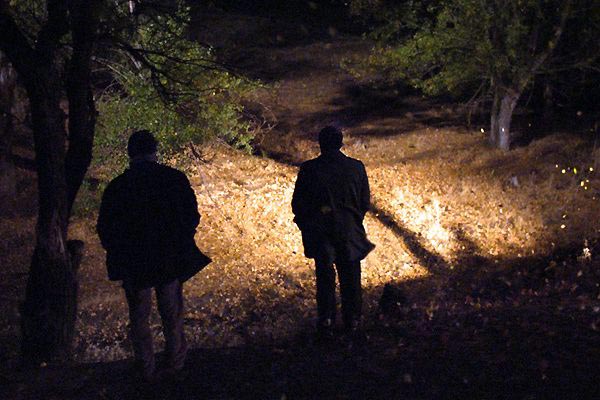
The search itself begins at sunset, with the gracefully composed pink and orange sky quickly giving way to the pitch-black night. Ceylan's film accordingly becomes a work of nocturnal landscapes, with the vehicle's high-beams flooding not only the curving roadways, but also the potential excavation sites that the film's suspected killer Kenan (Firat Tanis) identifies as potential burial grounds for the missing person. Ceylan and cinematographer Gökhan Tiryaki's high-end digital F35 camera captures these spaces in more sensual blacks than are typical for digitally-shot cinema, with the headlights disclosing the facets of the natural panorama in strongly-directional golden whites. Their's is a painterly, frequently low-key aesthetic, as appropriate for its' latter-day noir as it is for the film's modernist art-cinema patrimony. With the group consequently arriving in a demographically endangered village - to the comic welcome of mayor, and co-writer Kesal's Mukhtar - a sudden loss of power impels the year's most distinctive set-piece, with a single lamp illuminating Mukhtar's gorgeous maiden daughter, as she serves each of their bewitched guests tea. As the sequence progresses with a series of dissolves mimicking their rolling losses of consciousnesses (following the party's long, on-screen night of exploration), Ceylan's film shifts into a more fantastical mode. At this juncture, Andrei Tarkovsky proves a marked point-of-reference, as he does likewise in an earlier exchange of conversing interior monologues, and as he will remain throughout much of the film's final act, where Stalker's (1979) return from the 'zone' suggests a narrative model.

Tarkovsky's own schizophrenic sense of rootedness, commensurate with his Russian identity (divided between East and West), returns as one of a set of binaries that defines Ceylan's national allegory: Once Upon a Time in Anatolia signposts both Turkey's Middle Eastern status and also its desired European allegiance, with the film's cosmopolitan prosecutor Nusret (Taner Birsel) comically offering that a bit of untoward police work will not help with the country's EU application. As he makes the claim, the aforementioned apple slides down the hillside, reminding the viewer of the Iranian auteur even as the aforesaid professes a hope for European assimilation; that is, Ceylan juxtaposes Turkey's split national personality, dividing the two on the level of style and content. Augmenting this split thereafter, and its cousin in the cosmopolitan-urban/villager-rural divide that structures the narrative, is the film's panoramic presentation of the nation's class structure and ethnic affiliations, which again register with the exceptional clarity in the memorable visit with the country mayor. In this instance, Nusret, Commissar Naci (Yilmaz Erdogan) and belated narrative focus, physician Cemal (Muhammet Uzuner) encircle the local head's table, while the "Arab" driver Ali (Ahmet Mumtaz Taylan), members of the military and even the convict are relegated to a peripheral second; Ceylan creates a graphic analogy for his picture's governing social-caste rhetoric. Many of the film's procedural sequences exhibit a similar two-tiered spatial logic - delivering his report as if it were a Shakespearean monologue, Nasret (at once genuinely dashing and tragically self-deluding) occupies the center of the mise-en-scène, while lower level functionaries mock him from the edge of the frame.

As the film enters its final, urban setting, the quotidian details of everyday existence come to replace the "fairy-tale" occurrences that marked the microcosmic group's excursion into the picturesque, though often visually obfuscated countryside. Moving from the country to the city, the police caravan seems also to be traveling through time. In the picture's last act, the mid-century existentialism of another master of landscape, Michelangelo Antonioni, moves into the fore. With the police procedural narrative at its end, the tension and excitement - the cinematic magic - of the genre film form falls away and the characters find themselves unmoored. Faced with the grim business of performing the dead man's autopsy, Cemal looks for a reason to continue his own Anatolian story. In a striking sequence near the end of the film that recalls the apocalyptic finale of Antonioni's L'Eclisse (1962), he wanders the nearly deserted small-town streets. Of course, Antonioni's modernism manifests itself to an even greater degree in the multiplicity of forms, figures and tones that insures that there exists no less comprehensiveness on the level of style as in the film's inscription of national identity. Ceylan's film, it remains to be said, combines comedy and criminal melodrama with extraordinary dexterity; indeed, in Once Upon a Time in Anatolia, these competing tendencies are paired frequently within the same set-up, as when Nusret compares the same corpse to Clark Gable that the Arab will later shove into his trunk, stashing an armful of pumpkins beside the dead man's head. The filmmakers, in other words, bring a gallows humor to a film that certainly is as classically pleasurable, ultimately, as it is meaningfully meandering.

This review was co-written by Michael J. Anderson and Lisa K. Broad. The New York Film Festival will screen Once Upon a Time in Anatolia on Saturday, October 8 at 5:30 PM, with Cinema Guild releasing the film in a limited capacity beginning January 4, 2012.

Thursday, September 29, 2011

The 49th New York Film Festival: A Separation & This Is Not a Film

Opening with a pre-credit passage in which separating eponymous leads Nader (Peyman Moaadi) and Simin (Leila Hatami) address an off-camera magistrate in a tight, frontal two-shot, writer-director Asghar Farhadi's A Separation (Jodaeiye Nader az Simin, 2011) proceeds to cultivate the first long-take's implied logic of domestic surveillance, with the film's consistently transparent home architecture taking the lead hereafter. Farhadi's focal domestic interior - in which Nader and sixth-grade daughter Termeh (Sarina Farhadi) live with the former's Alzheimer's debilitated father (Ali-Asghar Shahbazi) - is divided by a series of French doors, interior apertures and even a translucent glass front entrance that all bring the film's domestic melodrama into public view. Consistently compressing the visual field in telephoto, Farhadi and cinematographer Mahmoud Kalari's camera shoots through these visually permeable barriers, as well as through the home's exterior windows, in a creating a sense that nothing in this household (as in the Iranian nation itself) is beyond the purview of its invisible monitors. With new nurse Razieh (Sareh Bayat) brought in following Simin's departure, the film's virtual surveillance is extended to both the culture's religious authorities, with the former consulting church-leaders to determine the spiritual legality of a series of actions, and also to the Islamic faith's patriarchy, which in this case is adjudicated by Razieh's bad-tempered, out-of-work husband, Hodjat (Shahab Hosseini), from whom the pregnant co-lead initially is forced to hide her place of work.

A Separation will turn on those things, within its governing system of abundant visibility, that may or may not have escaped witness, whether it is the ambiguous, just-out-of-view accident that transforms the film from household drama to criminal mystery or the piece of related information that will dictate the magnitude of the legal charges. With Farhadi's film accordingly shifting into crime-thriller mode, the picture's leads and supporting roster - the full slate of performers are superlative in their respective roles - are forced into investigative positions, as they attempt not only to make sense of their incomplete perspective on the events, but also on what will prove uniformly unreliable testimony. Consequently, the film's players, along with its spectators, who in the latter case participate in the same acts, calling not only on their intuition, but also on their murky recollections of seemingly off-handed moments in the narrative, are made complicit in the operation of A Separation's inscribed surveillance society. They become actors in the film's economy of monitoring and reporting, which will result finally in a denouement that escapes every witness expect the religiously conditioned moral guilt that impacts one character disproportionately. Farhadi's robust depiction of modern-day theocratic Iranian society, as comprehensive as any that this particular writer knows, is reproduced accordingly in the very structure of A Separation's narrative, just as the film's mediated visual strategies allegorize the same theme imagistically. In transforming both in the image of the film's distinctly big subject, therefore, Farhadi's film qualifies as a genuine masterpiece of the contemporary Iranian cinema.

Among the higher profile victims of President Mahmoud Ahmadinejad's authoritarian regime, from which he has received a six-year prison sentence and twenty-year filmmaking ban for colluding to commit crimes against the nation's security and producing propaganda against the Islamic Republic, Iranian master Jafar Panahi subverts if not openly transgresses against the ruling with his latest, This Is Not a Film (In Film Nist), shot by the director and documentarian Mojtaba Mirtahmasb, under the conditions of Panahi's house arrest. Drawing on the caption to René Magritte's Treachery of Images (1929; see below) - "Ceci n'est pas une pipe" - Panahi and Mirtahmasb create a work that like the painting, isn't and is that to which it refers: after renouncing the unintended fiction of the film's commencing static set-ups in which Panahi goes about his quotidian daily activities, the filmmaker proceeds to read and reenact a scene from his latest banned screenplay, judging that he has been prohibited neither from acting out nor reading his un-produced material (though his direction to Mirtahmasb to "cut" does lead the latter to insist that he and not Panahi will control the subsequent filming). This, it should be added, follows on the aforementioned set-ups that likewise offer an additional, audio-visual alternative to traditional, screenplay-based narrative filmmaking in the rough form of surveillance once again - with a phone conversation dictating, fictitiously in all likelihood, that Panahi himself was not responsible for at least one of the shots. In other words, Panahi seeks at this point to represent rather than make his film, to transform himself and his work in every respect into the subject of his art, which theoretically will be documented without out his intervening agency as director.

This shift from static set-ups to hand-held documentation occurs after a pivotal telephone conversation first, where Panahi's dire legal status is reinforced, and his screening of a clip from his second feature consequently, The Mirror (1997), which the filmmaker argues provides a model for what he should be attempting with the work that will become This Is Not a Film - namely, that he should take his "cast" off and respond authentically like his young child actress. Panahi's screening of his Mirror clip provides the first of three of on-screen passages from the director's prior corpus, with the latter two moments from Crimson Gold (2003) and The Circle (2000) illustrating the unplanned contributions of the actor and the power of plastic representation respectively. That is, they each show the limitations of an experiment in cinema-based imagination with respect to which Panahi becomes quickly disillusioned. They also comprise a film critical intervention that combines with This Is Not a Film's theoretical examination of the natures of film and documentary to construct a discourse that in some sense surrounds or encircles the act of filmmaking that Panahi of necessity musty avoid. As such, it might be argued that Panahi substitutes the acts of documentation (which he further does on his cellphone later in the work), collaboration and analysis for the auteurist production of narrative art cinema, which is to say the activity that drew the administration's ire.

It needs not be said what Panahi in fact produces with This Is Not a Film - the auteur's latest naturally demands a certain degree of spectatorial complicity - except to say that the banned filmmaker has produced a work of exceptional entertainment and surprising humor, as well as one of lasting impact, thanks especially to the same ontological play and litany of questions that formerly appeared in relation to the Magritte - albeit with greater plausible deniability in 1929. Panahi's effort additionally provides the latest entry into the fact-fiction hybrid that Abbas Kiarostami's Close-Up (1990) inaugurated (at least in the context of the international festival circuit), with performativity providing as key a motif for Panahi and Mirtahmasb as it once would for the former's mentor. The banned filmmaker likewise draws on Kiarostami's more recent Shirin (2008) in embedding his own un-filmed work within the diegesis of This Is Not a Film. In this respect, the tacit discourse on censorship that occurs throughout Kiarostami and especially Shirin becomes a matter of a terrible practical necessity in Panahi's latest. 

Considering both the interventions of This Is Not a Film and A Separation, therefore, there emerges yet further of evidence of a distinctive Iranian art film idiom, as developed foremost by Kiarostami, with Moshen Makhmalbaf serving as his earliest and most significant respondent. Within both of the latter-day films, this national form is articulated in their referential emphasis on what remains off-camera (out of view and between the cuts) as a result of domestic censorship, once again; in their semantic properties (telephone conversations in the former, automobile travel in the latter, strong female and child characters in both); and in the spaces that each leave for viewer adjudication, whether it is the ending of the latter or the ontological questions of the former. Suffice it to say that with A Separation and This Is Not a Film, Iranian filmmakers have not only developed and expanded the horizons of their nation's cinematic art, but have also produced the year's strongest domestic double bill. With that said, the tenuous nature of the industry, to say nothing of Panahi's even more tragic circumstances, provide substantial reason for pause before declaring a full-scale renewal of the nation's cinematic fortunes - to the lofty place it occupied when Panahi was first emerging as one of the globe's leading art cinema auteurs, as a maker of films.

A Separation will screen twice for the New York Film Festival, once on October 1st and again on October 2nd, while This Is Not a Film will play only once on the evening of October 13th. Both films do have U.S. distribution, with the former beginning its limited run December 30th.

Sunday, September 25, 2011

The 49th New York Film Festival: Dreileben

Comprised of three occasionally interlacing, though separately authored and shot tele-visual features issuing from Germany's ever-vital "Berlin School," leading-light Christian Petzold's Dreileben - Etwas Besseres als den Tod (Beats Being Dead), Dominik Graf's Dreileben - Komm mir nicht nach (Don't Follow Me Around) and Christoph Hochhäusler's Dreileben - Eine Minute Dunkel (One Minute of Darkness), the broader Dreileben project grounds itself in the spatiotemporal narrative fact of a prisoner Molesch's (Stefan Kurt) escape from police custody, with each of the three successive films representing an increasingly intimate connection with the pivotal plot point. Occupying the same literal terrain (and overlapping temporality), the three Dreileben's explore very different generic territories and narratological focuses within what will prove a single diegetic world in which characters from one repeatedly make cameo appearances in the others. In this sense, the Eastern 'Berlin School' is making its best effort at commemorating the memory of Polish master Krzysztof Kieslowski and his single-diegesis multi-part sagas - both The Decalogue (1989) and the Three Colors triology (1993-1994) are very germane to the latter-day trio - following more than a decade after the FDR-born Tom Tykwer began his own work of elaborating upon the former's idiom. Kieslowski, in other words, is once again proving to be an over-sized influence in his neighboring Germany, even as the tenor of modernist and postmodernist world cinema elsewhere appears less and less indebted to the maestro of multitudinous parallel narrative forms and especially to his very keen sense of filmic craft.

Few filmmakers working anywhere today (at least this side of David Fincher) have demonstrated as high and consistent a level of achievement in the latter regard, over the past decade, as has part one's writer-director Petzold. Beats Being Dead once again applies the director's highly composed, old-fashioned visual sense and horror film shock-effect repertoire - especially in the feature's expert sound design - to a narrative that like Petzold's outstanding Jerichow (2008), combines a socially and ethnically-tinged love-triangle with the suspense strategies of the thriller form. As young lovers Johannes (Jacob Matschenz) and Bosnian-immigrant Ana (Luna Zimic Mijovic) peregrinate through the magnificently crisp mixed evergreen forests that surround the eponymous northern German village - constant Petzold collaborator Hans Fromm captures the verdant exteriors and antiseptic hospital interiors in a saturated, hyper-detailed HD - Petzold cuts to a series of surveillance inserts of the frequently quarreling couple, which within the context of the larger project (and as a consequence of the set-ups' twinned rapid movements and over-dubbed guttural sound effects) emerge as unmarked point-of-view stagings from the predominately out-of-view Molesch. The trilogy's central figure indeed will remain peripheral, both spatially and also narratively, throughout much of Beats Being Dead's eighty-eight minute running time, with only a late, initially ambiguous on-screen appearance substantially breaking from this strategy.  

Petzold's feature instead centers on the burgeoning, and very sexy, romance between the young medical student Johannes and his new hotel-worker acquaintance Ana - both Matschenz and Mijovic are excellent in this entry - after the male lead cares for the latter following her public sexual humiliation at the hands of her thug-motorcyclist boyfriend. (Johannes, who clandestinely witnesses the scene while lying nude in the nearby grass at the edge of the woods, rescues the abandoned and shirtless young woman as she huddles behind a nearby tree.) Throughout Petzold's installment, clandestine glances, sweeping searches, and voyeuristic gazes generate a creeping sense of suspense and unease. The dense forest that lies at the center of the trilogy's fictional geography is also its dark heart; the epicenter of a developing manhunt for the escaped Molesch, it is also a site of nameless, almost supernatural dread that darkens the edges of the young couple's developing relationship. Emerging from the woods in a bedraggled red dress after a lover's quarrel, Ana brings to mind a present-day Little Red Riding Hood. 

Ever expert at the art of manipulation,  Petzold cuts violently against the spectator's established sense of the characters late in the narrative, reversing fields as he reveals both Johannes' far less admirable side and also Ana's commensurate instability. In so doing, Petzold reinforces the psychological importance of the literal, black-and-white surveillance footage that Johannes views in the picture's opening scene - Beats Being Dead ultimately introduces an economy of such points-of-view within a variety of contexts, including the three noted above - while even more significantly revealing the presumed working-class, native German Johannes' particular relationship both to his economic betters and also to Ana's  immigrant underclass. From the cultural differences that constantly drive a wedge of misunderstanding between Ana and Johannes, to the lack of private transportation that forces Ana to take a dangerous road to work everyday (more than wolves or even madmen) it is the longing for social mobility that ultimately threatens the young couple's future. In Beats Being Dead, as in Jerichow, Petzold's re-imagines Germany's multi-cultural social and demographic presents in decisively personal terms.

While politics likewise play a role in Dreileben's equally striking second part, Don't Follow Me Around, Dominik Graf and co-writer Markus Busch depart from the class-based rhetoric of Petzold, in exchange for an institutional criticism that finds targets in both the systematic crimes of the GDR and also those of the film's neighboring small-town police force. Ostensibly employed to help track the escaped Molesch, police psychologist Johanna (Jeanette Hain; pictured, left), who it should be added makes an initially opaque cameo in Beats Being Dead, in fact is brought to Dreileben foremost to suss out the aforementioned departmental abuses, with her pursuit of the convicted killer occurring only after the former situation is resolved. While in this sense Don't Follow Me Around attends more closely to the principle narrative focus of the 'Berlin school' triptych, Graf's principle subject (like Petzold's) lies foremost in a love triangle, which in the second feature develops between old friends Johanna and her local host Vera (Susanne Wolff; pictured, right) after they learn of a point-of-convergence in their respective romantic pasts. In this sense, Don't Follow Me Around extends its larger focus on historical incident, on the past, to a matter of more personal interest (thus replicating Beats Being Dead's comparable grafting of social and ethnic politics onto the interactions of its own triangular narrative structure; and as in the earlier film the results tilt in favor of the same Nordic archetypes). Fittingly, given  the sprawling novelistic feel of the entire Dreilieben series, the central mystery of Graf's episode is linked not to murder or police misconduct, but to paternity. Perhaps a reflexive comment on the authorship of this unique collective work, questions of parentage run through all three strands of the trilogy - like Johanna's young daughter, Johannes, Ana, and Molesh have missing parents.

For its fundamental narrative similarities to Beats Being Dead, not to mention its overlapping incidents that the second film on occasion helps to clarify retrospectively, Don't Follow Me Around nonetheless breaks substantially from Petzold's film on the level of the image, both in terms of Graf and cinematographer Michael Wiesweg's shooting strategies and also of the content of what appears before the camera. Graf's film relies both on a less crisp, grainier 16mm stock and also on hand-held camera work in its articulation of domestic melodrama in the tradition of Ingmar Bergman and Rainer Werner Fassbinder. Pro-filmically, Don't Follow Me Around matches Beats Being Dead's overriding emphasis on surveillance with its own even more pronounced constellation of concrete settings. Indeed, from Johanna's original departure for the village to her collaboration with the local police department that takes the single-mother on a series of dining excursion throughout the community, Graf stacks location upon location, in essence (and in one instance literally) mapping the film's Dreileben setting. Even more distinctive than these exteriors, however, is Vera and hack-author husband Bruno's (Misel Maticevic) village home - once purportedly the site of a communist brothel. The villa provides an apt setting for the second parallel love triangle that the grows out of the trio's amusing wine-fueled meditations on love and memory, with the homestead's exterior shower permitting at least one passage of comic titillation, while the series of locked doors inside invite a psychoanalytic interpretation to match the film's psycho-sexual content.

While Don't Follow Me Around succeeds in further enriching the experience of part one, thanks both to its substantive convergences and divergences from Petzold's film, Christoph Hochhäusler's One Minute of Darkness ultimately fails to achieve the same. One Minute of Darkness, co-written by Peer Klehmet, indeed suffers not only from its comparably insufficient development of its middle-aged police detective co-lead Marcus (Eberhard Kirchberg), who spends the narrative pursuing the fugitive Molesch as well as the truth of the brutal murder that led to his incarceration, but also from the arguably unsatisfying nature of the reversals that Hochhäusler's film employs in resolving both the latter film's own structuring mystery, and also that of Beats Being Dead. The initially compelling relationship between the laconic Marcus and the adult gym-owner son, who seems starved for his affection and regard, is briefly sketched and quickly abandoned. Likewise, the flesh and blood Molesch, emerging from the obscure darkness of the woods into the center of the narrative both figuratively and visually, additionally fails to live up to the leering phantom of the first two episodes.  

Ultimately, the comparative weakness of Hochhäusler's effort belongs as much to its position at the end of the series, as a work that according to logic of the project demands some form of resolution or at least a consistent logic - One Minute of Darkness does not refashion the love triangle; it does not inaugurate an original DV idiom wholly distinct from the first two parts - as it does to any internal falterings per se. Perhaps Hochhäusler should not be held accountable for failing to produce a summarizing work on the level of Three Colors: Red (1994), given the discrete nature of the Dreileben productions. Nevertheless, One Minute of Darkness reveals a structural deficiency in the project that insures that at best, Dreileben remains two-thirds great cinema.

This review was co-written by Michael J. Anderson and Lisa K. Broad. Dreileben will screen at the New York Film Festival in its entirety on Saturday, October 1, beginning at 1:00 PM , and over three successive days, starting Tuesday, October 4, at 3:30 PM.

Saturday, September 17, 2011

New Film: Drive (2011)

Testifying convincingly to the New Wave axiom that superior sources breed better art, Nicolas Winding Refn's Drive, from Hossein Amini's fine adaptation of James Sallis's novel, compiles more than four decades of action-film antecedents for a work overwhelmingly lauded as an exercise in consummate style, in cool, when not (or not also) derided as an empty example of the same. With Jean-Pierre MelvilleMartin Scorsese and late Cronenberg, Oldboy (2003) and a very pointed Mr. Arkadin (1955) reference - which happens in this instance to be both signposted and embroidered - all providing motival filigree, the real substance of Refn's generic inspiration flows from Drive's proximate namesake, Walter Hill's The Driver (1978), as well as from Michael Mann's masterful celebration of Los Angeles at night, Collateral (2004). Combining the professional acumen, not to mention the getaway profession of the Hill - as well as a very striking resemblance between the two unnamed male leads, Ryan O'Neal in The Driver and Ryan Gosling in Drive respectively; both are credited only as "The Driver" - with Mann's fluid aerial mapping of the glowing cityscape in high-definition digital, Drive pays conspicuous homage to some of the most elegant mid-level auteurist action filmmaking of the forty year-old Danish director's lifetime, that is, to the American formalist tradition that Refn very ably extends.

Drive opens with one of the finest pre-credit sequences in recent film history: an essentially complete representation of the first of the film's getaways, with Gosling executing throughout with absolute precision. Befitting the Hill source once more, Gosling is the best at what he does, a professional in the mold of the aforesaid's stagflation-era transformation of Howard Hawks. Refn paints Gosling's expert split-second decision-making in an economy of close-up inserts of the poker-faced, toothpick-chewing lead and in over-the-shoulder set-ups that chart the hazy, low-key Los Angeleno side streets that Gosling has fully mastered. As he alternately flies and slinks out of view, Gosling's complete attention is calibrated to successfully elude the police dragnet that emerges moments after the heist concludes; to this end, even a seemingly distracting Los Angeles Clippers basketball game on the radio, which Gosling happened to have been watching at home prior to the start of the job, is used to free the lead and his two freelance employers from their pursuers (thanks to a perfectly timed arrival at Staples Center). As Gosling disappears into the departing masses, Refn cuts to gliding overheads of the nocturnal city, scored electronically by Cliff Martinez as the credits appear in cursive hot pink. In so doing, Drive synthesizes its two primary sources once again, bringing together the signature visuals of Mann's opus and Hill's larger late 1970s, early 1980s historical moment, both musically and graphically.

As Drive progresses, Gosling is revealed to work under Bryan Cranston's good-natured if also ethically impaired and down-on-his-luck garage owner and stunt director, in both of the latter's ventures. Cranston warmly confides to Carrie Mulligan's radiant married love interest Irene that he has been underpaying Gosling for years, while on the set, the latter is compelled to wave his right to seek legal restitution should the rollover he is about to perform goes poorly - after Cranston takes half of his $500 bonus; naturally, given again his extraordinary professional ability, the rollover does come off. The exploited, working class Gosling's life, in other words, proves to be of very little worth compared to those stars for whom he is performing the stunts. In this respect, Refn introduces both a backdoor social consciousness, commensurate with the work of Hill and even Mann's Collateral, as well as an interest in the periphery of celebrity culture that likewise provided a somewhat unsatisfying emphasis in the director's earlier Bronson (2008). Of course, Bronson and especially the stronger Valhalla Rising (2009) converge even more closely with Refn's latest in the brutality that ultimately overtakes Drive's narrative, with Gosling proving as capable with his clenched fists and a shower curtain rod as he is behind the wheel.

While Gosling's steely, if occasionally vulnerable performance quite effectively grounds Drive, Refn's co-stars and supporting players manufacture much of the film's moment-to-moment richness, beginning with Mulligan's sunny allure as the focal point of the film's romantic triangle. Cranston's hunched and weathered, though also sympathetic turn as Shannon is as Academy-worthy as any - no surprise from one of television's finest actors since his "Malcolm in the Middle" days - Christina Hendricks is well cast as a small-timer's Moll (her personalized nameplate earrings seem a good latter-day match for her impossibly curvaceous physique) and Ron Perlman and Oscar Isaac each effectively add tension in their antagonistic roles.  Finally, in yet further confirmation that Refn has somehow occupied this writer's subconscious in casting his film, Albert Brooks casually dominates the screen as ex-film producer cum gangster Bernie Rose (in precisely the type of role that the specifically late middle-aged Brooks was born to inhabit). Brooks's Rose, likewise, extends the film's late Carter, early Reagan-era reference point both within the diegetic world of the film itself - he claims to have produced  film actioners in the 1980s that one critic identified as European, not unlike the Dane Refn's twinned primary generic sources Hill and the Mann of Thief (1981) - and certainly extra-diegetically in the presence of that era's superlative comedic director Brooks. Refn as such remains remarkably loyal and thorough in his reformulation of his preferred generic moment, an era that he seems intent on (and capable of) reviving single-handedly as that period replays itself economically and socially in the early 2010s.

A special thanks is due to site co-author Lisa K. Broad for her input to this piece.

Tuesday, August 30, 2011

Walter Hill's Streets of Fire (1984) & the Dystopian Recursion of the 1950s

Walter Hill's Streets of Fire (1984), from a screenplay by Hill and Larry Gross, closes the director's exceptionally rich first decade of productivity - one of the finest of any American filmmaker of Hill's "Silent" and New Hollywood generations - with one of the more zeitgeisty efforts of the perennially under-appreciated 1980s. Presaging Robert Zemeckis's multiplex masterpiece Back to the Future (1985), Hill's rock-and-roll fable mythically interlaces the sleek material culture and "juvenile delinquent" generic form (Richard Brooks's Blackboard Jungle, 1955; Nicholas Ray's Rebel Without a Cause, 1955) of the filmmaker's adolescence with neon-saturated, pop-futurist aesthetics of the latter era. What results is a world that while neither the 1950s nor the 1980s exactly - Streets of Fire features both 1950s and 1980s fashions as just one totem of its anachronicity - nonetheless preserves the spirit of each; Hill's film, even more than Zemeckis's, interprets the contemporary moment as an especially troubled reappearance of the postwar decade.

Hill's mid-1980s likewise maintain continuity with the previous decade, as well as with his earlier corpus, with the mobile street-gangs of The Warriors (1979) reappearing in Streets of Fire's no-less dystopian, geographically fictionalized urban present. Headed by Willem Dafoe's characteristically wide-eyed Raven Shaddock, the head-to-toe leather-clad Bombers biker gang abduct Diane Lane's Ellen Aim at the conclusion of her opening, power pop-brand musical number. Saving her from Raven's "Battery" lair, situated inside a dilapidated, Gowanusesque warehouse in which a rockabilly outfit performs beside a fish-net wearing stripper, are a semi-disreputable pair of ex-soldiers: Aim's ex-lover Tom Cody (Michael Paré) and his new, platonic female acquaintance and sidekick, McCoy (Amy Madigan). In a measure of Hill's ever-present Hawksianism, McCoy assures her John T. Chance, go-it-alone companion that she is "plenty good enough," offering to serve as getaway driver in another internal reference - The Driver (1978) naturally - to Hill's outstanding late 1970s work. With Cody consequently facing off against Raven and his gang in the picture's Western-encoded action climax, Bill Paxton's pompadoured bartender friend organizes the defiant city-folk as a vigilante para-military force in the former's defense. In this respect, Hill additionally reprises the social vision of Howard Hawks's supreme masterwork, Rio Bravo (1959), with the community coming to the individual's aid.

Back on stage, Hill presents a set of consecutive musical numbers with the Sorel's R&B rendition of "I Can Dream About You" especially prefiguring Back to the Future (and the Starlighters) once again. Ellen Aim follows-up the African American quartet with Fire Inc.'s "Tonight is What It Means to be Young," providing a more resolutely 1980s feel and fashion-sense on the neon black-lit stage. In both of these concluding performances, Hill works with the semantics of the concert film, as his camera circulates throughout the typically low-key venue. However, in the previous on-screen number, inserted in the midst of Streets of Fire's narrative - and visualized both on television screens and indistinguishably from the diegetic world of the film itself - the iconography, and indeed even the percussive visual syntax refer rather to a much newer form: the musical video. In this early set-piece, Hill's film again proves very much of its early to mid-1980s moment, a time that was witnessing the infancy of the new audio-visual form - as well as the dystopian (though of course also nostalgic and even romantic) recursion of the 1950s.

With Nicolas Winding Refn's Drive (2011) about to premiere on American screens at the time of this writing, it would seem that Hill and his present are making cameos of their own, in the reappearance on the one hand of the filmmaker as an essential inspiration for the Danish auteur - though I have not yet seen Refn's ostensibly Hill-influenced latest, I would argue that the elder director was formative for Bronson (2008), through Hard Times (1975), and Valhalla Rising (2009), conjugated in the latter case with Andrei Tarkovsky-style modernist art cinema - and in the social and economic environments on the other that the director perceptively inscribed beginning with Hard Times and continuing to at least Streets of Fire. Right on schedule, in other words, we are experiencing a rebirth of Hill's late 1970s, early 1980s moment.

Streets of Fire currently is streaming on Netflix Instant.

Friday, August 26, 2011

Now Playing, Coming Soon

Longtime Tativille readers will know that this site sees very little action this time of year, and that it officially has remained a one-man endeavor since its inception in 2005. Well, both of the above are about to change. As to the latter, let me be the first to welcome long-time collaborator, Mrs. Tativille Lisa K. Broad (pictured - okay, perhaps not... sorry Lisa), as Tativille's latest "contributor," just in time for the 2011 New York Film Festival. For those of you who fear the prospect of a second Tativille 'contributor,' let me be the first to reassure you of not only Lisa's exceptional ability as a film scholar and reviewer - those of you who are longtime readers already will be well aware of both - but also of her extraordinary credentials: Lisa is a rising seventh year PhD candidate in the Cinema Studies department at New York University, where she also holds an M.A. in Cinema Studies and a B.A. in Philosophy. Suffice it to say that Lisa's future contributions will only improve what is now 'our' little site.

As to the promise of increased future posting, Lisa and I will be covering this year's NYFF on an equally official capacity, beginning next month. For those of you who are perhaps less than fully versed on the exigencies of international art cinema (Tativille's primary, though not exclusive focus) distribution in New York, basically this is how it works: the best in world cinema of each calendar year more often than not begins to arrive in late September with the commencement of the NYFF; subsequently, the next eleven months tend to see the commercial releases of most of those titles, as well as first-runs of works that were passed over by the festival, sometimes more deservedly than others. 2010-2011 has been no exception to this pattern, with the the majority of early 2011's best titles being holdovers from last year's event: Apichatpong Weerasethakul's Uncle Boonmee Who Can Recall His Past Lives, Abbas Kiarostami's Certified Copy, Raoul Ruiz's Mysteries of Lisbon, Cristi Puiu's Aurora, Radu Muntean's Tuesday, After Christmas, Michelangelo Frammartino's Le quattro volte, Mike Leigh's Another Year (released in Connecticut this past January), Frederick Wiseman's Boxing Gym and Xavier Beauvois's Of Gods and Men. As I saw the first six in 2010, again at the NYFF, and the last three in the first quarter of 2011, it should become apparent why posting on this site can become a bit sparser as the summer months progress - and why there is also reason for optimism as September nears.

Of those 2010 films not screened at last year's event, noteworthy 2011 releases and festival premieres have included Patricio Guzmán's Nostalgia for the Light, Werner Herzog's Cave of Forgotten Dreams, Kim Jee-woon's I Saw the Devil, Jia Zhang-ke's I Wish I Knew, Na Hong-jin's The Yellow Sea and Mahamat-Saleh Haroun's A Screaming Man. Here, I have less excuse for my more recent lack of production on Tativille - save for the fact that this is hobby and that I do happen to be writing a dissertation on film - with only the Herzog prompting a post. However, I would add that none of these films, in my estimation, quite matched the Ten Best Films I saw last autumn (including the first six listed above, in order of preference; as well as a certain Tony Scott film that recently took an unwarranted beating from a good friend of this site). As for actual 2011 premieres and releases, I thus far have seen two films that will merit mention when I account for the best of the year this coming December: Béla Tarr and Ágnes Hranitzky's The Turin Horse (the one film that I've seen on the 2011 NYFF slate - and let me assure you, it absolutely is not to be missed) and Terrence Malick's The Tree of Life. That's two more premieres of a very high caliber than I had seen at this time one year ago. Here's to the promise of 2011!