Saturday, September 29, 2007

The 45th New York Film Festival: The Romance of Astree and Celadon

Warning: the following post contains spoilers.

If, as is rumored, The Romance of Astree and Celadon proves to be octogenarian writer-director Eric Rohmer's final film, the nouvelle vague's senior auteur will have accomplished something truly remarkable - and perhaps even unprecedented for a film director of his level of productivity: namely, Rohmer will have completed a feature filmmaking career spanning nearly fifty years and some twenty-plus features without having once directed a single work of even middling quality. This is not to say that The Romance of Astree and Celadon is merely 'good'; perhaps more than even his late masterwork The Lady and the Duke (2001), The Romance of Astree and Celadon serves to consolidate and even extend a number of the director's key themes. This is to say that The Romance of Astree and Celadon is truly up to the extraordinary task of being the director's finale, not that we wouldn't relish more still from one of the medium's supreme masters.

Adapting Honoré d'Urfé's novel of 5th century Gaul life, The Romance of Astree and Celadon claims to reproduce less the period depicted than its 17th century readers' imagination of the earlier period. Commensurate with this goal, the director features canvases painted in the seventeenth century, a castle built well after the novel's setting and importantly a grafting of the Christian faith onto the Druid-themed source material. Also Rohmer, in typical hyper-realist fashion, apologizes for setting the film in a location other than that represented in the novel - as per the place's disfiguration in the coming industrial centuries. That is, rather than utilizing matte painting to substitute for that which could not be recreated with a high degree of verisimilitude (as he does with the 18th century Paris of The Lady and the Duke) Rohmer substitutes locations, confirming the place that the environment plays in his pastoral narrative.

Indeed, this untrammeled nature appears on both the sun-dappled 16mm cinematography (on the same format he used for his supreme masterpiece Summer [The Green Ray; 1986]) or in the ubiquitous bird songs that fill the film's soundtrack. Hence, The Romance of Astree and Celadon serves to synthesize Rohmer's hyper-stylized period work (The Marquise of O, Perceval, The Lady and the Duke and Triple Agent) and the naturalist ethos of his contemporary corpus (everything else): here we have a film that maintains Rohmer's interrogation of the problematic of period recreation, while introducing a series of natural locations that define his more widely-appreciated present-day works.

In these landscape, Rohmer commences with a misunderstanding between the film's eponymous lovers, Astree (Stéphanie Crayencour) and Celadon (Andy Gillet), where the former sees her male paramour in the arms of another - comparable to a similar misunderstanding appearing late in An Autumn Tale (1998) that features Rohmer axiom Marie Rivière, who also appears as Celadon's mother (uncredited) in this opening scene. Following Astree's clandestine sighting of Celadon, the young woman states her desire to never again see Celadon, leading the latter to attempt suicide. Suffice it to say that he survives his attempt, though he does find himself in the presence of three nymphs (including a second Rohmer regular Rosette).

Of course, it is in their amorous company that Celadon's love will be put to the test, as so often occurs in Rohmer's universe. Likewise, this theme of fidelity - similarly characteristic for the director's corpus - allegorizes religious faith, though in the case of his latest it is with the added valence of a pre-Christian Druidism that nonetheless sounds an awful lot like the director's trinitarian Catholicism. Here, we have Celadon's philosopher of love brother arguing the case for fidelity - where magically two lovers become the same person - versus the musician's philanderer, who says we love what he have yet to carnally love. He is the unbeliever, the film's Antoine Vitez to its Jean-Louis Trintignant (i.e. the Marxist philosopher and the Catholic in My Night at Maud's [1969] to which The Romance of Astree and Celadon shows an unexpected resemblance). And like that film, Rohmer's latest establishes the conflict through conversation before providing its double in the consequent plot.

In the film's closing passages, among the most absolutely sensual in the contemporary cinema, Celadon, resolute in keeping his promise to remain forever out of Astree's sight, takes on the appearance of a Druid priest's missing daughter - after encountering her sleeping body (and uncovered legs - cf. Claire's Knee [1970] in a forest grove). Soon thereafter, her bare snow white breast proves too much for the frustrated Celadon, which compels the costumed lead to passionately grope his soul mate. Noticing that her girlfriend has no chest, she asks Celadon who (s)he is. Having since changed into her clothes, Celadon responds he is Astree, thereby literalizing the construct introduced by the former's brother. With his identity thereafter disclosed, Astree jubilantly responds "live, live, Celadon," with only the closing credits to follow. As such, Rohmer gives us a truly great ending - surpassed in his corpus only by the single "oui" that concludes Summer - to what may prove his truly great final film.

Saturday, September 22, 2007

New Film: Eastern Promises

Warning: the following post contains spoilers.

As Village Voice film critic J. Hoberman has pointed out (among others, certainly), David Cronenberg's Eastern Promises, from a screenplay by Steven Knight, is "very much a companion to A History of Violence [2005]." That is, like the director's earlier masterpiece, Eastern Promises examines the gap between surface - between the person that one appears to be - and sub-surface, or the conflicting/conflicted reality of the individual. Whereas A History of Violence utilized this distinction to craft a hero (Viggo Mortensen, as will be also the case in Eastern Promises) whose perfected exterior conceals a phenomenal capacity for violence, Eastern Promises reverses this equation to disguise - in the person of a Russian ex-con turned mobster - another whose peaceful proclivities may out-weigh his apparent sadism. In other words, as Hoberman likewise notes, we have another potentially schizoid, Cronenbergian hero.

In Eastern Promises, the process of concealment is achieved not only through the exigencies of character, but in the appearance of Mortensen's flesh itself. The actor is covered in prison tattoos - as we are told, purportedly commensurate with a Russian axiom, that the man without any tattoos "doesn't exist" - which narrate the story of his life. Indeed, in one of the film's pivotal set-pieces, Mortensen is tattooed with stars on his knees and over his heart to officially and inexorably initiate his character into the Russian mafia. However, this tattooing is revealed to be a set-up, a gambit on mob king-pin Semyon's (Armin Mueller-Stahl) part to pass Mortensen off as his dandy son (Vincent Cassel), whose life a clan of Chechen mobsters demand. His flesh is manipulated to deceive. Of course, the fact, as will be revealed subsequently, that Mortensen is an undercover agent dictates that the very story inscribed on his flesh is itself a lie.

Even so, the violence his body suffers, whether or not under the auspices of undercover work, are entirely authentic. In the film's most notorious set-piece - its truly extraordinary bath house hand-to-hand combat sequence - the wounds that Mortensen's Nikolai incurs are very real indeed (as were the bruises to the film's nude star). His body is here subject to an extraordinary, disfiguring violence, even if it doesn't quite compare to that he inflicts on others: namely, in the dead mafioso's fingers that he clips off or in the Chechen's eye that he stabs only inches in front of the camera lens. This is a film of grotesque, hyperbolic violence - of slit, truly gaping necks - that somehow still succeeds in shocking thanks to the suspension of disbelief entered into by its horror-trained audiences.

Speaking of Mortensen's flogging, his body, as film scholar Lisa K. Broad suggests, is made to suggest that of Christ's crucified figure, replete with an incision on his side. In fact, Broad notes that Russian iconography is emphasized throughout the work, be it in the impregnated Virgin who sparks the film's investigative story line or in the frequent close-ups extracted from background detail that call attention to the traditional form of the icon. (Indeed, Mortensen, in the first indication that his character may exceed his obvious villainy, hands a prostitute an icon portrait - imploring her to stay alive a little longer.) And as Hoberman notes, apropos of its iconographic content, this is "a Christmas story complete with a miracle." We have our Holy Family.

Then again, comparisons to icons aside, Cronenberg's style is foremost an instantiation of a profoundly old-fashioned classical Hollywood continuity technique of editing. With metronomic regularity, Cronenberg establishes his scenes with a long or lateral tracking shot, cuts in to a two-shot composition and then into a shot/reverse-shot schema - before re-establishing and again launching into subsequent articulations of the same technique. (Broad additionally notes that Cronenberg frequently utilizes wide-angle lenses, as is typical of his visual style.) Even so, Cronenberg calibrates the framing lengths of his shot/reverse-shot pattern to accentuate singularities of the various character relationships that he shows in dialogue. In other words, while there may be no passages that explicitly exceed the bounds of classical continuity editing as does the opening, thematizing real-time sequence of A History of Violence, Cronenberg's minor manipulations of classical style maintain the expressive individualities that exemplify this technique at its very best.

Then again, Cronenberg does seem to find a second model for his decoupage in the bath house sequence - according to Broad - beyond that of classical-era Hollywood: namely the perfected analytic editing of Robert Bresson and Pickpocket (1959). That is, in striking comparison to The Bourne Ultimatum (Paul Greengrass, 2007), again in the insight of Broad, where the most visible moments are felt rather than seen, Eastern Promises shows us far more than we would ever have the opportunity to see (secured through a series of clarifying close-ups). Indeed, what we see often shocks in Eastern Promises, through its sheer gratuity, often coupled with the most old-fashioned of forms. Actually, one could argue that the film's use of English, French and Polish speaking actors to create a milieu entirely foreign to them and the film's Anglo audience trades in the same evocations of an earlier moment in Hollywood filmmaking.

In sum, Eastern Promises may just be the English-language film to beat in 2007. It is also one of the director's better efforts, placing just below career peaks Dead Ringers (1988), A History of Violence (2005) and the highly-underrated Spider (2002). Importantly, Eastern Promises, like Spider, clarifies one of his earlier themes - this time on the tattooed flesh of the director's newest axiomatic split performer.

Wednesday, September 12, 2007

Masterpieces of the Early Sound Cinema: Rouben Mamoulian's City Streets (by, Lisa K. Broad)

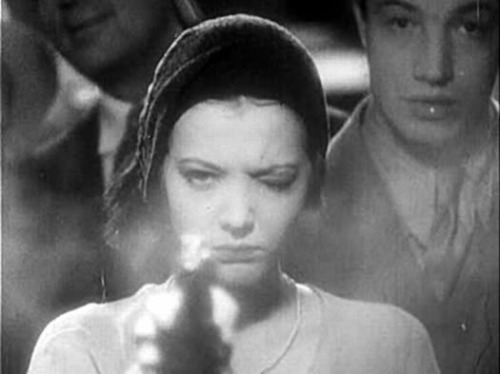
Rouben Mamoulian’s second film City Streets (1931), with a screenplay by Dashiel Hammett, screened yesterday at Film Forum as part of a larger Mamoulian retrospective. In it Gary Cooper plays a straight arrow and sharp shooting carnival man who is roped into the mob when his girlfriend is framed for a murder committed by her bootlegging father. Mamoulian famously remarked that the film contains 10 murders, none of which are seen.

The film opens with a low-angled shot of trucks barreling down the eponymous boulevards before passing over the camera, a close-up of a mysterious liquid leaking out of the back of one of the vehicles prompts an explanitory cut a to a beer bottling plant, and finally to a pint of beer being dispensed in extreme close-up. The camera lingers on the head of the froth in the glass as a light, effervescent bubbling sound is picked up on the soundtrack, a pregnant moment which distills the exuberance that greeted the sound cinema in the early 30s – the new and improved beer bubbles of the talking cinema can be seen and heard.

A man moves into the shot and downs the glass prompting a cut-to a close-up of a large wooden vat of beer being filled with a hose, the rushing and bubbling of the liquid fills the soundtrack, drawing a fascinating contrast between the recorded sound of moving and still liquid. After a beat the camera pulls back to reveal a crowd of bootleggers around the still, arguing over their territory. One man pulls a wad of bills out of a hat – a silent-film style close-up draws the spectators attention to the initials marking its crown – and pays the other. At the conclusion of a tense but amiable discussion between the men, the camera returns once again to admire the swirling vat of liquid that will bring joy and heartache to many as the narrative continues.

A first instance of the latter comes to the fore as a graphic match transports the story from the froth of forbidden ale to the threatening waves of the river where the hat with the initials is seen floating. Here again the sound of the water is highlighted. In this way, Mamoulian the consummate cinematic innovator is not content merely to highlight the existence of cinematic sound – as he did with great success in 1929’s Applause – but its possibility for subtlety and variety. He gives the spectator both the auditory thrill of jazz clubs and gun shots, and also the nearly scientific fascination (audio-microscopy) of recorded beer bubbles. Mamoulian also plays with early sound film conventions, providing a close-up of a bird in a cage but refusing the audience its song – the bird’s owner notes that it hasn’t produced a tune all day.

Despite the aural fireworks, City Street’s image track holds its own just fine. The scenes in the seaside carnival provide plenty of spectacular bells, whistles, flashing lights, and funhouse mirrors while the love scene between Cooper and Sylvia Sidney as Nan yields up breathtaking beauty. A 180° panning shot sweeps the moonlit beach and finds the lovers ensconced on a large rock in the surf. Cooper and Sidney are both lovely to look at, and the moonlight reflected off the water gilds their faces as they embrace, squabble, and embrace again.

A clever and appealing use of shadow and smoke throughout the film – a gangster converses with an offscreen man whose giant, speaking shadow can be seen on the wall; a nightclub scene is so fogged with smoke that each lamp casts a delicate halo – creates a mysterious yet playful tone similar to that of Jean Renoir’s early sound masterwork La Nuit Du Carrefour (1932). While City Streets is every inch the sound film, it harkens back to silent-film convention in its frequent use of extreme close-ups, attention-directing camera movements, and associative montage. In this way, Mamoulian places heightened emphasis on the materiality of both the sound and the image tracks, creating a film that is constantly directing the audience’s attention to its own virtuosic construction.

Tuesday, August 28, 2007

"What does it mean that we are going to have visitors from other worlds, other planets, dropping in on us?"


Spaceman came down to answer some things,
The world gathered round from paupers to kings,
I’ll answer your questions, I’ll answer them true,
I’ll show you the way you know what to do,
Who is wrong and who is right?
Yellow, brown or black or white?
The spaceman he answered "You’ll no longer mind...
I’ve opened your eyes, you’re now colour blind."

Racial.

-David Brent, "The Office"

Warning: the following post contains spoilers.

The reputation of Robert Wise's The Day the Earth Stood Still (1951) as an anti-nuclear allegory certainly precedes it. Indeed, as a film of the immediate post-World War II zeitgeist, few films can claim as unequivocal a connection to the era's principle political and technological anxieties and developments as does Wise's and screenwriter Edmund H. North's established science fiction classic.

After the film's opening spacecraft point-of-view (not that this short shot is revealed as such) we are introduced to a litany of broadcast reports - from India to France to Britain to the United States - each (presumably) highlighting the bright white orb circling the planet at supersonic speeds. Shortly thereafter, Wise provides an additional news anchor narrating the on-going story, while we are shown a television set broadcasting the report at the location of the recently-descended U.F.O. Wise couples the voice-over with a camera movement directed toward the box, with the audio continuing after we have transitioned to the space shown on the screen-within-a-screen. Hence, Wise reminds us of both telecommunication's' role in making the world smaller and also television's specificity - and particularly - its liveness as a defining aesthetic at a time when it was still a rarity (in 1951, 14 million U.S. homes owned a set to 42 million by the end of the decade).

Of course, it is less television's cardinality than it is the exigencies of the nascent Cold War and the threat of nuclear holocaust that places The Day the Earth Stood Still within its particular moment. Upon arriving, the jump-suited Klaatu (aka Mr. Carpenter, Michael Rennie) demands "to meet with all nations on earth." After a U.S. military official proclaims his reticence, Klaatu follows up by asking about the United Nations - another institution of the moment. Again he is declined on the basis of the UN's lack of representation for all nations. Nevertheless Klaatu communicates that he is "not as cynical about the earth's prospects." Even after the soldier responds that "I've been dealing in the earth's politics longer than you have," it remains clear that The Day the Earth Stood Still shares Klaatu's optimism.

At this juncture, we are still under the impression (from Klaatu's warnings) that the earth is under an external threat. As such, the film's obvious - if implicit - denials of the burgeoning Soviet threat would seem to conflict with the concept of an endangering other. That is, while one threat is neutralized another emerges; only the horizons shift - from the earth's nation-states to competing planets. Regardless, it is clear that Wise is offering a statement of trans-ethnic tolerance to match his signature West Side Story (1961), even if his allegory isn't yet entirely transparent.

Nevertheless, Wise does not entirely damn his rhetoric by revealing, ultimately, that planet earth's propensity for violence is what threatens its existence, not the alien other. However, to insure that earth doesn't destroy itself - or pose a threat to other planets - the alien states that Kaantu represents have installed the gentleman alien's metallic companion Gort (Lock Martin) as a check. That is, Wise offers a single executor of international/universal law in the place of the U.S.A. and U.S.S.R. (and mutually-assured destruction) of the time. Interestingly, to achieve this Kaantu and his more insightful species has foisted Gort on the people of earth, who at the first occurrence of violence will respond in turn. In other words, The Day the Earth Stood Still posits a very non-democratic solution to the world's problems: by fiat of a more intelligent elite, the people of earth will comply or be destroyed (even if it is for mankind's good). Similarly, Kaantu and his Professor associate (Sam Jaffe) stage a demonstration of force to encourage human complicity. That Wise would evoke demonstrations of force and the rule of a governing elite on the heels of the twentieth century's great age of dictators is curious indeed.

Christian Nyby's The Thing from Another World, produced and co-directed (without credit) by Howard Hawks, and released six months prior to Wise's film (also in 1951), is The Day the Earth Stood Still's profoundly pro-democratic generic double. In brief, The Thing... "tells the story of an Air Force crew and scientists at a remote Arctic research outpost who fight a malevolent alien being"; said being is first discovered as the pilot of a frozen spaceship. (For an extended plot summary - from which the above quotation has been gleaned - click here.)

With its very Hawksian emphasis on conversation, often in a heavily-populated middle-ground (cf. To Have and Have Not, 1944), Nyby's The Thing... highlights the conflict between science and religion that the appearance of the unknown visitor underscores. That is, the introduction of the eponymous Thing calls into question our long-held assumption that we exist atop the food chain. By contrast, science in The Thing... posits mankind as one among many animals, making its appearance non-threatening to humankind's identity.

Indeed, each idea is given its hearing, as the military officials (read humankind - and ultimately human religion's - protectors) and scientists debate a course of action. Again, these ideas are debated with figures interacting and discussing these alternatives in a single space, shot at eye-level, and thereby reinforcing the film's democratic ethos. Still, this is not to suggest that Nyby and Hawks refuse to take a position. Ultimately, it is with humanity - and action, commensurate with the genre - versus a dehumanizing science and inaction that they side. Surely, when the film's representative of science claims that "knowledge is more important than life... [that] we [as humanity] split the atom," it is not only the military but the filmmakers themselves that respond "and look how happy that made us."

In short, The Thing from Another World finds its own very different lesson from the horrors of Nazism, fascism and nuclear deployment: the limits of science in a world where its utilization has not always been benevolent. That is, The Thing... strikes the same realistic (vs. idealistic) note that The Day the Earth Stood Still refuses. And it does so with a form fully suited to the rhetoric it conveys. Comparatively, Wise's aesthetic is perhaps most notable for its visually plentiful black-and-white photography, securing its highest level of contrast in the picture's pitch-black nocturnal exteriors, seared by bright white streetlights. Elsewhere, Wise and D.P. Leo Tover succeed in registering their location-heavy Washington D.C. with a plush - characteristically broad - grey-scale. (This is not to suggest that The Thing...'s photography lacks the luster of Tover and Wise's; in reality, Hawks's films - including this one for which he failed to receive a director's credit - are often underrated in terms of their pictorial complexity.)

Perhaps, if there is a relationship between form and content in The Day the Earth Stood Still, however slight, it is in its insertion of location to highlight's the narrative's currency for its time, as well as the aforesaid spatial transitions introduced in the film's televisual motif. Still, Wise's picture displays nowhere near the formal rigor of The Thing from Another World, even as it it remains plausible to argue that Nyby and Hawks's remote Arctic outpost represents a more accurate account of the immediate post-war world: where a loss of faith in man's ability to ethically use science (from eugenics to the weapons of war) seems clear enough.

Monday, August 20, 2007

New Film: The Bourne Ultimatum

Paul Greengrass's The Bourne Ultimatum, the third installment of the Matt Damon-fronted action franchise adapted from the novels of the late Robert Ludlum, has recently generated a small, internet-driven backlash centering on the director's shaky, hand-held camerawork - or as one of Roger Ebert's readers has dubbed it, "Queasicam" - even as the 'Bourne' films look to be among Hollywood's healthiest tent pole franchises. The always estimable David Bordwell has even chimed in, providing historical context for Greengrass's "Unsteadicam" look, correctly highlighting the parallels between Greeengrass's and Tony Scott's styles. While my own aesthetic preferences commonly tend toward the contemplative (toward longer takes that allow the spectator to select the image's focus) Greengrass's latest derives from the imperatives of the series' eponymous hero, and as such highlights the same integral relationship between form and content that elevated the director's exceptional previous feature, 2006's United 93.

As with United 93, The Bourne Ultimatum's narrative characteristically progresses on a real-time basis (a fact that is repeated in the film's dialogue). This fact, coupled with the frenetic pacing of the action that develops, produces a visual field that is often glimpsed only passingly at best, in occasional, infinitesimally-short fragments. However, it is a space that the film's hero Jason Bourne (Damon) remains capable of reading and processing with extraordinary speed and unfailing accuracy. That he can navigate the space at such velocities - in fact, as my viewing companion Lisa K. Broad points out, he often serves as a directorial agent within the film narrative telling his supporting players and therefore the camera where each should be at any given moment - highlights his superhuman perception. We experience the action, without always seeing what is going on around us; in The Bourne Ultimatum, space is made subservient to time.

Bourne also possesses an unequalled acumen for hand-to-hand combat, with the film's rapid cutting and nervous framing allowing the filmmakers to mask Damon's real-life aptitude for such activities. Greengrass has found a form to simulate without exactly showing. When the narrative does take a break from its virtually non-stop action, providing us with uncharacteristic moments of dead time, The Bourne Ultimatum suffers from the unclear motivations of its villains, to say nothing of Bourne's absence of any private life. Not that either is essential to The Bourne Ultimatum, which is thoughtless action in the very best sense.

Nor is this to say that Greengrass's picture is lacking a discernible ideology. Following the commemorative nature of United 93 - a film that made many a left-of-center commentator unease for its political implications - Greengrass seems to be righting this earlier non-politically correct wrong: for instance, The Bourne Ultimatum figures a Muslim bomber who is in the employ of the United States government (creating a de facto cultural relativism), while the film's most sympathetic ciphers are both female - in comparison to the picture's white, male CIA antagonists. In other words, Greengrass has made a film very much of our time to pair with his film of that earlier, less equivocal moment. Then again, as my viewing companion likewise noted, Greengrass does reveal that Jason chose his path of his own accord, thereby saving us from V for Vendetta's (2005, James McTeigue) knee-jerk evocation of a supposed new fascism. To put it another way, Jason's struggle is against not only a malevolent state but also his potentially amoral nature.

Thursday, August 16, 2007

Facing the Bogeyman: John Carpenter's Halloween (1978)

Warning: the following post contains spoilers.

Every film critic/reviewer/scholar has his or her blind spots: chief among mine has long been horror films (from the time I dutifully avoided the slasher film bogeyman during my teenage years). Even now I have to be convinced beforehand of a horror pic's high quality - as I was recently with the highly arresting though ultimately compromised The Descent (2005, Neil Marshall); also, the inherently cinematic cave setting helped in its case - prior to spending my time in the presence of excessive carnage. Chalk it up to a puritanical adolescence, which I still believe served me well, viewing gaps aside.

Noticing John Carpenter's Halloween (1978) on IFC's late night schedule recently, and with my DVR ready to alter the time-space continuum so that I might watch it at my own convenience, I found the opportunity to improve, however incrementally, my familiarity with the genre. Suffice it to say that I was overwhelmed by Carpenter's horror standard, which in my estimation is every inch the equal of such other period generic classics as Don Siegel's Dirty Harry (1971) and William Friedkin's The Exorcist (1973) - with an ideology to match the content of these earlier films. Puritans of a different sort beware!

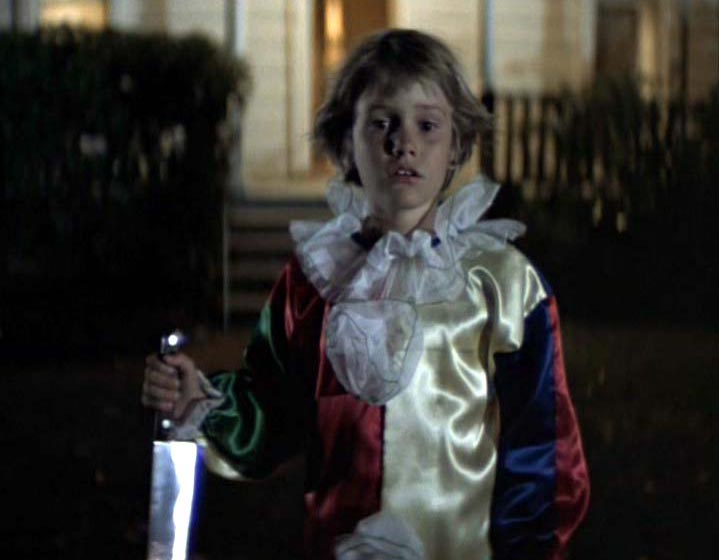
Halloween opens in the small town of Haddonfield, Illinois on Halloween night, 1963. Utilizing a wide angle lens, the camera tracks slowly toward a home in which we see a teenage couple making out before they steal away upstairs. The shot continues, passing around the side of the home and through the rear pantry. We already realize we are in the midst of a single-take point-of-view shot before we see a hand reach for a knife to the side of the camera. With the shot continuing, we wait as a teenage boy slinks out the front door. With the young man gone, we recommence with our movement up the front staircase. For a second time we see a hand, a child's hand, reach in front of the camera and grab an object - in this case a mask which shortly will transform the camera's visual field. Mask on, we enter the room of a beautiful naked teenager who scolds "Michael" as she stares at the camera. Seconds later he plunges the knife into her soft flesh as we continue to share his perspective. Leaving the room he heads down the same staircase and out the front the door where a man and a woman address him in the same way as they stand curbside. Carpenter's camera then reverses for the first time, showing a costumed little boy holding the bloody knife.

The film then jumps ahead to 1978 (its year of release) where we see a Doctor (Donald Pleasence) and his nurse en route to a parole hearing for the child killer, the one and only Michael Myers. Arriving at the asylum that holds the twenty-something (Tony Moran) - Dr. Loomis insists that he is beyond recuperation - we see a group of patients in white coats mulling around in pitch black near the side of the road. Momentarily, a visually-obscured Myers succeeds in stealing their car, which he will drive back to Haddonfield just in time for Halloween night, 1978.

With Myers back in the small Illinois town, Carpenter's often mobile camera, coupled with the menacing, if simple electronic score that the director himself likewise composed, provides the spectator with the unmistakable feeling that the film's on-screen subjects are constantly being watched. While cinema as an art form commonly trades on the impression that the viewer is watching life captured unawares - with a camera whose presence in space is typically effaced; that is, the players in the on-camera drama could never see the camera as in some theoretical sense it is presumed not to actually exist within the space of the narrative - here, our watching of the on-camera actors parallels that of the killer's. As such, Myers often crosses in front of the threshold of the camera, filling one of its corners with his back, or looming deep in the distance behind the actors. In this way, Carpenter succeeds in investing the majority of his picture with this voyeuristic quality. It is not simply that we could be sharing the killer's point-of-view but rather their unawareness that they are being watched, which therefore places them in danger.

Specifically, it is three teenager girls who are targeted by the maniacal murderer: Nancy Kyes's Annie, P. J. Soles's Lynda and most famously, Jamie Lee Curtis's Laurie, in her career-defining debut. Both Annie and Lynda endeavor to fool around with their boyfriends over the course of the evening. Annie is delayed when she spills food on her clothing, forcing her to strip on screen, before tossing her outfit into the washer. Lynda, however, succeeds, participating in a passionate bit of love-making on-camera with her young lover. On the other hand, Curtis's Laurie is stuck watching the children, and even when Annie does land her a date for the upcoming homecoming dance, the former protests vociferously after Annie tells Laurie's date of the latter's attraction for him. She seems to be in no rush to join her friends in their sexual activity.

It is significant, then, that only Laurie survives in Halloween: in fact, like Annie and Lynda, Myers's older sister is similarly sexually active, appearing like the others on-screen - and therefore before Myers - topless. Whether it is simply fate, for which Laurie provides a definition during class, even as Myers lurks outside the window, or it is her unwillingness to participate in the same behavior as the others, the fact remains that she is the only young woman who is saved from Myers. Importantly, she is also the lone young actress who does not appear topless on screen, even as he seems to stalk her with the greatest degree of vehemence. She does not receive the punishment of the young women who do display themselves unknowingly for Myers and knowingly for the audience. In this way, Halloween's sexual politics are definitively post-sexual revolution. Sex is punished.

This is not to argue that we don't share a certain complicity with Myers: obviously, the on-screen display of these young women is intended for the viewer; and again, we often share in the killer's visual point-of-view. (While Halloween references Carpenter's master Howard Hawks and particularly Thing from Another World [1951, dir. by Christian Nyby and produced by Hawks] it is Alfred Hitchcock and specifically Frenzy [1972] that appears to be the more direct point-of reference.)

Speaking of which, it is precisely the director's handling of this formal element - namely, point-of-view editing - that distinguishes Halloween as a work of unalloyed artistic importance. Beyond the astonishing opening sequence-shot, Carpenter routinely uses a shot/reverse-shot structure to facilitate the suspense that imbues the work. In particular, on countless occasions we see Myers somewhere in the background, lurking in the shadows quite literally; Carpenter then cuts to the person, most often Laurie or the young boy she babysits, looking on in terror. Upon the second cut, in shot after shot, Myers disappears.

Halloween closes like it begins - with exceptional bravura - though in the case of the ending it is sound rather than sight through which Carpenter's secures his tour-de-force. Here, after being pumped full of numerous rounds by Dr. Loomis, Myers's corpse disappears after a second reverse. Following this final implementation of Halloween's key stylistic motif, Carpenter shows us a series of empty, shadow-filled and dimly-lit interiors and exteriors accompanied by the sound of Myers heavy breathing behind his mask. In this one stroke, Carpenter tells us his bogeyman could be anywhere, while of course setting the stage for Halloween II.

For further reading, including whether or not to bother with any of the sequels, see Matt Singer's earlier Termite Art appreciation. Based on his recommendation, I think I'll stop my exploration of the Halloween films with the first.

Sunday, August 12, 2007

New Film: Colossal Youth

Pedro Costa's Colossal Youth (Juventude Em Marcha, 2006) recently concluded its ten-day Manhattan run as the season's most improbable über-small scale art house sensation. In some distant recess of the cinematic universe, Colossal Youth may just be the film of the year - that is as the latest and in many senses the most extreme instantiation of a European filmic minimalism that seeks to reinvent the language of the medium wholesale.

Colossal Youth opens with an extreme long framing of a Portuguese slum as furniture is tossed from a second floor window. In the next shot we see an aged immigrant woman, standing on a staircase with knife in hand, as she discusses swimming in Cape Verde as a younger woman. Like the prior take, Costa's camera doesn't move; in fact, with very few exceptions - a tilt here, and pan there - the director's camera never moves. It is only later that we will piece together that the woman presumably stabbed Ventura (played by an actor credited only as Ventura) who as the film proceeds will serve as our guide to the narrative.

As Colossal Youth unspools, Ventura moves between his former slum home, the new government flats built to house the former location's residents and even the makeshift housing that protected Ventura and a mate upon their 1972 arrival in Lisbon. In each of these places, save for the last, Ventura visits one or more persons that he refers to as his children, even when their physical appearance - to say nothing of the stories they narrate involving their biological parents - militate against the old man's claims (with the exception of the blind Bete). Regardless, Ventura's mobility provides Costa's minimal narrative with its structure: as a series of conversations and interactions between the lead and his under-class children.

This is to say, in the most conventional of senses, that nothing happens in Colossal Youth. In those instances that there is drama - when for example Ventura is stabbed (the opening image is an inversion of sorts as its long shot composition and presentation of action will be absent thereafter) or when Vanda's (Vanda Duarte, In Vanda's Room) sister dies - Costa's on-screen narrative, the image has excluded these incidents. Colossal Youth, in other words, is a narrative of interstitial fragments; we see a very small segment of the story Costa tells. In other words, Costa limits his narrative.

In a word, limitation is the operative principle behind Colossal Youth: whether it is the film's eschewal of action or more conspicuously, Costa's remarkably constricted framing. Throughout Colossal Youth, in fact, Costa reduces his frame to an excessively shallow space with one or two figures almost ubiquitously before a wall, a window or in a doorway. Maintaining this extraordinarily restricted framing, light enters the frame obliquely, detailing the edges of the shadow-engulfed figures. It is not only that Costa shows us an extremely small space but that even this fragment is often dominated by shadows: again, this is a cinema of infinite limitation.

Perhaps more than any other moment in Colossal Youth, this theme is highlighted in Ventura's inspection of his new flat. Here, Costa includes a door that continually swings shut, dictating that even in this potentially volumetric space Ventura will be restricted. He can never escape his social status, which along with everything else in Costa's film is worked out in spatial terms. Ultimately, the film's formal limitations match the social status of the film's heroic group: this swath of Lisbon's poorest class is removed to isolated corners of the slums and later to public housing once the former is raised.

Off-camera sound also proliferates, calling attention to the limitation placed on the mise-en-scène: the space utilized in the film, like the disclosure of narrative information, is severely limited, even as it continually refers to that which is not presented on screen. Costa is creating an art out of the scantest of means, thus confirming cinema's infinitesimal position within the broader cosmos. In this way, Colossal Youth is very much a film about the relationship between art and life, which is likewise established in the gap between the film's non-professional, Costa regular performers and the roles they play. When Ventura repeats the words of a letter time and again, we are reminded of this distinction.

In the end, Colossal Youth is above all a work of exceptional rigor, producing a form to match its content, whether it is the limitations noted above or in an experience of time to confer the banal subject.