Sunday, February 26, 2006

Current Exhibitions: Goya's Last Works & Edvard Munch: The Modern Life of the Soul

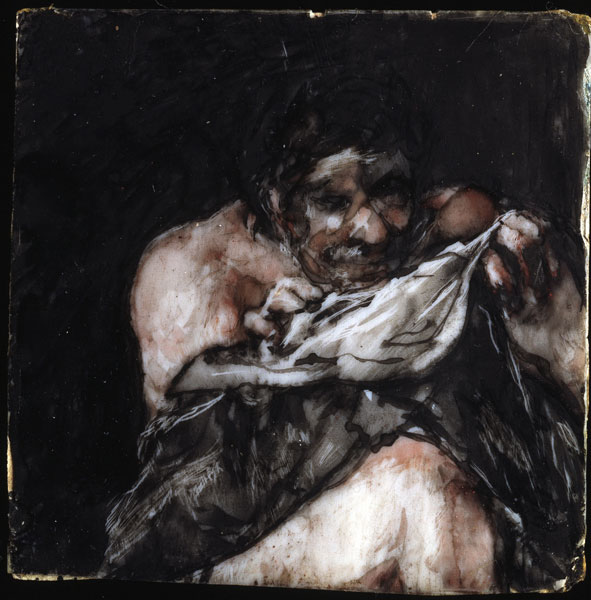
Goya's Last Works, running now through May 14th at the Frick on New York's Upper East Side, is the first exhibition in this country to focus exclusively on the final phase of Francisco de Goya y Lucientes' career, and particularly on the work he did while in exile in Bordeaux, France during the mid-1820s. This is to say that the work on display largely follows his famed Black Paintings-cycle, wherein the characteristic grotesqueness and violent spirit of his work comes into sharpest relief (as in the signature "Saturn") -- given the spare settings and the unrepentant horror of these creeping later masterworks. The Bordeaux cycle, to be sure, particularly picks up on the latter characteristic, especially in the crayon sketches featured at the Frick, which showcase the genuinely humane dimension of the artist's vision, as his retinue of beasts, convicts, lunatics, witches, the infirmed and the elderly gain not only representation but indeed humanity in spite of their ugliness (such as with the "Man Looking for Fleas in His Shirt"; 1824-5, water color on ivory). Of course there is still social critique (as in "Man Killing Monk," c.1824-8) and perverse humor ("To Eat a Lot," also c. 1824-8, which portrays a gentleman crapping) evident in these remarkable sketches.

Visually, Goya's paintings of this period (which, for this exhibition, include the wonderful "Self-Portrait with Dr. Arreita" [1820] on loan from the Minneapolis Institute of the Arts) eschew spatial depth in the same fashion as the Black Paintings, though few match the chromatic darkness of that marginally-earlier cycle. If there is a key to the portraits that Goya limned in southwestern France, it would seem to be (as my girlfriend Lisa Broad, a film scholar as it happens, observed) in his individual depictions of their mouths -- just as the key to Rembrandt's portraiture is in his handling of his subject's eyes. In both, it is possible for us to perceive an entire internal universe, though one might say in Goya's case it is more personality whereas with the Dutch master that universe is the soul.

Regardless, whenever one has the opportunity to see a large number of Goya's -- even in smaller shows such as the Frick's -- it is hard not to conclude that Goya was indeed the most purely talented painter to emerge between Vermeer (if not Velazquez and Rembrandt) and Cezanne. His was an art that looked to Velazquez in particular, but which imprinted his own internal tumult and social vision on an art that humanized often the most inhuman of subjects. As his friend Antonio Brugada once said of him, "[he] had never been able to imitate anyone," and by the time of this final phase, "he was too old to begin."

In contrast to Goya's unique idiom, the picture of Edvard Munch that emerges from the Museum of Modern Art's Edvard Munch: The Modern Life of the Soul is of a deft imitator who conveyed a singular vision only in the interstices of his lengthy career.

A cursory survey of the MoMA's expansive showcase would seem to indicate that Norway's most famous painter borrowed extensively from Manet, Whistler, Seurat, Sargent, Klimt, Gauguin, Ensor and Van Gogh (in particular), among others. Yet, Munch was capable of distinguishing himself as a gifted depicter of fin-de-siecle unease, anguish and even despair, as with his Death in the Sick Rooms-cycle, and with such masterpieces as the aptly-titled "Despair" (1892), "Moonlight" (1893) and especially the singular "The Storm" (1893; from the MoMA's permanent collection) where a gale-wind messes with a bride, hands to face, and the formless figures of her bridal party who imitate her gesture. It is in pieces like these that Munch's perspective is clearest, finding its formal expression particularly in their pale quality of light, their insistence of hard, mannered gesture and the indistinct duplication of human features that mark these works. If, in the end, we see works like these -- and the exhibition's structuring absence, "The Scream" -- as exceptions rather than the rule for Munch, then the importance of a show like the MoMA's can be easily interpreted: in portraying Munch as the artist he actually was, not in the artist a few spare masterpieces would have led us to believe.

Tuesday, February 21, 2006

Best Picture Nominees

The past couple of years, the Academy of Motion Picture Arts and Science has done a better than average job selecting those films which will compete for a 'best picture' Oscar. In 2003, remarkably, the AMPAS chose five relatively deserving titles, including my favorite for that year Clint Eastwood's Mystic River. Last year, they nearly duplicated that mark, selecting only one not-so-good title, Ray, alongside four more-or-less deserving films (with the year's best picture, Eastwood's Million Dollar Baby, actually winning top honors, for once).

Anyway, the AMPAS has demonstrated over the past couple of years that they do in fact have some insight -- some as they did chose the terrible A Beautiful Mind (2001) and Chicago (2002) as best pictures for their respective years. With their nominees for 2005, however, it is back to that earlier dark age -- even if they mercifully passed on Ron Howard and Rob Marshall's 2005 banalities. Okay, so two of the five films nominated are of above average quality, while numbers three through five are different shades of bad.

What follows are my brief assessments of the five titles, listed in descending order of preference. Beneath these is a second list of ten films which I would prefer to any of the five titles selected by the AMPAS to compete for the best picture Oscar, including the least offensive of this year's spate, Capote.


Bennett Miller's Capote is sustained by this year's flashiest (and to my mind best) male performance, Philip Seymour Hoffman as Southern novelist, wit and raconteur Truman Capote. Miller films the script's über-tight exposition in a startlingly unfussy, classically-sound manner, which at the same time offers some sense of the elegance of the film's predominantly Midwestern landscapes. But again, the performance is the thing here, as is the admirable complexity with which Miller paints his often un-heroic lead.

George Clooney's Good Night, and Good Luck. is easily the most visually flamboyant of the five nominees, shooting the Edward R. Murrow biopic in the sort of gorgeous high-contrast black-and-white that one is more likely to associate with the previous decade of American cinema. Never mind this, Clooney actually demonstrates an interest in style which is nearly approximated by the graceful cool of his performers, particularly by David Strathairn as Murrow himself, in a performance worthy of the actor's nomination. If Good Night, and Good Luck. doesn't quite match Capote in the former's ambiguity (if not integrity) with which the subject is depicted -- Clooney doesn't hesitate to canonize his hero -- the film's evocation of atmosphere (in the very broadest sense) nearly makes up for this shortcoming.

Ang Lee's Brokeback Mountain may well walk away with the hardware this year, as much one suspects for what its defenders would like it to say rather than for what it actually says or how it says it. This is not entirely the fault of Brokeback Mountain, which whatever happens on Oscar night, will remain a missed opportunity in genre revisionism (not that anything more should be expected of professional opportunist Lee). Ultimately, Lee's film is little more than a visually-flaccid examination of half-baked sexual pathologies, notable less for their supposed emotional depth than for the incomprehensibility of the structuring relationship. If Lee was indeed so keen on profaining the American Western, he should have attended more to its semantics.

Steven Spielberg's Munich should give the director's more vehement bashers enough ammunition for the rest of their natural lifetimes. How any thinking person could believe that this will do anything to heal the Israeli-Palestinian rift -- which Spielberg claimed on-record -- is unimaginable.
To do so, they would have to digest the morals of a narrative that builds its case upon the psychology of a hired assassin whose internal state has been willfully perverted for precisely this narratological reason (as Eric Bana's character is improbably wracked with guilt while he attends to the business of avenging the cold-blooded murder of his countrymen). Of course, human psychology does not exactly seem to be Spielberg's strong-suit, what with his ascribing of post-tramatic event syndrome to a character that didn't experience said occassion (most spectacularly, moreover, during one of the worst sex scenes in recent memory). Add to this the year's most heavy-handed -- and cloying -- conclusion and Spielberg would seem hard to beat in the category of worst 'best picture' nominee of 2005.

But for Paul Haggis' Crash, which is not only the worst of the five nominated films, but also the worst American film I have seen in the past twelve months. Granted, I am generally successful in avoiding contenders for honors such as this, but that said, there is something truly awe-inspiring to Crash's atrociousness. If you've seen Munich, think of the absence of any subtlty in the final scene and then apply it to an entire script and you begin to approach what Haggis is doing in Crash. That's just part of what you get with Crash, which when its not trading on this or that racial stereotype, offers such moments of understated elegance as Matt Dillon's Oscar-nominated black-hating cop who ends up rescuing the same African American woman from a burning car that he had molested earlier in the film; Sandra Bullock's perpetually angry white woman, who is helped after a terrible fall by the same minority maid who up to this point had been quite often the object of her tyrades; and most astonishing of all, the Islamic store owner who targets the wrong Hispanic gentleman for vandlizing his store and in the process shoots the latter's daughter... who nonetheless survives because of the forsight of the store owner's older daughter. That a film this bad could be under consideration for the title of the year's best invalidates any organization that would make this case -- as it seems to validate the auteur theory: surely Million Dollar Baby (which Haggis scripted) is Eastwood's genius after all.

Had the AMPAS been interested in recognizing truly deserving work,
they would have cited any one of the following ten films above the five they did in fact choose: Christopher Nolan's Batman Begins (deserving of its cinematography nomination); Andrew Adamson's The Chronicles of Narnia: The Lion, the Witch and the Wardrobe; David Cronenberg's A History of Violence (easily the year's best English language film); Harold Ramis' The Ice Harvest; Phil Morrison's Junebug (Amy Adams should win in her supporting category); Woody Allen's Match Point; Robert Rodriguez and Frank Miller's Sin City; Noah Baumbach's The Squid and the Whale (hopefully will walk away with the best original screenplay trophy); Tommy Lee Jones' The Three Burials of Melquiades Estrada; and David Dobkin's Wedding Crashers.

Thursday, January 26, 2006

Shigehiko Hasumi: An Appreciation

The first time I encountered Shigehiko Hasumi's writing was in a volume on Japanese master Mikio Naruse, which he co-edited for the Filmoteca Espanol, on the occasion of an exhaustive retrospective of the director's work at the San Sebastian film festival. The volume, half in Spanish, half in English became something of a sacred text to me, having just discovered Naruse's work through the writings of Philip Lopate. As much as I owe to the latter for the discovery, it was Hasumi's glorious prose however which helped me to appraise Naruse as one of the cinema's very best directors. Hasumi's approach in this writing might be best understood as disclosing a matrix for viewing the auteur's cinema that conformed to much larger questions of medium specificity. In Naruse's case, Hasumi traced a lineage of simplicity from Griffith through Ford and Godard: the first posited that cinema was comprised of a man, a woman and a gun; the second, a man, a woman and a horse; Godard, a man, a woman and a car; and finally with Naruse, cinema had reached its base of simplicity with a man and a woman, or more accurately, a man, a woman and light. It thus became Hasumi's task to illustrate those moments which reveal this essential state in cinema throughout Naruse's work. (For this reason he found particular value in 1940s curiosity, The Song Lantern).

My second encounter with Mr. Hasumi -- actually that's professor, and not only professor, but dean of Tokyo University; indeed, a number of his students have gone on to become great directors such as Kiyoshi Kurosawa -- was for a panel discussion on the art of Yasujiro Ozu for the director's centenary in 2003. At this event, which also featured Robin Wood, Tom Gunning and a number of other film studies big shots, Hasumi gave one of the most compelling and off-beat presentations as he examined Ozu's women through the gesture of tossing down articles of clothing (and particularly their husband's). In so doing, he revisited the opinion that his was a socially conservative cinema, while delving into a concern central to the medium's particularity: namely, the gesture.

Interestingly enough, Prof. Hasumi returns to the throwing gesture in his latest Rouge essay "John Ford, or The Eloquence of Gesture". Here, he supposes that the essence of that master can be found in that same gesture, while again enlivening his auteur study with a deeper theoretical inquiry into the essence of the art. This is the best film essay that I've read in a very long time; it is indeed the sort of prose and analysis that should serve as a model for all aspiring film scholars and critics -- I know it will for me. In simply reading it, I found my own avocation elevated to a level which it rarely attains.

Monday, January 23, 2006

New Film: Looking for Comedy in the Muslim World & Match Point

I am an Albert Brooks fan. A big Albert Brooks fan. To me, Modern Romance (1981), Lost in America (1985) and Defending Your Life (1991) each rate among the best American comedies of their era, with Real Life (1979) and Mother (1996) not far behind. The lone dud in his corpus is his 1999 Sharon Stone-vehicle The Muse, which even I will concede doesn't qualify as a good film, quote-endquote.

After seeing the trailer for Brooks's latest, Looking for Comedy in the Muslim World, and learning of Warner Brother's unceremonious dumping of the picture onto its independent label, I worried that Brooks perhaps had made something roughly equivalent to his earlier failure. I am pleased to report that Looking for Comedy... isn't the unmitigated disaster I had feared. Okay, so it isn't a great film either, but all things considered, Looking for Comedy... is a minor success for a director whom many would seem prepared to toss on the ash heap of film history. Sure, Looking for Comedy in the Muslim World is minor Brooks. But the mere fact that it is still an ambitious, intelligent comedy while holding that distinction confirms Brooks as a major American film artist, in spite of his small output. In other words, even minor Brooks can be quite good.

The premise of Looking for Comedy... is compelling enough: an American council, headed by Fred Dalton Thompson, has selected Albert Brooks to travel to India and Pakistan in order to learn what it is that makes Muslims laugh (as a first step in developing an understanding of that Byzantine culture). Okay, so he wasn't exactly their first choice, but they did eventually chose him -- and with the inducement of the "Medal of Freedom," for which Brooks is more than a little excited, he's sold. Plus, it's not exactly like Brooks has been working a lot lately.

In fact, Looking for Comedy... trades on this suggestion that Brooks is a has-been, who is now best-known for voicing Nemo, not for his brilliant directorial work. Having said that, Brooks's work in Looking for Comedy... remains nothing if not ambitious, as he challenges the new orthodoxy of our overtly-political present: is the US's problem that it does not better understand the Muslim world? Ostensibly, Brooks's answer seems to be that for better or worse, any cursory attempts at such an understanding cannot yield the intended results -- leading the film to its clever concluding punchline. Indeed, it is in this final bit of humor that Brooks's concerns coalesce as we are instructed on the political implications of his post 9-11 endeavors (speaking of both the film and the project depicted by the film).

Yet, it is often less the political issues that guide Brooks in Looking for Comedy... than it is the autobiographical elements of the persona that he has once again resurrected for the screen. That his project goes so horribly awry indicates not his self-pity but rather his self-deprecating humor, which it should be remembered largely separates Brooks from his East Coast counterpart, Woody Allen, and the latter's competing screen personality. Typically the punchline to many of his own jokes, here Brooks trots out his thirty year-old stage act to a confused New Delhi public, which hasn't nearly the familiarity with his smart takes on improv and ventriloquist routines that his jokes obviously demand. As a matter of fact, a companion of his later points this out to an affronted Brooks, who as always remains confident of his comedy's (and crowd's) intelligence.

Indeed, what we get yet again is an Albert Brooks unwilling to compromise his art -- he is offered an al Jeezera sitcom in which he would play the "Jew" in a Muslim apartment complex, to which he reiterates his refusal to do t.v. -- even if this means making a comedy which isn't always that funny. One might even say there is a certain avant-garde quality to Looking for Comedy... provided Brooks's willingness to describe himself on-screen as a has-been with comedy that is thirty years out-of-date. Then again, Brooks shows himself to be on the vanguard when it comes to addressing post-9/11 reality. In this, Looking for Comedy... hardly seems minor.

As I have mentioned, Brooks's natural filmmaking double has long been Woody Allen, whom I admire a good deal less, customarily.


Consequently, I found myself rather skeptical when I heard all the praise surrounding Allen's latest, Match Point. Having ultimately succumbed to the hype, let me just say that this is indeed Allen's best in quite some time -- perhaps the last equivalent work is his 1992 Husbands and Wives, which of course shares a mutual interest in marital infidelity and Ingmar Bergman. Without elaborating in too much detail or giving away too much of the plot, suffice it to say that Allen successfully weaves his operative metaphor (the tennis ball that could go over the net or fall back on one's own side in equal measure) into the narrative in an organic and I would say surprising way. Sure, he is tempted by his characteristic heavy-handedness here -- but so was his primary source for the film, Bergman, almost to a film -- but ultimately this sporadic failing detracts very little from what is ultimately an expertly narrated crime drama. If last year's atrocious Melinda and Melinda made me want to forget Allen's existence entirely, Match Point is a reminder that he can be a very good director -- even when his dialogue is hopelessly dated and his lead, Scarlet Johansson, is a black hole when it comes to charisma. What is really on display here is exceptional story-telling structure coupled with a clean, classical technique. Given the converging elements of Allen's pacing and plotting, the other player's uniformly strong performances and Johansson's rotten one, Match Point truly made me hope for its male lead's happiness, whatever that might mean -- think of Hitchcock's Frenzy (1972). What I will not give it credit for is an avant-garde, cringe-producing performance equaling Brooks's intentionally bad comedy. With that said, Match Point marks one of those rare occasions when Allen has been unmistakably better than Brooks. I guess that goes to show what he can still do when he stays out of the film and away from comedy.

Friday, December 30, 2005

The Year in Film


As much as a number of my colleagues seem to be convinced that 2005 was a great year for film-going, I remain somewhat unimpressed by the quality of new work which I saw during the previous twelve months. To say this is not to imply that there was a dearth of films worthy of mention as one of the year's best: I was reasonably satisfied with the quality of all ten films I mentioned for my Senses of Cinema ten best list which I submitted a couple of weeks ago, even before I saw an eleventh which I feel definitely deserves mention (which I will in my 'top 11' to follow). However, it is my belief that there has been noticeably few all-time great films released in the past three or four years. Put another way, I would say of the half-dozen or so best films that have been made since the conclusion of the 90s, only one was made after 2001 (and that was 2002's Russian Ark). And concerning these masterpieces -- Yi Yi, Werckmeister Harmonies, The House of Mirth, In the Mood for Love, I'm Going Home, Mulholland Drive, Spirited Away, Russian Ark -- I'm not sure any (save the first) would rate with the half dozen or so best films of the previous decade, which were in a few cases were made by the same directors (Edward Yang, Bela Tarr, Wong Kar-wai, Manoel de Oliveira) who had made clearly superior films during the prior ten years.

All of this is to wonder whether we are beginning to find ourselves between generations of great filmmakers -- as we did, I would submit in the late 70s and early 80s before the Asian new wave which was ushered in by such talents as Yang, Hou Hsiao-hsien, Tian Zhunagzhuang, John Woo, Takeshi Kitano and Hayao Miyazaki. Perhaps my number one will prove to be the first great film by one of the next generation's greatest artists, Apichatpong Weerasethakul? Perhaps Lisandro Alonso and his Argentine cinema will become this decade's [early] Abbas Kiarostami and Iran? Perhaps Lucile Hadzihalilovic will experience a peak comparable to Jane Campion's in the early to mid 90s? Hopefully, 2005 will prove ultimately to be the beginning of something new, not the trough that seems from its final days.

Here they are, the eleven best films of 2005 (1-10 in order of preference, plus an 11th not in order):

Tropical Malady (Apichatpong Weerasethakul, 04)
2046 (Wong Kar-wai, 04)
The Sun (Aleksandr Sokurov)
A History of Violence (David Cronenberg)
Los Muertos (Lisandro Alonso, 04)
Innocence (Lucile Hadzihalilovic, 04)
Three Times (Hou Hsiao-hsien)
L'Enfant (Luc & Jean-Pierre Dardenne)
Kings and Queen (Arnaud Desplechin, 04)
13 Lakes (James Benning, 04)

And the eleventh that I saw after my initial submission of the list:
Caché (Michael Haneke)

(For more detailed analyses of the best of these, see my annual annotated 'ten best' lists with a 2005 version to follow sometime next year.)


Then again, it was less the above films that truly rewarded my love of film this year than it was the rarely-screened silent, classical & post-classical Japanese pictures I saw as part of "The Beauty of the Everyday: Japan's Shochiku Company at 110," "Early Autumn: Masterworks of Japanese Cinema from the National Film Center, Tokyo," "The IFC Center's Weekend Classics," and "Naruse: The Unknown Master." For this cinephile, 2005 was the year of classical Japanese film in New York. It is only fitting that the best of these celebrated its fiftieth anniversary this past year.

Here are fifteen of the best:

Floating Clouds (Mikio Naruse, 55)
Humanity and Paper Balloons (Sadao Yamanaka, 37)
Boy (Nagisa Oshima, 69)
Wife! Be Like a Rose! (Naruse, 35)
Sound of the Mountain (Naruse, 54)
Mr. Thank You (Hiroshi Shimizu, 36)
Scattered Clouds (Naruse, 67)
Late Autumn (Yasujiro Ozu, 60)
The Whole Family Works (Naruse, 39)
Ornamental Hairpin (Shimizu, 41)
Flowing (Naruse, 56)
Every Night Dreams (Naruse, 33)
Women of the Night (Kenji Mizoguchi, 48)
Our Neighbor Miss Yae (Yasujiro Shimazu, 34)
Japanese Girls at the Harbor (Shimizu, 33)

Monday, December 12, 2005

New Film: Brokeback Mountain & The Chronicles of Narnia: The Lion, the Witch and the Wardrobe

Over the past two days, Ang Lee's gay-themed western, Brokeback Mountain, has been named the year's best picture and Lee best director by both the New York and the Los Angeles film critics circles. Add to these honors record-setting box office (per-screen for a live action film) and the only thing that appears to stand between 'Brokeback and an Academy 'best picture' statuette seems to be a giant ape. If Lee's film therefore seems to represent the latest blue-state victory in America's on-going culture wars, it is a success predicated upon the [well-groomed] middle-brow sensibilities of America's urban tastemakers. Not so much a film for the masses, Ang Lee sets his sights on the mass of elites for whom prohibitions on gay marriage smack of being today's equivalent of Jim Crow.

This is to neither praise nor damn Brokeback Mountain, even if much of Lee's support would seem commensurate with the film's political stance. The quality (or lack, as in this instance) of Lee's film rests in its negotiation of the terms of its generic origins. This is to say that Brokeback Mountain's ultimate failures can be traced to its inadequate engagements with the western and queer cinema. To the first, in particular, it is worth observing that Brokeback Mountain fails to employ landscape in any fashion other than for its ability to give two lovers cover for their illicit affair. In this way, Lee eschews the pictorial and iconographic values of the western landscape in exchange for narrative expedience. While this alone does not preclude 'Brokeback from taking its place among the canon of westerns -- Rio Bravo (1959, Howard Hawks) for instance uses a similarly indescript space as per the director's programmatic artlessness -- Lee combines this visual imperviousness with a glibness towards the geographic West manifesting itself in Anne Hathaway's teased hair and her Texas farm implement magnate father's insistences that a young boy must watch football if he is going to ever grow up to become a man. All of this is to say that Mr. Lee shows no affection for the setting of his film.

However, lest it be said that Brokeback Mountain is not fundamentally a western, as apparently the director has claimed, Lee does hold to the basic homo-social structure of the genre (at least for the film's first half). Indeed, 'Brokeback proceeds according to the suggestion that the ties of fraternity which play such a defining role in the history of the genre are irreducibly possessed of a latent homosexuality. In so doing, Lee does not so much revise his genre of choice as underscore its political deficiencies (just as Far From Heaven [Todd Haynes, 2002] indicates a need to revise Sirk which frankly I don't see). Ultimately, it is easy to see why Lee decided to make a film in a genre for which he has little regard in a geographical location he likes even less: because it allows him to score easy points with his middle-brow crowd; this is a film made to make those that agree with it feel morally superior.

At the opposite end of the spectrum, Andrew Adamson's The Chronicles of Narnia: The Lion, the Witch and the Wardrobe offers red-state safe, mass entertainment in a richly sketched, lovingly-crafted space which is already well-known to millions of young readers. As a former reader of the 'Chronicles myself, let me attest to the justice that Adamson has done to Lewis' children's classic. Indeed, I would use that last word, "classic," or better yet instant children's classic, to describe the results of Adamson's adaptation. One can imagine that this version of the beloved first volume will introduce future generations to Lewis' stories, while giving its many readers the satisfaction of seeing Lewis' world come to CGI life.

Of course, The Chronicles of Narnia are no less imbued with a perspective than is Lee's film; nevertheless, Lewis' (and now Adamson's) Christian allegory allows its viewer a space that is absent in Brokeback Mountain. Surely there is Aslan, the Christ-figure, who dies for the sins of the young Edmund (in betraying his siblings for the fleeting pleasures of Turkish Delight) before rising again to liberate the people of Narnia from eternal winter; and certainly there is the faith of young Lucy which offers a prototype for Christian faith. Yet, there is also the pagan iconography of Lewis' and Adamson's world and its unmistakable critique of fascism (its World War II setting, Narnia's secret police force) which allow for separate readings -- quite unlike Lee's propagandic denunciation of society.

Yes, those with a penchant for the Christian faith will see Aslan's suffering servant as a propitiation for the children's and possibly their own sins, while those without will encounter a narrative filled with wonder and magic -- quite literally. Part of this magic, to be sure, rests in the performances that Adamson summons from Tilda Swinton (there will never be a more perfect White Witch) and the children, particularly Georgie Henley as Lucy Pevensie. Indeed, it is the wonder and the pathos of her performance that truly sustains Adamson's Narnia -- a wonder shared by anyone who has fancied themselves to be Lucy or Susan or Peter or even Edmund.

It is curious then that it is in Lewis' tale that we find characters who are flawed but whom ultimately attain redemption, and not in Lee's very grown up piece of Oscar-baiting, where no enlightened member of the audience is to blame. It is society itself, and one which is comfortably distant (in time and space) from its New York and Los Angeles advocates, which is at fault; would that they would have just allow these two men to be happy together -- and would that we might do the same today. To take my cue from Lewis and not Lee, let me just ask which is closer to the truth: is everyone else to blame or sometimes are we ourselves at fault? And if society was as we would like it, would the attainment of happiness be a simple matter of knowing ourselves?

Thursday, December 1, 2005

New Film: The Ice Harvest

Entering the final month of 2005, it has suddenly become clear to me just how atrocious this past eleven months have been for new American cinema. Aside from Canadian auteur David Cronenberg's masterful A History of Violence and German madman Werner Herzog's Grizzly Man, it seems reasonable to me that the modest virtues of Harold Ramis' The Ice Harvest may just make it the second or third runner-up on what is thus far a dismal list (save us Brokeback Mountain and The New World). Indeed, it is only the former that will figure on my year end's top ten list, not that that says anything for the relative quality of Hollywood. For 2002, for instance, I would not include a single American-financed film among my ten best (though again there is a Cronenberg film, Spider) even if I could name perhaps a half dozen very good films which I prefer to everything but A History of Violence and Grizzly Man this season. The point in this is that one, much of the best of world cinema happens outside the U.S.; and two, usually we fare quite a bit better -- Hollywood-wise -- than we have in 2005.

So, yes, if you've confined yourself to Hollywood pictures this year, by choice or circumstance, you most likely have convinced yourself that there are no good movies out there... and largely, you're correct.
However, as I have said, there are modest virtues to be witnessed in the John Cusack-Billy Bob Thorton headliner, The Ice Harvest, which opened nationwide last week to below average reviews and an indifferent public -- judging by the poor box office. What critics and audiences have missed in passing over the über-cruel comedy cum neo-noir is this year's most extravagant reinterpretation of genre, in this case the Christmas film, even if the Ramis-helmer may at times seem like Bad Santa (2003) redux or a Coen Brothers retread.

In the Groundhog Day director's favor, however, is what might be judged to be the fuller reversal of genre (even if it can't equal Bad Santa's wicked pleasures) and the more generous picture, as it avoids the condescension of the Coen's, however nihilistic Ramis' perspective may be. The point is that The Ice Harvest operates according to a spatial logic that catalogues those places that Christmas movies tend to elide -- bars, strip-clubs... okay, lots of strip-clubs, etc. -- and a set of details that seem to cut against the holiday's mythical grain, be it Oliver Platt's Christmas Eve binge-drinking and subsequent purging, Thorton's porn video and even the (freezing) rainstorm itself, which Ramis snidely and economically introduces during the opening credit sequence with a few drops falling on a nativity Christ child. These are people and places which exist -- on Christmas just as they do anytime else -- but typically have no place in your typical Christmas movie... and rightfully so, one could argue.

Nevertheless, Ramis' Bad Santa set-up (which is surely the epochal film in this sub-subgenre) gives way to a Fargo (1996) or A Simple Plan (1998) without the accents -- or more importantly, given that we are talking about Witchita and not Minneapolis, the snow.
Consequently, Ramis reminds us of his postmodern street-cred by giving us another generic mash-up, just as he presaged Pulp Fiction a decade earlier with his experimental Groundhog Day-time structure. Still, it is less the director's adept generic/tonal shift than it is the cohesiveness of his heterocosm that marks The Ice Harvest as noteworthy new Hollywood cinema. The very fact that The Ice Harvest engages our sense of narrative expectation, let alone the rigor of its conceit, provides its anomaly in the wasteland that has been 2005.