Indisputably the movie of the present moment, though perhaps not entirely of its moment, Christopher Nolan's Inception is even more, and more importantly, the film of its writer-director's career, distilling Nolan's thematic concerns, style and signature narrative constructions within its single, "A"-picture shape. For good or ill, and it is indeed both, Inception contains all of Nolan's cinema - often not simply through allusion, but in visual citation as well - construed in a form that intermittently engages with the digital-age cinematic medium. Ultimately, it is on this last level that Inception proves of greatest interest to this piece's writers, at once extending the late 1990s, early 2000s engagement with the ontology of the analog-digital hybrid, while staking the director's place on the personal-impersonal artistic continuum.
In this latter respect, Inception joins David Fincher's own recent career-peak Zodiac (2007) in favoring its maker's effacement, albeit in a form subsumed by subjectivity, rather than by Fincher's comparatively fact-based approach. In Inception, Nolan introduces the question of the artist's place in the incursion of artist-surrogate Leonardo DiCaprio's memories into CillianMurphy's dream world - where the aforesaid seeks, along with his colleagues, to implant an idea at the behest of Ken Watanabe, Murphy's Far East corporate rival. (Following in the pattern of Memento [2000], Inception introduces the concept of the idea as "virus," as an all-consuming contagion that remakes the individual.)As DiCaprio's dead wife, Marion Cotillard, comes to disrupt her husband and his co-conspirator's work of inception, and with the couple's children more benignly present on repeated occasions, Nolan constructs a narrative where the personal not only challenges but in fact threatens to destroy the work of creation at hand. In order to successfully implant the idea, to create Murphy's recollection ex nihilo, DiCaprio is forced to resist his own traumatic past - his subjectivity, in other words.
In more straightforwardly psychoanalytic terms, trauma proves formative for Nolan's latest, where the director's leads mine progressively deeper into human interiorty, seeking those secrets that are quite literally, in the film's science-fiction world, locked away within vaults. In its exploration of a repressed past, Inception particularly recalls the filmmaker's retrospectively cardinal psychoanalytic prequel, Batman Begins (2005), as it does DiCaprio's previous pairing with Martin Scorsese, Shutter Island(2010); DiCaprio himself seems in the incipient stages of establishing his own authorial voice. Batman Begins also generates one of the more obvious citations in Inception, with the former's Tibet set-piece returning as a cite of Freudian extraction. On the other hand, the director's behemoth box office follow-up to said reboot, The Dark Knight (2008), proves most formative for the low-key visual design of Nolan's current feature: The Dark Knight's warm golden light once again radiates through Inception's mahogony-paneled interiors. Present likewise is the 2008 film's reliance on a Griffithian form of cross-cutting, which in Inception, as in Peter Jackson's capstone to his 'Lord of the Rings trilogy,' The Return of the King(2003), sets a new standard in its activation of multiple, simultaneous narrative stages. This trio of contemporary blockbusters accordingly signals a return of Hollywood's repressed feature-film origin, The Birth of a Nation (1915).
Inception, however, adds a new dimension to the technique, thanks to its multiple dream-within-a-dream scenarios, each of which possess their own temporal schemas. Thus, an extended battle sequence in one dream-scape occupies the same relative story duration as a van's drop from a lift bridge. In this regard, Nolan again returns to the American cinema's original master, whose cross-cutting once pitted a cross-town traversal in The Drive for Life (1909) with the time it would take to raise a single piece of poisoned candy to its heroine's lips - in both Nolan's and Griffith's work, a Hollywood ending ensues. Of course, Inception explains its adoption of proto-classicism's temporal distensions through its science-fiction conceit; Nolan naturalizes Griffith's improbable last-minute rescues. Inception's narrative structure, like The Prestige's (2006) subject matter, returns to cinema's relative nascence.
The Prestige similarly proves a precursor for Inception's fable of the ontological loss of innocence, where the original sin of the copy begins the work of robbing the individual of his or her sense of reality. In the director's current work, the infinite regress dovetailing from waking life invites a skepticism that at least in one instance proves fatal. In this sense, Inception offers an allegory for the cinema not simply within the present digital age, but also inclusive of its proto-chemical mode. Still, Inception does belong meaningfully to the digital and new media moment, presenting a world that is wholly created, however uniformly photo-real, while also adopting video gaming's logic of immersed multiple lives. Consequently, Inspection repeats the narrative pattern instantiated previously by David Cronenberg's eXistenZ and the Wachowski Bros.'s The Matrix (both 1999), albeit from within rather than on the threshold of the digital revolution.
Writer-director Pedro González-Rubio's Alamar (To the Sea, 2009), one of the past year's unequivocal festival-circuit breakthroughs, pursues the same unmarked path between documentary and fiction as another of these writers' favorite 2010 New York premieres, Lisandro Alonso'sLa libertad (2001). In González-Rubio's seventy-three minute feature, as in Alonso's similarly undersized debut, the narrative focuses upon the rituals of its non-fiction leads within a rural Latin American backwater. Unlike in La libertad, however,which Alonso grounds in his protagonist's work environment, Alamar centers on Jorge Machado (as himself) as he travels on holiday with his young son Natan Machado Palombini to the Chinchorro-reef Caribbean home of his father, played by Nestór Marín. Hence, Alamar presents its human subjects, save for the grandfather, in a world that is removed from their typical daily habits, though Jorge is clearly conversant with his father's routine. Alamar thusly concerns itself within an exceptional moment in the lives of father Jorge and son Natan, as they vacation together before the latter returns to be with his mother in Rome - and even of Nestóras he receives his absent son and grandson - rather than with the everyday monotony that characterizes La libertad.
Indeed, it is Alamar's externally imposed spatio-temporal unity - its holiday, or idyll structure - that lends it a sense of fictionality. However, the events contained within these loose narrative boundaries seem to unfold with a kind of naturalistic grace that feels entirely unconstrained. While La libertad consciously privileges the messier, more elemental aspects of man's relationship with nature, positioning itself at the mythical apotheosis of neo-realism, Alamar strips away the rough edges of subsistence living, creating the kind of shimmering, romantic lyricism that Robert Flaherty sought among the natives in Nanook of the North(1922). Not coincidentally, then, La libertad, despite its eminent naturalism, somehow feels more fictional than Alamar's Edenic ethnography.
If Alamar therefore injects less ambiguity into the relation that it procures between fiction and non-fiction, it nevertheless captures its real-world spaces not in conventional 16 or 35mm, but in a DV that ratchets up the film's gorgeous sea-green waters and pink sunsets to an almost preternatural degree. González-Rubio's intense daylight features significant bleaching, thereby providing a canvas upon which the circling scavenger birds appear about as real as the namesakes of Alfred Hitchcock's The Birds (1963). The director's camera work likewise follows its leads as they take their trade underwater, capturing the vibrant, undersea life of the world's second largest coral reef. As Michael Mann's Miami Vice (2006) and Nuri Bilge Ceylan'sClimates(2006) have before it, Alamar's breathtaking vistas reveal the digital cinema's unique, medium-specific capacity to exquisitely render both sea and sky in a profusion of vivid color and fine-grained detail that seems almost on occasion to exceed the real.
If the film's landscapes provide a poetical excess of beauty, its representation of the process of fishing endows an often painstaking and patience-trying trade with a fantastic sense of ease and pleasure. In Alamar's magical realist universe, each cast of the fishing line almost instantly brings in a gleaming, exotic fish, just as every dive concludes with a ruddy, oversize lobster. The fruits of the catch invariably provide rustic cuisine of the highest order, which again is very different from the pot that La libertad's lead returns to daily, or to the armadillo from which he gleans a very perfunctory meal. In this respect, as in the film's varying depictions of labor - Alonso's film discloses nothing if not the banal details of its lead's very small-scale logging operation - Alamar proves to be an almost anti-La libertad, despite the two films' immediate similarities. Where the earlier work emphasizes the labor performed by its subject, thereby proving ceaselessly ordinary, however novel it may be to many viewers, the later is anything but, erasing the hardships of the work in a world that verges on becoming fantastic. In other words, while the Sisyphean labors of the La libertad's man-in-nature come to take on a mythic cast, Alamar presents a kind of ultra-masculine fairy-tale.
To this latter end, the film's trio occupies a home constructed on stilts over the turquoise water, with a crocodile circling beneath the structure in search of scraps. (In a moment reminiscent of film theorist André Bazin's description of the danger posed to a child in the 1951 British film, Where No Vultures Fly, Natan does get perilously close to a crocodile at one point, with the child's father and grandfather causally, laughingly warning the young boy as they sand their gleaming white boat at the water's edge.) An ibis that they nickname "blanquita" not only visits their home repeatedly, becoming something of an ersatz pet to the child, but is even trained by Jorge to wait patiently for a handful of food. There is something perfect about the world they construct apart for these two weeks; the film very much veils itself in their fond recollections of the vacation.
Of course, Alamar does depict a very transient moment in their lives, before they will once again separate, with the child returning to his mother in Italy. (The film opens with black-and-white footage and then voiced-off stills that detail the family's current estrangement.) Jorge has a very small amount of time with his son, which he makes the most of by tenderly holding the seasick child on his lap as they first travel to the house on the sea and when they wrestle under the hammocks that they sleep on nightly. If Alamar does offer a sort of paradise for the film's three male generations, it is a momentary one only, one that will conclude before the film's seventy-three minutes.
The writers of this piece would like to thank R. Emmet Sweeneyespecially for his strong and insistent recommendations of both Alamar and La libertad.
Receiving its New York premiere this past weekend in conjunction with the just-completed 2010 Robert Flaherty Seminar, Argentine filmmaker Lisandro Alonso's La libertad(2001), the 1975-born director's first feature, provided a fit course for international modernist art cinema in the years immediately following the Abbas Kiarostami-dominated 1990s. With Kiarostami redrawing the boundaries delimiting fact and fiction from Close-Up (1990) onward, La libertad emerges as a sensible extension of the aforesaid's ontological interest, providing a work that is properly speaking neither fiction feature nor documentary. La libertad's grounding in the factual - its non-professional lead performs actions belonging to his daily ritual - insures that this is not fiction filmmaking as it is conventionally defined, while the film's lack of explanation equally argues against its status as documentary. If anything, La libertad suggests a form of semi-fictionalized cinema that is separated from more traditional fiction film by the gulf of non-fiction; in specifying so little, La libertad becomes something other than the non-fiction that a description of its scenario might suggest otherwise.
After the black and red credits and heavy industrial-style scoring that have since become a discordant signature of Alonso's, La libertad opens on Misael Saavedra as he performs the tasks of a lumberjack: the young male fells trees, stripping the bark off the dead trunks with his forearms pulled tight as he flicks the steel blade against the thin outer layer. The viewer can almost feel the vibrations of the axe handle that accompany the thud of the blade as it catches in the thick trunk. Alonso's camera remains fixed on Misael, often in longer compositions and extended duration takes, as he repeats the same practice on a number of the locale's leafless trees, both fallen and standing, before leaving for the shade of his camp and a meal from an iron pot. Once he finishes, pushing the remnants of his lunch back into the same pot, Misael leaves his shaded exterior, covered by a sheet metal roof that also provides its waist-high fencing, the film's subject lies in the dark of his exposed bedroom with his gaze directed outside his makeshift hut.
At this juncture, Alonso's camera peels off from his lead, moving independently to a wire fence that closes off an adjacent field. As such, Alonso intimates the presence of his own narrational position within the film, separating subject from apparatus for the remaining duration of the take. Upon the conclusion of this visual diversion, Alonso returns to Misael who subsequently meets a man and his son after they pull up in an empty pickup truck. After loading the flatbed, Misael rides on the bare logs, with his hand resting on the neck of a panting dog. Throughout this sequence, Alonso awakens his viewer's sensory memory, calling to mind the smooth textures of the logs covered in fine sawdust, the warmth of the animal's neck and its angular shoulder bones. In this way, La libertad prefigures Alonso's outstanding recent Liverpool(2008).
Ultimately, Misael continues on alone in the truck, finally reaching a rural lumberyard where he sells the object of his work - below the price that he seeks initially. Having concluded his sale, he purchases gas and supplies at a petrol station, before returning finally to the same improvised homestead. Building a large bonfire, Misael sits staring into the camera - thus again enunciating the film's apparatus - which accordingly reenacts the shot that opened the film before the loose narration commences in earnest with the lead's work. In this respect, Alonso invites the viewer to consider the film's depiction of work as routine, as a repeated set of gestures carried out before the film begins and after the picture concludes. Here again Liverpool comes to mind. In total, La libertad constitutes a form of cinematic portraiture, procuring an abundant sense of Misael's daily life, featuring not simply the actions performed on the job - though this does constitute the majority of the film as it would presumably Misael's waking life - but also the tactile sensations of these experiences and even those acts that are typically elided from feature and documentary filmmaking alike, whether it is riding in and driving the truck, preparing his meal (including his very ethnographic butchering of an armadillo, a scene that is essentially replayed in his masterpiece Los Muertos; 2004) or even defecating as he crouches toward the bottom of the frame. In this latter instance, the viewer hears though does not see said act, which Misael prepares for by clutching sheets of tissue paper in his fist. La libertad in sum seeks to comprehensively portray what Misael's life is like as he lives alone in the film's isolated rural setting.
Indeed, it may just be the solitary character of Misael's existence that provides the film with its most distinctive quality. The great majority of Alonso's seventy-three minute feature frames Alonso alone, where, save for his singing of a single song, he remains silent. The film itself, though it features an abundant ambient soundtrack, which attracts the viewer's attention as much as does the image track, likewise trades on Misael's silence, with the additional exception of the passages at his homestead where he turns on his hand-held radio. Alonso thusly identifies the experience of being alone as a silent one, where the viewer gradually becomes aware of Misael's lack of speech and the need for communication that will manifest itself in his moments spent listening to his radio, his brief conversation with the gas station worker, a phone call to a friend and even to his song declaimed as he crosses the field in late afternoon.
By comparison, writer-director Rolf de Heer's Ten Canoes(2006), co-directed by Peter Djigirr, which like La libertad premiered in the Un Certain Regard section of the Cannes film festival, abounds with speech, featuring a voice-over in English depicting the events occurring in not one but two pasts of increasing remoteness from the opening's present. In the first of these historical settings, an on-screen narrator (David Gulpilil) tells the same extra-diegetically told story in Aborigine to his fellow tribesman (Jamie Gulpilil), whom he suspects of coveting his wife. The story told on-screen is intended therefore as a parable for the young man, with the same actor playing his earlier, covetous counterpart. As Ten Canoes proceeds in its telling of this story, the filmmakers frequently shift between the film's two pasts and at times even the present, featuring black-and-white for the earlier past and color for the both the present and more frequently the distant past. While there is an inelegance to de Heer and company's visual choice in this respect, their strategy does at least insure maximum intelligibly. Indeed, Ten Canoes' non-sequential narrative structure is not adopted to disorient the film's spectators.
Rather, de Heer and his fellow filmmakers utilize multiple temporalities in order to provide a historical framework for the stories being told. Specifically, Ten Canoes pursues a form for the representation of its Aboriginal people's oral history, in this case literally passed down from the past depicted in the black-and-white to the present, with narrators at both historical stages sharing the same story. In this regard, Ten Canoes represents a remaking of film language no less than does La libertad's poeticsub-documentary narrative minimality, through a form of incessant narration that almost completely eschews mimesis (the act of showing rather than telling); in this sense it is the very opposite of La libertad that shows everything and provides no commentary. Instead, de Heer and company's film uses its image track to illustrate both the story being told twice - a mark of another major direction in twenty-first century modernist art cinema, as instantiated by the works of Hong Sang-soo and Apichatpong Weerasethakul - and also the ethnographic details, the spectacle articulated by the off-screen narrator that emerge throughout the goose egg hunt on which the on-screen narrator shares the film's oral history.
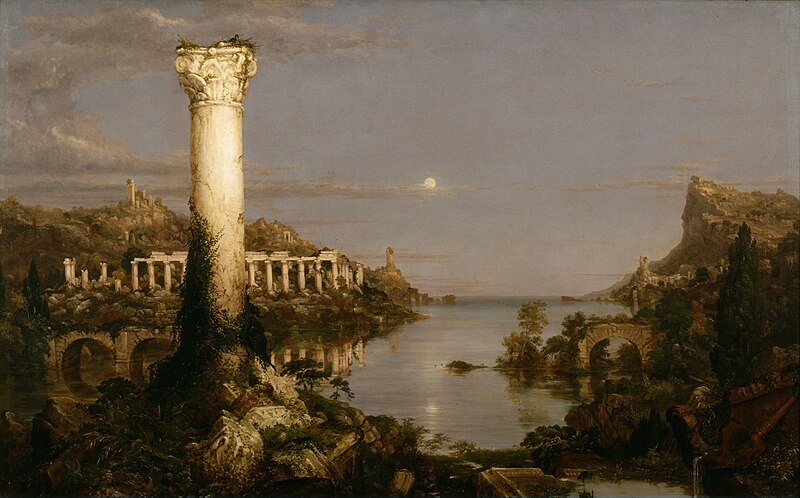
In his essay “Thomas Cole: Landscape and the Course of American Empire,” written for the National Museum of American Art’s 1994 exhibition “Thomas Cole: Landscape into History,” Allan Wallach argues for a “mythic-historical narrative” in the artist’s landscapes.[1] According to the author, “this narrative… unfolds in three stages: in the first, there is the wilderness untouched by European culture (Kaaterskill Falls); in the second, white settlements and outposts appear (The Hunter’s Return); finally, the wild terrain of the frontier is transformed into pastoral or Arcadian landscape (View on the Catskill).”[2] Moreover, “each stage implied the next. The trackless wilderness would be explored, cleared, and settled; log cabins would be built only to be replaced by prosperous farmhouses.”[3]
By the time of Andrew Jackson’s election as the seventh President of the United States in 1828 – and the first to bare the mantra of Democrat singularly – each of the three above phases were clearly manifest in the historical transformation of the North American continent. So too were the first and second scenes from the artist’s 1834-36 “The Course of Empire.” Of course, it would take an additional five-plus years of Jacksonian democracy to draw out the “deep-seated historical pessimism” that was visible in the third through fifth panels of this same monumental artifact – and which would characterize his later landscape works, including those mentioned within the previous ‘mythic-historical’ program.[4] With ‘The Course of Empire,’ Cole’s attitudes toward Jacksonian democracy and “utilitarianism” were made unequivocal: each would “lead the nation to disaster.”[5] Consequently, no Cole landscape painted on either side of this grandiose cycle could be interpreted thereafter without being measured against it – whether it was the pre-Arcadian and Arcadian views of a Pre-Jacksonian America or the more apocalyptic scenes that culminated in Desolation (see below).
A second cycle hints at a different transformation in Cole’s view of the world, which nonetheless was just as shaped by the exigencies of Jackson’s America. By the middle 1830s, Cole began attending St. Luke’s Episcopal Church in Catskill.[6] According to biographer Louis Legrand Noble, Cole commenced church member shortly after his return from Europe in 1842, the same year he painted his deeply religious set of four panels collectively titled “The Voyage of Life.”[7] Hence, Cole’s turn toward organized religion coincided with the “increasingly religious temper of the Jacksonian period,”[8] and specifically with the Second Great Awakening, which dominated American religious life into the late 1840s.[9]
The Course of Empire: Desolation (1836)
Further, it was in this same period that Cole “came to see in Christianity’s promise of individual salvation a personal resolution to society’s seemingly unresolvable crises,” as would be exemplified for instance in ‘The Course of Empire.’[10] To quote Wallach once again, “from then on his interest in religious issues grew rapidly, while the social and historical concerns that animated his art during the 1820s and 1830s diminished or disappeared.”[11] The vine covered ruins of a decimated civilization were replaced within less than a decade by a castle in the sky.
If it is possible therefore to compose a narrative whereby Cole first responded to the problems posed by Jacksonian democracy and then by those highlighted in the Second Great Awakening, the question remains what precisely were the issues or concerns that confronted Cole in the few years that preceded the election of President Jackson. Indeed, one might even ask, and perhaps one needs to do so first, whether Cole became a critical artist on the occasion of America’s transformation following the election of Jackson, or whether this tendency – in whichever way it might have been directed – was already present in this earlier phase of the painter’s career? In other words, might Cole have experienced a third period prior to the rise of Jackson and the Democratic party in 1828?
The subsequent essay addresses this question by considering two of Cole’s works in greater detail, The Clove, Catskills and Sunny Morning on the Hudson, both of which date to 1827 (and both of which are reproduced below). In each of these two canvases, a middle-ground mountain face, cast in shadow, bisected by a second mountain or set of mountains, obstructs the spectator’s view onto an expansive valley rendered lower than the paintings’ chosen point-of-view. In my reading of the works, however, Wallach’s social and historical narrative fails to account for the peculiarity that is manifest in these canvases. In fact, the genesis of the following piece was the simple question why does Sunny Morning on the Hudson look the way it does? Hence, this essay intends to answer that question above all others.
In so doing, I will also ask whether Cole’s subsequent work offers any clues to interpret these seemingly obscure, historically-transitional works (that is from a Federalist to a Jacksonian America), in much the same way that ‘The Course of Empire’ inflects the political content of Cole’s other landscapes. Moreover, I will trace the semantics of the above move, emphasizing what it means to leave hidden significant portions of these spaces, by eliciting comparisons especially to Cole’s disciple Frederic Church. I will begin however by creating a baseline for Cole’s pre-Jacksonian corpus with his works of 1825-27.
Lake with Dead Trees (Catskill) (1825)
1825-1827: Cole & Claude Lorrain
As Wallach has indicated, Cole “from the beginning of his career… frequently employed the conventions of pastoral or Arcadian landscape, long associated with Claude Lorrain, for portrayals of rural scenery.”[12] The author cites the example of an 1826 “view” of William G. Featherstonhaugh’s estate, where the artist “employed a basic Claudian formula in painting a serenely horizontal composition, with a single framing tree, in which sheep – the sine qua non of pastoral landscape – graze placidly in a newly cleared pasture overlooked in the distance by Featherstonhaugh’s country mansion.”[13] Indeed, this formula characterizes many of the artist’s earliest canvas. To this end, Cole painted a second landscape, View near Catskill (1827), which similarly figures a group of three grazing sheep on a small grass and pebble covered incline before a placid pond. Likewise, there is the instance of the painter’s even earlier Lake with Dead Trees (Catskill) (1825), where Cole substituted deer for the later canvases’ sheep: the buck on the left is caught staring to its right, its figure framed by three separate fallen trees that form a triangular shape around the animal, whereas its companion trots off to the right in front of the perfectly still, earth-toned pool. In short, Cole was procuring a profoundly Federalist vision of America, represented in a picturesque mode, which in instances such as the Featherstonehaugh canvas “centered on the preservation of aristocratic privilege and traditional property rights.”[14]
Still, it is essential to affirm the role that identity-formation played in these earliest canvases. As Wallach points out, the “taste for landscape,” not more than thirty years old in the Americas, was the sole purview of the aristocracy of the time.[15] As such, Cole, who “had learned to think of himself as a gentleman… whatever his actual circumstances, his belief was unshakable,” would have found an avenue of social-mobility in these canvases.[16] Under the serenity of Claude, the painter’s master and the artist he would later crown “the greatest of all landscape painters,” Cole could create works that befitted his Federalist patrons’ tastes as well.[17] In other words, as expressive as these works are of a particular ethos, it might be just as possible to read these earliest canvases as efforts in imitation that nonetheless found an audience and launched the artist’s career. That is, they represent Cole’s desire to become an artist, even a great artist, more than they do his vision of social and historical circumstances. Only later, with the explicit critique of his post-Jacksonian corpus, does it become clear that Cole is creating out an effort to summarize the political landscape – and in its case the decline of the American civilization. For the time being, the American republic seems more secure.
River Landscape with Apollo and the Cumean Sibyl (c. 1655)
1827: Cole and Salvator Rosa
Importantly, Cole’s work would soon bare a greater resemblance to that of Salvator Rosa, marking the painter as an inheritor to the tradition of the sublime rather than to the Burkean beautiful of Claude: to this end, Wallach points out that “during the 1820s Cole was considered the ‘American Salvator’ in recognition of the extravagant sublimity of many of his early landscape paintings.”[18] However, when Cole himself saw the painter’s work in his 1832 visit to Italy, he claimed to be “disappointed:” “Salvator Rosa’s is a great name… he is peculiar, energetic, but of limited capacity comparatively.”[19] In fact, it was precisely at this time that he affirmed his belief that “Claude, to me, is the greatest of all landscape painters: and, indeed, I should rank him with Raphael or Michelangelo.”[20] Not surprisingly then it was “during the 1830s… when a new tranquility began to manifest itself in [Cole’s] art, [that] he became the ‘American Claude’ – or as one writer put it, ‘our ‘American Claude.’’”[21]
Yet to return to the possibility of Salvator’s inspiration on Cole’s art, which appeared obvious in contemporary judgments of the painter, the American-based artist’s two mountain-centered compositions of 1827, Sunny Morning on the Hudson River and The Clove, Catskills, do seem to confirm the comparison. Once again, in each, the spectator’s view of an expansive flat field, well below the adopted point-of-view, is obstructed by a mountain or set of mountains that fill the image’s near middle-ground, even as they are in part or in whole cast in deep shadow, thus reducing the detail of this facing landmass. Similarly, Salvator’s River Landscape with Apollo and the Cumean Sibyl (c. 1655) positions a mountain mass in the furthest recesses of its right foreground, thereby occluding the path of the river which snakes behind this geological formation. As if to highlight this obstructed space, Rosa introduces small swaths of yellow around the outer edges of rock and upon the water itself. As such, the spectator is cued into reading this hidden space as the point of origin for a light source that is only hinted at within the composition proper. In a sense, the most visually dramatic component of the landscape – a sunset over the serpentine river – is denied to the spectator. Rather we are given intimations of a phenomenon that is far more visually resplendent than the one which the painter has depicted.
So too has Cole chosen to eliminate the most spectacular vantage in exchange for an image that is far less awe-inspiring, particularly in its orientation of the viewer’s point-of-view to the landscape. Of course, Salvator’s painting frames a mythological exchange within the setting in much the same way that two more of Cole’s canvases from the same year treat a historical scene within a space that denies its spectator the most dramatic possible vistas. The first of the two historical panels, Scene from “The Last of the Mohicans”: Cora Kneeling at the Feet of Tamenund (see below), commissioned by Daniel Wadsworth, represents an assemblage of the eponymous tribe on a stone platform hanging above a deep precipice.[22] Behind this found proscenium – and a pair of shadow-covered rock outcroppings that back the platform – the landscape again falls significantly. As such, Cole has adopted a point-of-view – in its case, the viewer is positioned above the platform – which once again denies the most dramatic vantage onto this locale, while also greatly reducing the detail and therefore the narrative legibility of the distant middle-ground figural assembly. In other words, Cole’s choice of vantage denies both a clear view of the drama rendered on canvas and also of the dramatic landscape above which these persons hover.
Cole’s other major historical landscape of 1827, Landscape Composition, St. John in the Wilderness, which was purchased by Wadsworth as well, similarly utilizes a rock out-cropping to stage a fictionalized historic encounter. In its case, the platform is divided into two elevations: on top of the first, a single figure points to a lone cross; a golden afternoon side light hits this higher elevation, the figure and cross. Below, a series of figures look above to the evangelist, presumably, occupying the shrub-covered rocky promontory. Palm trees extend from the edge of this platform, and line the spot-lit valley below, exoticizing Cole’s fictional Israel.
Scene from “The Last of the Mohicans”: Cora Kneeling at the Feet of Tamenund (1827)
Visually, this promontory again blocks the viewer’s vantage onto the valley beneath the theatrical grouping, though our point-of-view is in this case beneath the platform. Then again, the tops of trees emerge beneath the spectator’s imaginary position, securing a placement that seems to hover in mid air. As with Scene from “The Last of the Mohicans”: Cora Kneeling at the Feet of Tamenund, Cole has dispensed with the ground-level perspective of Salvator, thereby violating “traditional prohibitions against rendering a view from a high vantage point,” as the artist would do even more famously in 1836’s The Oxbow.
By comparison, both The Clove, Catskills and Sunny Morning on the Hudson River occupy positions on the ground of their respective landscapes, though in the case of the latter it is a position close to a rocky cliff’s edge, perpendicular to a shadow-covered mountain. Moreover, there is a stone ledge at the edge of the cliff that compares to the rocky platforms in the historical paintings, though it is a rocky promontory in The Clove that appears closer to the mythic landscapes. In both, these geological figures are lit theatricality – that is the exact source seems to exceed the canvas’s natural lighting – as is also the case with the natural platforms in Landscape Composition and Scene from “The Last of the Mohicans.” However, absent the human subjects of the historical compositions, this choice of lighting marks the platforms the artist has chosen not to adopt, the more dramatic views that have been denied the spectator.
Parenthetically, it should be noted that this feature of a rock platform appears in a third figure-less canvas from the previous year, Mountain Sunrise (1826). In this work, which in some sense offers a template for the more radical Sunny Morning, Cole has figured a free-standing rock ledge in the deep middle-ground of the composition, highlighting its tip and the facing stone cliff with the same sort of theatrical lighting that appears in The Clove and especially Sunny Morning. In the background, behind a shadow-covered wooded mount, the day begins to break, producing a yellow light that spreads across the horizon and infuses the clouds that bracket the sunrise with a pinkish tint. Here, as we will see in Sunny Morning, the subject of the sunrise is removed from the spectator’s view.
Sunny Morning on the Hudson (1827)
Sunny Morning: Connoting the Un-Visible
What we do see in Sunny Morning is the shadow-darkened face of a rounded, evergreen-covered summit, crowned on the top and encircled to the right by cottony cumulus fingers. In both places, Cole directs our attention around the edges of the geological figure to the sunny front face of a valley that of course we can never reach. On the other side of the mountain, we can see the light brightened horizon, thus confirming that indeed the object of the picture’s title – the sun in the morning – is located outside our view: both behind the mountain, and to the left of the image itself. Ironically, our position is figured at precisely the place where we can least experience the eponymous subject of the art work. Rather, we are given a theatrically-lit, natural viewing platform in the foreground and a mountain face opposite the illumination just beyond. It is behind this seemingly misplaced viewing platform and the occluding mountain that the film’s dramatic content resides. Indeed, Cole’s panel is a remarkably dark rendering of the subject of morning light.
So what than can be made of Cole’s decision to deny his spectator the view of the Sunny Morning that his title announces? Why are we made to view a mountain cast in shadow from close up, rather than either the phenomenon signified or the expansive space over which this event is occurring? While Cole’s debt to Salvator must be noted, certainly this lineage does not tell us everything we wish to know, particularly again as Salvator’s compositions at least figure foreground mythical subject matter, making his blocking geological figures backdrops – even as they imply a segment of the world depicted that remains beyond our vision. Again in Sunny Morning and The Clove (to a lesser extent, perhaps) all that remains is the obstruction, this portion of the world not seen.
Then again, it is worth noting the connotative value of the object selected to complete this task – the mountain – for the artist. According to Noble, in comparison to Niagara specifically, mountains for Cole “were symbols of the eternal majesty, immutability and repose, which no cataract could ever be.”[23] The author continues:
The mountain, with a fullness of might in itself, is yet mightier as one of an innumerable brotherhood, in each of which you behold an image of everlasting repose – from its summit can escape into the infinite, and upon the perpetual rocks hear voices from the bosom of inwrapping clouds, talking of the presence of the Almighty, and say, with both a lowly sense of your own present littleness and restlessness, and a lofty sense of your immortality and final rest, “it is good to here.”[24]
In a word, the mountain figures presence, but even in more ‘as one of an innumerable brotherhood.’ It is at once an aesthetic object in its own right, engendering contemplation and appreciation; and at the same time, the mountain acts as an interface, a place of meeting between the physical and metaphysical, upon whose summit one can ‘escape into the infinite,’ and upon whose ‘perpetual rocks [one can] hear voices of inwrapping clouds, talking of the presence of the Almighty.’
This latter metaphor of the ‘inwrapping clouds, talking of the presence of the Almighty’ seems particular apt a description for Sunny Morning’s mediating function, inasmuch as they lead us from the mountain, from its eternal, unshakable presence, back to the absence, to the un-visible rather than the invisible – that is, to a world whose existence is manifest, but outside the represented universe of the painting. With these ‘inwrapping clouds’ encircling the conical object, as with the river whose course the same figure obscures, we are assured of a presence that we simply cannot see. In short, the mountain generates meaning doubly: first, as a signifier of God’s presence in his creation; and second, as a figure of obstruction, of an object blocking a world not seen but one that most certainly exists.
The Voyage of Life: Manhood (1842)
“The Voyage of Life:” Making Visible the Un-Visible
While this representation of a world not seen repeats in many of the artist’s canvases, it is perhaps even more significant – as it reveals the scope of Cole’s interest in the subject – that the artist moves to make visible this unseen world in his second major cycle, “The Voyage of Life” (1842). Again, deeply religious in both subject matter and tone, Cole completed this cycle at roughly the same time he began his church membership. Here, supernatural presence unequivocally enters Cole’s canvases: an angel with a glimmering halo accompanies the infant in Childhood; the same figure points the way to a heavenly city in Youth; with the human figure in Manhood kneeling in supplication, the same ethereal guardian looks down from heaven (even as further figures are rendered in the gray clouds above); and in Old Age, this guardian reappears with a second to presumably lead the everyman to his new home in the light.
Therefore, the physical and the spiritual have come to occupy the same pictorial space in this series of highly allegorized landscapes. Whereas The Clove and especially Sunny Morning suggested the Divine in its representation of the figure of the mountain and in the un-seen reality that object obstructs, ‘The Voyage of Life’ leaves nothing to implication. There is in this latter series of canvases an unwillingness to be mistaken, and for its religious content to go unnoticed. The world hidden to our view in the former compositions here becomes the ‘cloud-built palace’ as Cole himself described it.[25] In fact, to this latter point, it is not simply that Cole reduced the ambiguity in his landscapes, but that he produced descriptions of each of the scenes, so as to leave none of its meaning up for debate.[26]
Furthermore, ‘The Voyage of Life’ depicts an interventionist God: here, heaven and earth remain in constant communication, be it in the mediating presence of the Guardian Spirit – both with the child, pointing the way to the heavenly city, listening to the prayers of the endangered protagonist or leading the way to the other world – or once again in the combination of physical and metaphysical spheres in a single space. And as the white-waters of Manhood have given way to the calm pool of Old Age, the heavens seem to answer the man’s prayers. By contrast, images such as The Clove and Sunny Morning fail to embellish the non-visible world they depict and to make visible what is invisible. God can be known through what he once made, not through his present intervention. If anything, the divine being of these early landscapes is fundamentally deist, while the God of ‘The Voyage of Life’ is active.
So while God is present in Cole from the first, it is only with his deepening devotion to the faith that the hidden is made manifest, that what has always been is now made clear and unequivocal.
A View of the Mountain Pass Called the Notch of the White Mountains (Crawford Notch) (1839)
The Hidden and the Horizontal in Cole
Importantly, the subject of an unseen presence does not entirely cease with Cole’s ‘Voyage of Life’ cycle. In his A View of the Two Lakes and Mountain House, Catskill Mountains, Morning (1844), Cole represents a lone figure in the lower left foreground, standing upon the bottom of two rock platforms. He gazes off toward his and the composition’s left, in the direction of the sun that illuminates the mountain face that bares the eponymous Mountain House. Likewise, on the right half of the composition, two long, narrow, parallel lakes extend toward and perhaps beyond the right edge of the composition. While the two arched trees on either foreground edge of the painting ostensibly frame this picturesque setting, the tree on the left reinforces the direction of the human figure’s gaze, leading the spectator’s off the canvas toward the unseen. A real place beyond the canvas is conceived, and so therefore is a metaphor for the metaphysical.
The motif of the lakes on the right half of the composition is further picked up in canvases such as Catskill Mountain House: The Four Elements (1843-44; also post ‘Voyage’), where the same parallel lakes extend over the right edge of the canvas in a pair of powerful horizontal planes. This same horizontality is also evident, though implicitly, in the earlier A View of the Mountain Pass Called the Notch of the White Mountains (Crawford Notch) from 1839. Here the titular notch emerges at the base of a towering mountain face, between two lower sections of rock. The mountainous section on the right particularly stands out from the background stone inasmuch as the former is covered in green pines, while the latter is rendered in duller earth tones. Between these two geological formations, a strong horizontal plane extends to the right and eventually past the towering background mountain. Here we have a strong sense of a plane that we cannot see but whose presence is nonetheless manifest.
Crawford Notch in this way possesses more than a passing resemblance to View of Delft, one of the rate landscapes of a second seventeenth century artist, Jan Vermeer. In that artist’s atypical work from ca. 1660-61, once again the spectator is confronted with an occluding foreground rendered at ground level, and covered in shadows, which accordingly blocks the recessive planes of the city’s flat topography. Here and there snatches of the cityscape are visible between the facing structures, but largely the city remains hidden to the spectator. In a more conventional (for the artist) genre setting, a second composition secures a similar effect, 1870’s The Love Letter. In its case, the framing doorway both highlights the work’s human subject, and also renders space invisible before us. It works like the mountains or the front row of structures in Delft. Here, as in so many of the artist’s compositions, a strong sidelight breaches the space, thus calling attention to its off-canvas point of origin – or, once again, rendering real a world beyond our perception.
Twilight in the Wilderness (1860)
Frederic Church: Naturalizing Cole
While Vermeer’s work may be more analogous to Cole’s than it is causally linked, Frederic Church’s intimate connection to the older American landscapist is well-documented.[27] At the same time, it is a similar interest in making manifest the invisible that concerns both Vermeer and Church. In Church’s case, however, it is principally in the landscape idiom – in most cases naturalized, unlike Cole’s ‘The Voyage of Life’ or even ‘The Oxbow’ with its Hebrew script on the hillside in the far distance – that he achieves this end. Accordingly, one might look for example to Church’s 1847 Scene on Catskill Creek: in this canvas, Church presents the placid waterway framed on the left by a picturesquely felled dead tree and on the right by a tall, cropped deciduous. Along its left edge and low on the horizon, the sun is barely made visible. Nonetheless, its excessive luminosity infuses the right half of the image, thereby calling attention to this light source, and equally to the occluded and cropped space that the orb inhabits. Church is making known another reality, through both the mediating object of the sun and also the composition’s guillotine framing on the right side – where another world seems to seep into the frame. A more spectacular instance of this strategy can be found in Church’s Twilight in the Wilderness from 1860. In this canvas, we are once again provided a strong horizontal obstruction in the manner of the View of Delft and Crawford Notch, with the low-rising mountains blocking Church’s conspicuous horizon. Over the furthest range, the sun is barely made visible once again with a shimmering white light hugging the craggy peaks and a golden yellow radiating above the first hue. The illuminated world beyond the horizon, and indeed the heavens themselves, reaches into the landscape of Twilight in the Wilderness, entering through the sun’s orbital interface.
Then again, it is less in this recurrent motif than it is in the rich salmons and oranges that ordain the dark clouds that cut through the navy sky that the painting’s metaphysical presence is made clear. Church’s world shows God at his most aesthetic: he, instantiated on the horizon-line in a radiant glory, is the painter of this sky that Church faithfully depicts. It is as though this other world has broken through into the terrestrial world, passing through the horizon-bound point of intercession. Or, Church has exploded the obstruction itself, creating a world where the earthly and the divine commingle. And it is a world that is naturalized.
What is significant here is that Church largely follows the same trajectory as Cole, though they achieve roughly the same ends by different means. If both, early in their careers, utilize the same logic of obstruction and occlusion to indicate a world beyond what we see, their investment of this invisible in the pictorial space differs in the elaboration later in their respective corpuses: whereas Cole makes physical the metaphysical heavenly city, Church leaves the trace of the divine in the adornment of a natural world whose beauty far exceeds everyday phenomenon.
The Clove, Catskills (1827)
Conclusion
But what does this tell us again of Sunny Morning and its 1827 corollary The Clove? Simply that in Church, as in his inspiration Cole, each canvas negotiations the terrestrial and the extra-terrestrial, the earthly and the divine. These elements may be subsumed by other subjects, as with a later Cole such as The Oxbow, but they remain nevertheless keys – and perhaps the most important keys – to understanding each artist. After all, what can these paintings tell us of an America they largely refuse to depict? Again, considering the painters 1836 canvas listed previously, we would seem to have a clear contraposition of wilderness and civilization rendered on the left and right halves of the image respectively, with the Hebraic writing behind to provide the canvas with an added religious dimension. However, with Sunny Morning and The Clove there is no similar allegory for historical progress inasmuch as we are viewing a space at the same stage of un-civilization.
What we have instead is the religious rather than the political axis of Cole’s art taking precedence. To summarize, these canvases of 1827 give us the writing in the distance, an indication of the presence of the divine, stripped of the allegorical content in the fore and middle grounds. In the foreground of these works we have viewing platforms that are either not adopted (as in The Clove) or which generate a view that provides minimal impact (as in Sunny Morning). In the middle distance we have the occluding mountains, the makers of meaning in these works, the very trace of God that Cole makes so explicit thereafter, and the figures that nonetheless keep him hidden from view. And in this invisible background we have the creator of these mountains, indicated by a world we know to exist but which has been forever elided from our view.
[1] Allan Wallach, "Thomas Cole: Landscape and the Course of American Empire" in Thomas Cole: Landscape into History, ed. William H. Truettner and Wallach (New Haven: Yale University Press, 1994), 64. [2] Ibid, 64-65. [3] Ibid. [4] Ibid. [5] Ibid. [6] Ibid, 98. [7] Louis Legrand Noble, The Life and Works of Thomas Cole, ed. Elliot S. Vesell (Cambridge, Mass.: The Belknap Press of Harvard University Press, 1964), 252. [8] Ibid. [9] Sean Wilentz, The Rise of American Democracy (New York: W. W. Norton & Co., 2005), 266. [10] Ibid. [11] Ibid, 98. [12] Ibid, 70. [13] Ibid. [14] Wallach, "Thomas Cole and the Aristocracy" in Reading American Art, eds. Marianne Doezema and Elizabeth Milroy (New Haven: Yale University Press, 1998), 80-81. [15] "Thomas Cole: Landscape and the Course of American Empire," 28. [16] "Thomas Cole and the Aristocracy," 83. [17] "Thomas Cole: Landscape and the Course of American Empire," 70. [18] Noble, 125. [19] Ibid. [20] Ibid. [21] Wallach, 70. [22] Robert Gilmor commissioned a second, slightly smaller (25 x 31 in. to 25 3/8 x 35 1/16) canvas on the same subject which Cole completed the same year (1827). I have chosen to highlight the Wadsworth for its similarities to the St. John canvas that I have described subsequently. In any case the Gilmor composition features the same elision of the dramatic that is characteristic of the other two 1827 pieces. [23] Noble, 73. [24] Ibid. [25] Ibid, 215. [26] Reprinted in Noble, 214-216. [27] In a letter reprinted by Noble it even seems that he was to give Cole's son a drawing lesson. Ibid, 272.
Another highpoint in an exceedingly strong year for both the French cinema and female directors, Mia Hansen-Løve's The Father of My Children(Le père de mes enfants, 2009) fictionalizes the last days of French producer Humbert Balsan's life, with his filmic equivalent Grégoire Canvel (Louis-Do de Lencquesaing) taking his own life in the midst of the meltdowns of his finances and of a Swedish-based film production modeled in part on Béla Tarr's real-life shoot of The Man from London(2007); Tarr's film in fact precipitated Balsan's actual suicide.* For the viewer aware of the Balsan-Tarr connection, The Man from London perpetually hangs over The Father of My Children as a possible hermeneutic key that nonetheless never seems to explain Balsan/Canvel's act. The Man from London more significantly provides a perfect inversion of Hansen-Løve's retelling, with the former's long-take, luminous black-and-white camera work articulated for graphic effect and generic citation foremost, whereas The Father of My Children's natural light-infused color mise-en-scène and elliptic cutting proves subordinate to its filmmaker's storytelling and her character formulations; Tarr's film is pure application of style, in other words, while Hansen-Løve's is all humanity.
The film's tenderness emerges very early in The Father of My Children, with Grégoire calling home to speak to his wife Sylvia (Chiara Caselli), following a series of work calls that Hansen-Løve combines through a conventionally Gallic, elliptical cutting schema. Sylvia puts on their two younger daughters, Valentine (Alice Gautier) and Billie (Manelle Driss), who affectionately and jokingly converse with their greatly overworked father, who though exhausted, humors and goes along with the tangents of his daughters. Later that evening, following Grégoire's citation for speeding, the same two young girls stage a play for their mother, father and oldest sister Clémence (Alice de Lencquesaing); the latter reclines and rests her head on her father's shoulder, one of many moments of physical affection. With the play's monster playfully named for Grégoire, the film's male lead responds, again in jest, with a promise that his daughters will receive the spankings of their life, which he then offers hugging and wrestling his two delighted daughters. Hansen-Løve accordingly captures the authentic, loving rapport shared by members of the close Canvel family. In this way, the late twenty-something's accomplishment converges closely with that of her early thirty-something German counterpart, Maren Ade, whose Everyone Else (2009) similarly brings the lives of its singular protagonists into vivid existence. Both female filmmakers in particular show a heightened sensitivity for the feelings of their young female women, while reserving opacity for their male leads.
Indeed, The Father of My Children is similarly aided by its sketchy depiction of Grégoire's psychology as his suicide nears. The viewer is made aware of his severe financial problems - he receives word that his assets have been frozen immediately prior to his death - which again were most recently exacerbated by the overages of his genius Swede director Stig Janson (Magne Brekke), the film's Tarr equivalent. No more motive is articulated, though it would seem clear enough that Canvel's act followed from his sense that he had no way out of his financial straights, that his career's work was all but gone, as he cautions when it is proposed that he sell his catalog. Hansen-Løve, to her credit, does not push an interpretation of an action that though opaque is easy to identify.
That he acted in the wrong becomes immediately clear, however, whether or not his despair is understandable. Yet, the writer-director does not sentimentalize the experiences of Grégoire's four female survivors, whose grief and perseverance supply the subject of the film's second part. In so doing, the director constructs her narrative to match her persevering rhetoric with the picture's focus shifting from the eponymous male patriarch halfway through, to those whom he has left behind and for whom life must go on after his departure. The Father of My Children's content organically generates its form. At the same time, Hansen-Løve does extract maximal emotion impact from the suffering of Sylvia and her young daughters, inviting an extraordinary amount of pathos for the young victims of Grégoire's action; this again is a work of extraordinary humanity.
As The Father of My Children proceeds, sanspère, the female Canvel's grapple with Grégoire's death and especially their professed feelings of abandonment. Sylvia, in her husband's absence, is compelled to deal with his failing production company, and with the outfit's on-going difficulties with their Swedish auteur. Clémence, on the other hand, discovers an estranged son in her father's past, acquaints herself with one of his Central Asian filmmakers - played here by Tajik director Jamshed Usmonov - and, commensurate with her pre-adult liminality, has (presumably) her first sexual experience with another of her father's would-be young directors. His older two women, in other words, are forced to face up to his problems, while forging their own paths forward.
The Father of My Children thereby inscribes life's continuation after tragedy, the necessity of perseverance after human loss. To this end, Hansen-Løve's film continues to abound with singular, life-filled moments even as the family continues to mourn, as for instance when a sudden power outage forces the women and family friend Serge (Eric Elmosnino) out onto a city street, or when the younger girls insistently greet the workers at the now liquidated production company, before play-acting and searching through their mother's workspace. In the scene to follow, The Father of My Children closes as it has opened, with compositions of the Parisian streets cut with an upbeat musical refrain that serves as the film's literal epitaph: "que sera sera."
Correction [*]: Writing for theVillage Voice, Ella Taylor suggests the director is meant to invoke Lars von Trier and the production was his Manderlay (2005), even though other, earlier reviewers and interviewers have also suggested The Man from London as the source, as I have in this piece; in many respects von Trier's anti-humanism provides as compelling a counterpoint to Hansen-Løve's work as does Tarr's formalism. Perhaps then it would be more accurate to say that "Saturn" is a composite of these two productions.
For the American film viewer predisposed toward seeking out works of substantial artistic achievement - including, I would imagine, the full roster of this site's domestic readership - one's sense of any given year essentially begins in the middle of May with the first reviews issuing from that year's Festival de Cannes. For the same viewer, so long as she or he is fortunate enough to live within a commutable distance of New York or Toronto, the first arrivals from the Côte d'Azur will typically follow that coming fall, through each city's eponymous film festival, with their commercial runs occurring (when the film has managed to secure North American distribution in the first place) at uneven intervals over the next year-and-half-plus. If a viewer accordingly misses even one of the more universally lauded titles of the previous year - such as 2008's The Headless Woman or 2009's Wild Grass - it might mean a wait of at least a year before the titles begin their limited engagements (The Headless Woman opened in August while the latter will debut stateside in late June), let alone reach home video and on-demand platforms.
With the 63rd installment of the Cannes Film Festival set to conclude this weekend, a number of the best films 2010, if history is to be any guide, have just received their first screenings: candidates seem to include Apichatpong Weerasethakul'sUncle Boonmee Who Can Recall His Past Lives, Abbas Kiarostami's Certified Copy, Manoel de Oliveira's The Strange Case of Angelica, Cristi Puiu's Aurora,Xavier Beauvois'sOf Gods and Men, perhaps Jean-Luc Godard'sFilm Socialism; readers should assume that I will review at least the first three, hopefully in October after NYFF premieres, and that I may be infuriated by the last. In the meantime, in cinema as art terms, it remains 2009 for most American viewers, with Alain Resnais's Wild Grass and Mia Hansen-Løve's Father of My Children, among others, still forthcoming, along with our first comprehensive sense of 2009's Asian popular cinema, late June's New York Asian Film Festival. (At this juncture, the previous twelve months seem very light on superlative works from the world's most populous, and for a number of years now, our most filmically forward-thinking continent; I can only hope that the NYAFF will prompt a revision of this assessment.)
With 2009, therefore, still very much on my mind cinematically, as I wait for the new film year, I have recently returned to one of the better films of Cannes 62 and the previous year, Jane Campion's Bright Star (2009), for which I did not find the time or perhaps have the inclination to write about last fall upon my first viewing - Bright Star bucked the aforementioned trend in that it received an autumn 2009 release, while not being included on the NYFF schedule. That I might not have had the inclination follows in no small measure from the exceedingly bizarre circumstances of my first (preview) viewing of the film: the packed house of Yale undergraduates with whom I watched Bright Star laughed uproariously and inappropriately, at what I cannot even to begin to imagine, throughout the picture. Suffice it to say that if you have seen Bright Star, you are as baffled by that as I was. At the very least, the fact that the Yale Film Society could not in some sense handle Jane Campion of all people does not make me overly optimistic that future US film-goers will demand more timely theatrical releases of the finest in future art house features.
***
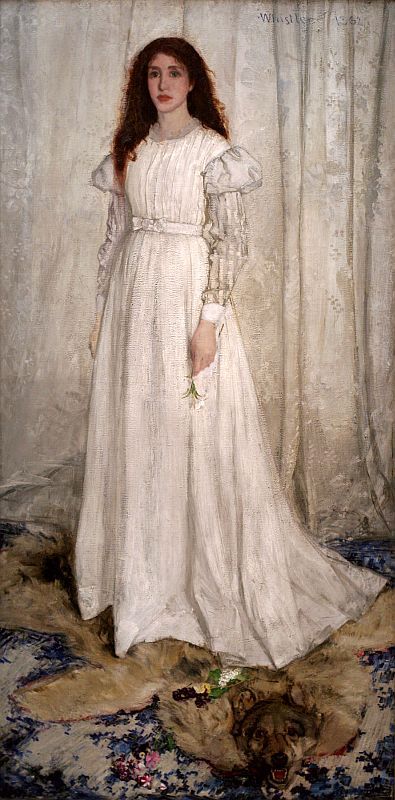
Jane Campion's Bright Star, adapted by the director from Andrew Motion's biography Keats, opens on an extreme close-up of a needle being threaded, as the film's title credit is written across the screen in a thin cursive. Campion accordingly cuts to the needle puncturing a cotton surface, pulling tiny tendrils of fabric with it as it pushes upward, before looping back through the white material. The viewer then sees the stitching, and a moment later, the sewer, wearing a white cotton dress and hat as she sits before a blank wall, hunched over her garment (with a back-lit window opening onto a snowy, winter scene to the spectator's right). Campion's art therefore registers an extraordinary degree of harmony from the outset; in this and other moments, Bright Star is reminiscent both visually and conceptually of the work of James McNeill Whistler (see above, as well as the artist's 1871 "Arrangement in Grey and Black"). Indeed, Campion characteristically matches the dress of her human figures, and especially female lead Abbie Cornish, to the details of her film's art direction, whether it is to her drapes (see top image), or the meadow of blooming blue-bells that has provided the film with its most iconic image (see below). Consequently, the filmmaker, like her painter progenitor, reveals a belief in the value of art for its own sake, and of the innate importance of beauty. Bright Star indeed teams with visually redolent candle-lit interiors and pale, moody early winter landscapes that especially in the latter instance foretell of the film's inevitably tragic conclusion.
As the film's central romantic relationship, featuring Cornish's Fanny Brawneand Ben Whishaw's John Keats, develops, the former entreats her poet-neighbor (and beloved) to teach her to appreciate his craft. In their first lesson, after he confesses his doubts about their new pedagogical endeavor, Keats offers a metaphor that equally serves to describe both his art and also Campion's filmmaking practice in Bright Star: "The point of diving in a lake is not immediately to swim to the shore, but to be in the lake, to luxuriate in the sensation of water. You do not work the lake out, it is an experience beyond thought. Poetry soothes and emboldens the soul to accept mystery." Bright Star indeed offers just such an experience, luxuriating in the early nineteenth century world that Campion, director of photography Greig Fraser, art director Christian Huband and costume designer Janet Patterson, among many others, have combined to render in such exacting detail. Bright Star is in this respect a very environmental work, a film that compels immersion in its often placid world.
Campion, however, introduces fissures into her enameled period surface. The most notable of these is Paul Schneider's exceptional, tonally modern performance as Keats confident and rival to Miss Brawne, Charles Brown. Schneider in particular brings a quick-witted snideness and disdain, almost exclusively targeted at Fanny, to Bright Star, which in turn reveals both his competitiveness vis-a-vis Keats' affections and also his not-entirely-latent desire for the young woman. Though his behavior often exhibits a high degree of performativity, registering for instance in his grimacing reactions to Fanny, the result is a naturalism that is not conventionally manifest in costume form. In this way, Schneider's work contributes mightily to the film's departures from the genre's characteristic staidness.
The director achieves a similar result by inviting contingency in her direction of child actress Edie Martin as Fanny's sister and Kerry Fox's daughter 'Toots' - the pumpkin-haired, very light-complexioned child performer in fact provides the latest instantiation of the visual type that Fox herself formerly embodied in Campion's masterpiece An Angel at My Table(1990); Cornish, on the other hand, recalls Campion's lead, Nicole Kidman, from her other career peak, The Portrait of a Lady(1996). Through the young girl's very natural performance and Campion's authentic characterization, the viewer sees this expressed in her quarrels with her sister for example, the early eighteenth century emerges in very familiar terms for the twenty-first century spectator. Martin's real effort in performing the tasks of her role, as when the viewer sees the actress struggling to the balance the rolls that she is charged with plating, additionally underscores the film's ontological present-tense, even as it further suggests the gestural recognizability of the past (we can both see the actress really working to complete the task, while also imagining the same difficulty besetting a young girl in the earlier period). Campion's credited feline actor "Topper" likewise underscores the film's present-day valence, as it repeated wrestles itself away from Toots and Fanny's tight embraces. Topper in this way instantiates a pure form of contingency - which similarly appears in the aforesaid performances - of being outside, escaping the film's historical diegetic world, while also making the said world more authentic and vivid. Thus, it is not in the least surprising that the above Keats' quotation recalls the foremost theorist of this sort, André Bazin, and hisdescription of Jean Renoir's Boudu Saved from Drowning(1932).
The operation of contingency that these figures introduce accords further with Keats' description of poetry, which the viewer is invited to read as a signpost describing Campion's own strategies in Bright Star. In this regard, the writer-director self-identifies as a poet, selecting from the natural and man-made environments that her mise-en-scène brings into existence. Then again, the film's opening segment offers a second, competing artistic mode, which the cinema uniquely resolves: namely Fanny's art, that of the dressmaker, whose work, unlike Keats' and Brown's poetry, permits its creator to make a living. The particular analogy follows from the stitching and sewing, with the latter providing a metonymy for editing, and for the classical decoupage construction of narrative as the physical piecing together of component parts, its montage. With Bright Star, Campion offers a remarkably complete picture of her lyrical narrative cinema, split between the aesthetic crafts of her two leads.
With Fanny and Keats, Campion also reintroduces her signature reversal of the gendered subject-object split of conventional narrative cinema (cf. Laura Mulvey). Here again Campion invests Fanny with subjecthood, making her the focalized bearer of desire rather than its object, which, perversely to the extent that Bright Star is an artistic bio-pic, defines Whishaw's Keats, a cipher in Campion's hands. In this regard, but especially for the film's comprehensive dissection of its maker's artistic program, Bright Star ranks among Campion's definitive accomplishments. The director's latest also signals not only a major comeback for Campion, but the return of a very nineties form of art cinema - a poetical art for its own sake - amid the more socially-conscious art house works of the early 21st century. Campion gives us a "total art" with an emphasis on the latter.
 Indisputably the movie of the present moment, though perhaps not entirely of its moment, Christopher Nolan's Inception is even more, and more importantly, the film of its writer-director's career, distilling Nolan's thematic concerns, style and signature narrative constructions within its single, "A"-picture shape. For good or ill, and it is indeed both, Inception contains all of Nolan's cinema - often not simply through allusion, but in visual citation as well - construed in a form that intermittently engages with the digital-age cinematic medium. Ultimately, it is on this last level that Inception proves of greatest interest to this piece's writers, at once extending the late 1990s, early 2000s engagement with the ontology of the analog-digital hybrid, while staking the director's place on the personal-impersonal artistic continuum.