Saturday, April 17, 2010

Special to Tativille: Soli Deo Gloria? Art, Evil and Bergman’s Legacy in Michael Haneke’s The White Ribbon (By Jeremi Szaniawski)

One of the many striking features of Michael Haneke’s The White Ribbon (Das Weisse Band, 2009) is the insistence with which it summons the imagery and biography of Ingmar Bergman. And it is a known fact of the film’s production history, that Haneke asked his cinematographer Christian Berger to study carefully the work of Sven Nyqvist. Curiously enough, the film ends up visually evoking Carl Theodor Dreyer (the painterly compositions) and Belá Tarr (the treatment of duration and the ominous silences) rather than Bergman himself.[i] But while it is set in Northern Germany instead of (a not-so-distant) Sweden, and takes place in 1913—a good five years before the director was born—the film does, otherwise, use his biography and oeuvre in many details.


Let me give a couple clear indicators of this spectral presence: first, elements of Bergman’s biography are almost literally referenced in the pastor’s family situation: Bergman was famously (see for instance Peter Cowie’s biography on the subject) the rebellious son of an affluent and charismatic Swedish Lutheran minister. Their relationship was tense and complicated, and often, in the artist’s childhood, involved cruel castigations that went with physical punishment, followed by periods of manifest contrition which involved kissing the father’s and the mother’s hands and asking for forgiveness. All of this is literally represented in the film, with painstaking detail. Bergman was also forced to wear red pants whenever he’d wet his bed, a visual token akin to the white ribbon that the kids are made to wear in the film. If one adds, to this, the fact that young Ingmar Bergman (cf. photograph) looked very much like the actor picked by Michael Haneke to play the boy, it becomes quite clear that all these parallels are deliberate.[ii]


Haneke does not limit himself to representing episodes from Bergman’s early life. He also quotes several of his films, most literally a scene from Winter Light (1963, to me, Bergman’s purest and finest film), when the doctor insults the midwife—his lover, telling her how much he finds her repulsive, while she listens, stoically, a contemporary parallel to the similarly painful relationship between Gunnar Björnstrand and Ingrid Thulin. And to make matters worse, more perverse, as it were, Haneke adds an olfactory dimension, there: the doctor tells the midwife that her breath stinks, to which she replies that she has ulcers, from which Bergman notoriously suffered.


***


It is arresting that the Austrian director (but born in Munich in 1942 (!)) should delve so much on Bergman’s life and art to portray a film supposedly addressing the roots of nazism (much like Bergman’s own Serpent’s Egg [1977] addressed the rise of nazism in Weimar Germany) and terrorism. For at first it would seem grotesque to associate the dignified auteur (for all his traumatic relationship to the Swedish IRS) with extremists and Una-Bombers of the world. And yet…


Haneke has always investigated the nature of evil, cruelty and perversion. But where in his past films, there always was something both seducing and unnerving, something decidedly awkward in his style, brewing sadistic experimentations and emotional manipulations with sheer sincerity, which seemed coterminous with the effect his films aimed to achieve in general (to me, plainly speaking, a stark philosophical denunciation of intellectual dishonesty and the ravages of contemporary bourgeois society), with The White Ribbon, he seems to have reconciled the perfection of his sibylline narratives with a clear form.[iii] But this clarity does not exactly unmask the thick mysteries of the film. We are plunged into the realm of the drama, but remain helplessly outside its deepest secrets, and the false leads with which Haneke fills his narrative (including a misleadingly omniscient voice-over) do little to help us see the light at the end of the tunnel. Like many films by Bergman, the film investigates without ever truly disclosing the lives of people gripped in the contradictions between modernity and protestant faith and traditions. Spiritually dead or crippled, they come across, however, as colder, uglier and duller than any Bergman character—something the film’s detractors have used prominently against it, fooled by its digitally doctored pretense to realism, not perceiving that therein lies its allegorical beauty. By portraying a Bergman-proxy in this universally corrupt humanity, integrating him so tightly to the pattern of his story (and History?), Haneke’s message remains ultimately uncertain. And yet, as with all his other films, unnerving and jarring inconclusive crime stories as they may be, one gets a sense, an intimation of a message, some sort of truth that would be accessible to the higher spheres alone – Soli Deo Gloria – but whose sheen can be appreciated by all of us, poor mortals, and therein lies one of the virtues and purposes of art.


So if I may now indulge in some pedantic elaborations, one way of addressing the issue, and provocatively so, would be to say that what Bergman represents here is the seed of evil in the 20th century – the aesthete and brilliant author, divorced from religion, philandering and creating an oeuvre obsessed with isolation, suffering and personality disintegration, a way of channeling a form of evil which, in others, burst out in the guise of nazism – and the adolescent Bergman himself got a taste of the fascination with Nazi propaganda during his summer stays in Germany in the 1930s. There is something titillating to this hypothesis, and to be sure the numerous accounts of Bergman’s life always present him in contrasted lights – from the wise and wonderful friend to the selfish and perverse manipulator. But trying to answer that particular question would be pointless (even if it were within my grasp). One thing is for certain, trauma seems to appear as a culprit with variable geometries in both Bergman’s and Haneke’s oeuvres: humiliation, personal and national alike, surely did not help atone for the wounds of the World War I, and to many it was one of the keys to the rise of nazism in Weimar Germany. But this is old hat, and Haneke is telling a modern tale.


Let us then, in a film so interestingly connected with familial nexuses, legacy, and guilt, ask what the legacy of Bergman specifically entails. Both Bergman and Haneke have been the champions of cinematic modernism, always probing the limits of the medium and trying to find new forms for it. When Haneke made his boldest attempt in that direction (the admirable, but ultimately flawed experiment that is Time of the Wolf, 2003) he almost quoted the title of another highly daring Bergman film, Hour of the Wolf (1968).[iv] The latter is of course a rumination on artistic creation and its potential pitfalls, ending in madness and annihilation. But even in the darkest corners of this particularly bleak film, Bergman soothes the souls of his creative demons (both insufferable and indispensable engines of art) by feeding them the darkest notes of Mozart’s otherwise luminous Magic Flute. There is music to be heard in the world pictured by Haneke in The White Ribbon, but it is amateurish and degraded, a travesty of the greatness of the original works of art. Is this degraded, mundane, pedestrian world, then, a good and fertile ground for the emergence of the selfish and psychopathic minds who shaped one of history’s most inscrutable abominations, precisely because it is almost entirely devoid of such artistic pursuits (and safe-conducts, as it were?), or not at all? After all, everything in the film seems to seep with evil: the nobility is fraught and corrupt, for all its efforts to affirm some sort of hierarchical justice. The peasants are prone to acts of violence and despair. But it is the emerging middle class of this microcosm of a village which gets the proverbial cake: founded on ideals that they might believe holy and good, the cracks beneath the veneer of their existence take no time to appear (the most electrifying indicator of this, to me, is the blank stare of the doctor’s son, when he learns of the nature of death), when de facto confronted with the absurdity of it all.


Evil and suffering are very much a commonplace in the universe of Ingmar Bergman as well. But they always have human faces, being generally fluid, muddled, reversible, attributable to selfishness, no doubt, but hardly ever absolutes. Most of Bergman’s characters are either odious or fallible, pathetic and tragic, but none of them, even the proto-nazis of the Serpent’s Egg, can be seen as absolutely evil or compared to the allegorical, and inflexible, beyond-good-and-evil figures such as Death in The Seventh Seal (1957). Haneke seems to have littered his White Ribbon with such allegorical entities, profoundly un-human, zombies, almost; even the narrator, who in spite of his puffy cheeks and good intentions, brings no genuine relief whatsoever to it all. He is merely a witness, and a fairly uncomprehending one, at that, for all his eagerness to play the local detective.


But who can blame the village’s teacher? The nature of evil, and terrorism, Haneke seems to have been telling us since the dawn of his cinematic career, is coterminous with human nature, but ultimately inscrutable. In this sense, even the kind attentions of the pastor’s youngest son, who wants to cure the bird and seems always keen on doing acts of goodness, are also somehow blood curdling in their inscrutability. What is the real motivation behind the children’s actions? Ingmar Bergman’s strict upbringing and subsequent rebellion and divorce from religion and tradition led to a boisterous life of prodigious fecundity, both artistic and sexual. In many other cases, seemingly, it led to fascism. That Bergman was often referred to as a tyrant and insufferably aggressive director comes as another contradiction with the mild-mannered and soothing man others portrayed him as. This may not have been done, as the Bach music of yore, to God’s glory alone, but no doubt He alone can see the ultimate logic and truth to this mystery.


***


Gilbert Lely, in his biography of the Marquis de Sade, stated famously: ‘la prédication esthétique du mal exclut l’accomplissement de celui-ci’ (‘the aesthetic predication of evil excludes its realization’). In a world grown faster and maddeningly complex, with so many new faces to the predications of art and evil alike, let us point out the fact that to tell a story about our 21st century, Haneke should have used a metaphor engrained in the early twentieth century, the life and art of one of its greatest artists, and his most perfect, crystalline form to date. Through a crystal darkly, this winter light soli Deo Gloria.


Jeremi Szaniawski is a PhD student in the joint Film and Slavic Studies Program at Yale University.


[i] The film’s network of associations is rich and complex, drawing also upon works by German directors such as Edgar Reitz (Heimat), R.W. Fassbinder, Alexander Kluge, but also Frank Wedekind, the pre-war photographs of August Sander, as well as collages from the nazi period by John Heartfield (the English name of German artist Helmut Herzfeld)… The list hardly ends here.

[ii] To this one should add that the process of casting the children was a long and arduous one for Haneke, involving literally thousands of interviews. Haneke’s difficulties working with the children was, besides, among his main complaints regarding the shooting of The White Ribbon.

[iii] The only moment that I thought a little jarring here was the scene when the doctor on the horse makes a violent fall to the ground – a shot obviously digitally doctored, which ill-fits a narrative taking place in anno domini 1913. It is interesting to note the symbolism of the slain horse, also present in Haneke’s Time of the Wolf. But there is a strong ontological difference between the two pictured animal ‘deaths’, to be sure.

[iv] To many, a lesser film after the height reached by Persona (1966), but to Bergman himself, a difficult but necessary step in the right direction.


Monday, April 5, 2010

Special to Tativille: "From the bitter seas of genre cinema comes a gem! Un bijou Amer" (By Jeremi Szaniawski)

As a Belgian citizen with a passion for horror films, I could not have been more excited to find out that a film called Amer (Hélène Cattet and Bruno Forzani, 2009) was coming our way, paying homage primarily to the flamboyant universes of the Italian gialli and Japanese B movies of the 60s and 70s. After a score of festivals where it reaped overwhelmingly positive reviews, the film recently screened at Walter Reade and MoMA, ahead of its American theatrical release - and it was a great opportunity to catch it on two consecutive days, followed by a Q/A with the French (but Brussels-based) authors, Cattet and Forzani.


Amer tells the story of a woman, Ana, through three separate stages in her life: childhood, adolescence and adulthood. Each of these moments is investigated through the prism of her anxieties, growing more and more dangerous as eroticism and death become inextricably linked. While these three stages are clearly the center-pieces of the film (and feature three different actresses, all perfectly cast), the latter actually consists of seven distinct but coherent segments, with four shorter (and beautiful) moments investigating the transitions in Ana’s life. One consists of anamorphosis evoking the changes in the body from childhood to adolescence, another of curious photographic stop-motion on hairy body parts commingling with Ana’s flesh, evocative of the sexual act, before the final fragment, which I won’t reveal here, but which reconciles Eros and Thanatos more seductively than any other film I’ve seen.


One criticism one might formulate against the film is that it is ultimately nothing more than a series of sleek short films stringed together, lushly photographed and edited, but ultimately shallow and boring. But on second viewing, the film reveals its great cohesion, and the care with which the atypical script was put together strikes the viewer like a glaring ray of Riviera sunshine—it apparently took the filmmakers over a year and a half of back-and-forth rewriting before they achieved this degree of sophistication, which can indeed at first deceptively pass for a simplistic story.


The film is almost dialogue-less, but filled with a densely textured and beautiful sound mix and gloriously re-mastered musical themes by Ennio Morricone, Bruno Nicolai and Stelvio Cipriani (the latter, particularly, is used to fantastic effect in a couple key scenes of the film). A vast experiment in paying homage to a genre, Amer also revisits its aesthetics, taking the use of close-ups in giallo to a different level altogether (the majority of the film’s 900 shots are close-ups). The film overtly quotes Mario Bava, Dario Argento and Lucio Fulci, and in doing so it is akin to the cinema of Quentin Tarantino, with which it shares a kindred spirit of unabashed fan-dom for ‘base’ genres, choreographic chic and lush cinematography. Much like Tarantino’s latest installments, Amer also works through the character of the powerful and beautiful, but deadly, female character. But where the Belgian effort is more interesting than Kill Bill or Death Proof, is of course in the fact that Hélène Cattet brings a strong female subjectivity to the project, sharing it with Forzani to obtain an original mix (next to Tarantino and the Italian and Japanese B-movie authors, the filmmakers quote Claire Denis as a source of inspiration), and this is quite clear from the film’s onset, which marries the brazen forcefulness of a roaring racing car’s engine to the delicate texture of an eye ball and soft footsteps of a little girl on the wooden floors of her parents’ ominous seaside villa.


The title of the film gives away its affect and psychoanalytical implications: ‘amer’ means bitter in French, and this is the feeling that one is supposed to be left at death (‘la mort a un goût amer’ – ‘death has a bitter taste,’ claims the film’s website) but also after the film’s shocking finale. But Amer also evokes the French word ‘mère’ – mother, and ‘mer’ – the sea, and so Jung and Freud engage in a merry dance here, but never heavy-handedly so. More subtly, perhaps, Amer’s title could also be envisaged as a truncated version of ‘America’, and in many ways most of the Italian and Japanese exploitation cinema of the time was trying to emulate the success of American movies, while adding original elements of their own.


The film wants to elicit a bitter aftertaste in the viewer’s mouth, and to be sure it triggers not only sound and sight. What I found most remarkable about Amer was the sheer physical effect it produced. Forzani and Cattet, in a quick introduction to the film’s screening, explained that the film’s sound was mixed so as for the viewer to be inside the brain of the character, therefore inviting us to let go of our traditional apprehension of films through the mind, and investigating it through the five senses instead. After the film, the viewer is left with a strong somatic response, and I personally almost experienced a withdrawal when the jittering effect started wearing out, leaving me asking for more (and I do dearly hope the soundtrack to the film comes out commercially, as most of the tracks it resorts to are currently unavailable). If it’s probable that Dario Argento’s most successful films and memorable imagery were more the product of LSD (and perhaps the feminine influence of his wife and muse, Daria Nicolodi) than his own artistic talent, then Amer both elicits this effect (it summons Argento’s Inferno on the structural level as much as it visually quotes Deep Red and Suspiria in a variety of ways) while offering a positive counterpart to it – a genuine, coherent and potent ‘good trip’ of a movie.


In many ways, with its French Riviera setting and mostly French production team and cast (one of the producers and both directors are French ‘refugees’ in Belgium), one can wonder what is actually Belgian about Amer. Aside from slight hints at the surrealist school, of which of course Magritte’s country was a stronghold (the movement lasting much longer there than in France, for that matter), at one point during the episode where the mother and Ana take a walk in a small village, black, yellow and red stripes can be seen at the forefront; in other words, the colors of the Belgian flag. But Forzani told me that this was a pure coincidence. Be that as it may, the film can be envisaged as Belgian because of its unique, original and insular quality. There’s little chance any other film of the type will ever be produced, and so, like all the other successes of my country’s troubled and heroically penniless cinematography, Amer is destined to remain a prototype - which all should go enjoy on 35mm and surround sound to fully appreciate its sensuous glory.


Like all great exercises in genre cinema, the film bypasses the boundaries that it set out to pay homage to and becomes something bigger and stronger altogether, transcending its low budget in the process. Amer is, to my mind, one of the finest and most gorgeous horror films (and beyond) ever made.


Jeremi Szaniawski is currently enrolled in the PhD program in Film and Slavic studies at Yale University. He also makes horror films in his spare time.


Saturday, March 13, 2010

New Film: Like You Know It All

Warning: the following post contains spoilers.

For his ninth feature Like You Know It All (2009), following the diaristic structuring and Paris setting of the filmmaker's arguably lesser Eric Rohmer-inspired previous effort, Night and Day (2008), writer-director Hong Sang-soo renews his signature diptych narrative construction in his return to his native Korea. As such, Hong lends credence to those interpretations of his work that would emphasize the cultural specificity of his divided homeland in the formulation of his stories' constructions, from The Power of Kangwon Province (1998) onward, beyond the clear and continued examination of male and female natures (within a decisively Korean cultural context, to be certain) which these same divisions often facilitate, and which as always are present in Like You Know It All. Then again, Hong's latest has lost little of the aforesaid Rohmer influence, stringing together a series of conversations, meals and rounds of drinks - especially rounds of drinks - where mostly youngish artists and students ceaselessly feel out potential romantic pairings and rehash frequently unpleasant pasts, within a precise geographical and seasonal setting. Consequently, Hong easily claims the title as the most Rohmerian of all major world directors, with a body of work that demonstrates a similar consistency - albeit at level ever so slightly below the French master's corpus. Thus, to get the verdict over presently, Like You Know It All is fairly standard work for Hong, which is to say much better than most, and quite welcome once every year or two, whether or not much has changed from the director's past efforts.

In the case of Like You Know It All, it is less a matter of outright invention than it is a synthesizing of previous works. Specifically, Like You Know It All adopts the zoom lensing of the filmmaker's A Tale of Cinema (2005) - which upon its earlier release felt well outside the main current of the director's work, but which by virtue of this latest piece now becomes far less marginal - within a series of restaurant, bar and hotel room set-pieces that are likewise found in the director's work from The Power of Kangwon Province, again, through Woman on the Beach (2006). Hong typically favors horizontally organized two-shots and multi-figure compositions throughout these scenes, thereby further crystallizing his debt to Rohmer and in particular to that director's "Comedy and Proverbs" cycle, with Summer (1986) providing a touchstone, as it was for Night and Day. From this spatial base, Hong zooms in and out, selecting subject matter from his naturally-lit, visual field. In this respect, as in A Tale of Cinema, Hong's camera figures articulate a narrational presence; the viewer sees as objects of interest are identified by the camera.

That Like You Know It All's zoom shots are paired with a narrative about a filmmaker, moreover, confirms a certain organic interrelation between form and content. More importantly, however, Hong uses his camera to convey interpersonal power dynamics throughout, whether this entails a sudden pan to exclude the filmmaker-lead Ku (Kim Tae-woo) on the edge of a multi-figure composition after his stature in the group has been eclipsed by that of a second, more famous director; or when the latter's departure from the frame and the room leads to Ku's renewed preeminence in the center of the frame - on the cusp of a drinking contest that ends rather badly. At this latter juncture, Hong holds on a doorway after the lead and two others leave the hotel room, only to show their somewhat unexpected return with a very drunk porn-star gnashing in Ku and a festival colleague's arms. Hence, Hong plays on his viewer's expectations in much the same manner as he did in his masterpiece The Power of Kangwon Province, where static set-ups were frequently procured for comic effects.

Like You Know It All
in fact manages to remain quite comic throughout, whether it is in Hong's above noted manipulation of form, his narrative repetitions (such as Ku's repeated naps during the festival screenings he is set to judge), the writer-director's dialogue passages (an off-rhythm jab at a second, better-known filmmaker - "have you always been this short?" - is a personal favorite) or in Kim Tae-woo's admirably awkward embodiment of the filmmaker lead. Ku, further, represents a relatively straight instantiation of director Hong himself: he is a foreign prize-winner who always makes the same sorts of film, whether or not they are understood. And he is a filmmaker who always makes films about himself, as Ku's ex Gosun (Ko Hyun-jung) points out.

Gosun later asks for Ku's promise that he will not make a film about her, before deciding that she does not care. The fact that Ko's character does so on the sand, after her appearance alongside Kim in Woman on the Beach, suggests that Like You Know It All might thus offer an autobiographical extension of the director's experiences with the 2006 picture, in addition to its recasting of Summer's concluding set-piece sans the formation of the heterosexual couple and the psychologically clarifying 'green ray.' Hong's autobiographical reinvention of Rohmer's idiom accordingly rejects the latter's (crucial) redemptive dimension.

Like You Know It All is available on an English-subtitled, Region 3 DVD through YESASIA.

Wednesday, March 3, 2010

New Film: Shutter Island

Warning: the following post contains spoilers.

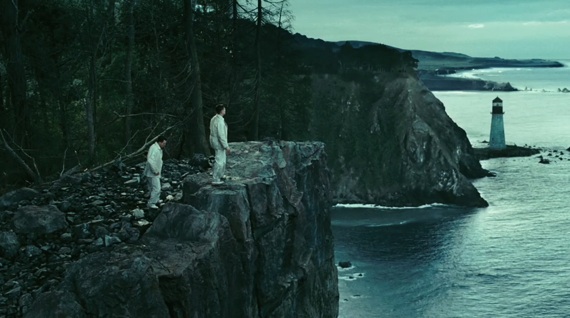
Martin Scorsese's
Shutter Island, from Laeta Kalogridis's adaptation of the Dennis Lehane novel, provides further evidence of the director's retreat from artistic relevance, following a decade in which the filmmaker's excesses overshadowed his accomplishments in Gangs of New York (2002), The Aviator (2004) and even 'best picture' winner The Departed (2006). Shutter Island proves no less distended in its narrative form, which is ironic certainly when one considers the film's clear indebtedness to the "b" film format that was itself distinguished by its relative economy. It is unclear precisely what lessons Scorsese imbibed from these films - save for his simulated rear-projections, overtly artificial mise-en-scène and conspicuous pulpiness - given the film's substantial narrative fat. Of course, more than your King Kong's (Merian C. Cooper and Ernest B. Schoedsack, 1933 - no "b" film in the truest sense, though a reference all the same) and Isle of Forgotten Sins' (Edgar G. Ulmer, 1943) of the world, Shutter Island owes, and indeed significantly refers to the films of Alfred Hitchcock and Stanley Kubrick (particularly the latter's The Shining, 1980), from which Scorsese's film generates its subjective modality, to say nothing of the 1940s Gothic melodramatic cycle instantiated by the thematically relevant Gaslight (George Cukor, 1944).

Indeed, Scorsese draws on Hitchcock's Marnie (1964) for its psychoanalytic denouement whereby Leonardo DiCaprio's U.S. Marshal Teddy Daniels comes to the learn the truth of his own traumatic past. In this way, Scorsese returns to the same crudely Freudian logic of his first feature Who's That Knocking on My Door (1967) - in the case of the earlier picture it was the Madonna-Whore complex - though to less immediately gratifying aesthetic effect. (Indeed, the 1967 film provides a notable intra-corpus point of reference thanks to its significant narrative fragmentation, which with the earlier picture more strongly recalls the contemporary work of Jean-Luc Godard.) Scorsese combines the personal trauma of Shutter Island, however, with the public trauma of Dachau, which gratuitously figures in recreations of the concentration camp (that Scorsese pairs with
problematically lyricized murders of Nazi officers). As such, Scorsese finds another starting point in Alain Resnais's cinema of fifty years earlier - namely his similarly structured, comparative Hiroshima mon amour (1959). Then again, where the French director's cinema has improved with age, finding its most personal expression in Private Fears in Public Places (2006), Scorsese's seems to have moved in the opposite direction, moving from the first-person tenor of his earliest films to the less reflective generic exercises of his past two works.

This is not to say that Shutter Island does not instantiate a world view; again it proposes a meaninglessness in the face of Dachau and the violence that as always Scorsese claims as ubiquitous, a 1950s, Hydrogen bomb-era existentialism (and perhaps even a nihilism arguably), even as DiCaprio's lead "bears witness," in the words of film scholar Lisa K. Broad, to the sins of both the Nazi's and those of Shutter Island. On this basis even more than with the film's somewhat uneven application of style, Shutter Island emerges as the work of an auteur - albeit of a maker seemingly in his decline.
Shutter Island also introduces a politics in the film's adoption of a HUAC-centered conspiracy that the protagonists fear will some day produce sins comparable to those of Nazi's. To the extent that one takes this governmental crime seriously, the most viable current equivalent might just be the muddled-headed thinking of 9/11 "truthers." Then again, since this conspiracy is revealed to be toothless, one might just as well conclude that Scorsese has come to this very conclusion on his own. Commensurate with the film's philosophy, grand theories ultimate cannot explain the world's sins.

Monday, March 1, 2010

"Eric Rohmer, Cross-Textuality and the Auteur Theory"

“‘Modern’ is in any case a rather compromised term. You ought not to set out to be modern; if you deserve it you are. And neither should you be afraid of not being modern. It mustn’t become an obsession.”
-ERIC ROHMER, ‘L’Ancien et le nouveau: entretien avec Eric Rohmer’i

Introduction
It would be far more convenient if film makers like Eric Rohmer could be appropriated for another age: then modernity could be Modernism and Postmodernism, Jean-Luc Godard and Quentin Tarantino. Not that such a shift would have any practical effect–even now Rohmer’s work is taken for granted as anachronistic and marginal (which is not to suggest, however, that his films are treated lightly). He is rather the polemical opposite of a Godard or a Jacques Rivette, the point of reference against which their relative modernity becomes clear. His art is not that of process, nor is he continually concerned with foregrounding the scaffolding of his art; self-reflexivity is not the primary means by which he examines the nature of cinema. There is none of the fragmentation of Godard or the caustic quality of the Postmodernists (read Tarantino and Jim Jarmusch) in his work. Instead, Rohmer has pursued a program which eschews the mannerism characteristic of the work of so many of his contemporaries. It would be a mistake, however, to overlook the intention implicit in Rohmer’s preferred mode. His art is no less interested in cinematic ontology than is that of any of his New Wave colleagues nor is he any less aware of the critical dimension of his work. Godard’s assertion that as a film maker he remained a critic who used the cinematic medium in place of writing could just as well be applied to Rohmer.ii

Idiosyncracy, however, remains key to placing Rohmer within the historical context of New Wave criticism. In the judgement of Australian critic C. G. Crisp, this peculiarity is evident in the inherent “realism” of his films, contingently producing a very different understanding of artistic agency from that which might be ascribed to his colleagues:
The director’s job is to open a window onto reality, to create a “transparent” cinema which simply presents, with as little interference as possible, the beauty of the world. He must “stand aside” and allow the spectator to savor it, to become involved in it, and to contemplate the harmony and unity underlying it.iii
For Crisp, the source of this effacement is Rohmer’s Catholicism, even Jansenism, which informs the realistic impulse apparent in both his criticism and subsequently, his film making.iv As such it becomes easily to assimilate Rohmer’s famed defense of classical American cinema within this rubric, given the supposed proclivity of each toward invisibility. However, in the seemingly contradictory instances–Rossellini, Mizoguchi, Murnau–when the artist’s signature was clearly and insuppressibly denoted in the film’s style, Crisp argues that Rohmer sought support for such auteurs on the basis of ideological rather than formal merits.v Certainly this distinction loses all meaning when one considers the works of an Eisenstein or a Welles, who Rohmer nonetheless admired in spite of their ideological differences and baroque styles. Indeed, the problem with Crisp’s argument seems to stem from his misjudgement of which film makers directly inspired Rohmer’s work. In an interview with Graham Petrie, Rohmer himself states unequivocally that it was Renoir and Rossellini who influenced him most, whereas American film makers like Hitchcock had an only indirect influence at best.vi The truth is that Rohmer never sought to obscure his creative agency. He was never one to shy away from the fundamentally Romantic notion of authorship propounded by Cahiers du Cinema: “the contemporary film maker–and this includes me–dreams of being the sole creator of the work.”vii

It would seem then that Crisp’s formulation destructs under the particularities of Rohmer’s actual attitudes toward authorial presence in film. Far from being merely compatible with his corpus, the auteur theory is formative to the structure of his work, but in a manner once again quite different to that employed by Godard, Rivette and François Truffaut. Rather than writing his authorship reflexively into the structure of each individual film, Rohmer instead has devised a strategy that works in the context of multiple films. Through the delineation of three discrete series–the six Contes moraux, six Comedies et Proverbes and Contes des quatre saisonsviii–Rohmer has constructed a peculiarly intertextual, macro cinema that by its elemental nature invites criticism. Still, it is not simply the existence of a schematic that is essential to understanding Rohmer’s critical self-awareness, but instead it is its constituent uniformity, as applied to each of the sets of texts, that reveal the director’s intentions. In this way then Rohmer’s corpus is the ultimate artistic expression of auteur theory: meaning is conceived in terms of the interrelationship of a set of texts, which themselves are of a uniform substance.

With regard to the interrelationship of the three sets of films, there exists a process of signification whereby a single “cornerstone” film in each series–to coopt James Monaco’s description of Ma nuit chez Maud (1969)–is set forth to parse out the metaphysical implications of his worldview.ix Whereas generally Catholicism in Rohmer’s work is implicit rather than explicit, discernable in the moral universe of his films in lieu of religious subject matter or verbal quotation, Maud, Le Rayon vert (1986) and Conte d’hiver (1992) conversely employ very different methodologies, in each case making clear the centrality of religious faith to the work. Yet, as it has been stated, Rohmer’s purpose is discernable finally in terms of sets of texts, rather than in the simple texts themselves. In this way, it is of primary significance that there are only three films which make explicit religious faith–leaving aside those films which do not fit within the framework of a series–and more importantly that each belongs to a separate body of texts. This strategy would seem to suggest the possibility at least of a conscious critical methodology written into the intertextuality of the series itself. What follows then is an examination of the explicitly religious in each of the three films listed above, the uniqueness of each within their context, and the consequent contextualization of all three within the broader megathemes of auteurism and modernity, which are themselves so central to an understanding of the New Wave as an artistic movement. In this way, Rohmer will be reconnected to an epoch from which he is more often disassociated.

Ma nuit chez Maud, Modernism, and Self-Reflexivity
Ma nuit chez Maud, according to Pascal Bonitzer, is “the first ‘moral tale’ by Rohmer to allow its signs, mechanisms, and concepts to reveal themselves as such.”x Indeed Ma nuit chez Maud signals a drastic departure from the previous works of the Contes moraux in terms of its process of signification, which is to imply that it is the first and only of these films that is aware of itself as cinema, that employs reflexive strategies. However, before expanding upon the reflexive characteristics of Ma nuit chez Maud, it might be beneficial to list, initially, the various other aspects in which it separates itself from the other films in its series: first, Ma nuit chez Maud is the only film in the Contes moraux that was filmed on black and white, thirty-five millimeter film stock, in spite of the fact that Rohmer had no financial justification for doing so at the time; it is the only film to be situated in a winter setting; it is the only film among the six to employ a first person narrator, who at no point is named; the characters are older in Ma nuit chez Maud than in any of the other films in the series; according to Monaco, “this is the only Tale... in which the relationships proceed in purely rational terms”; and this film is the first instance in the Contes moraux of Pascal and “le pari,” which is to say “the bet,”a motif that will instruct the rest of the sub-corpus.xi

Of course, the significance of Pascal in Ma nuit chez Maud cannot merely be assigned to its first occurrence in the Contes. Again in Monaco’s terms, Pascal’s wager is the “theoretical centerpiece” of Ma nuit chez Maud to the extant that Rohmer conflates the Narrator’s religious faith with his marital aspirations:xii in spite of never having talked to his blonde object of desire, he states with clarity that “on Monday, December 21, I suddenly knew without a doubt that Françoise would be my wife”; and later he tells her that “even if the odds would have been ten to one against [the woman he spotted being her], I would have stopped.” Each is predicted upon the same Pascalian notion of faith that is fundamental to the film’s discourse, albeit distilled through Vidal’s Marxist reconfiguration (simply substitute God for history and existence for meaning and one would have Pascal, almost to the word):
Hypothesis A: life in society and all political action are totally devoid of meaning. Hypothesis B: history has a meaning. I am not absolutely sure that hypothesis B has more likelihood of being true than hypothesis A. I’ll even say it has less. Let’s concede that hypothesis B has only ten chances in a hundred and hypothesis A ninety in a hundred. Nevertheless, I can’t wager on hypothesis B, because it is the only one,... the one, I mean, that history has a meaning,... because it is the only one that allows me to live. Let’s suppose that I wagered on hypothesis A and that hypothesis B proves true, despite its only 10 percent chance,... then I have absolutely wasted my life, therefore I must choose hypothesis B because it is the only that justifies my life and action.xiii
Significantly, however, the Catholic Narrator refuses Vidal’s schema, building a case against Pascal upon such trivialities as his imperviousness to the type of wine he was drinking and more damning, Pascal’s low view of marriage. In this way, Rohmer reaffirms the central dramatic tension of the film, while establishing a second parallel to Pascal’s work.


At this point, it might be beneficial to note the Narrator’s undependability, or according to Crisp, his “hypocritical” unreliability.xiv Certainly there is space between the Narrator’s affirmations that “individual acts are of no significance” and the resultant freedom this provides “to be tempted and to cede,” and the author’s own behaviors–as in his rejection of Maud.xv Rohmer seems to make his disapproval of his protagonist’s hypocrisy clear in the Priest’s homily: looking directly into the camera, the Priest avers that “Christianity is not an ethic, it is a way of life.” Yet, this sequence does far more than merely distance the author from his protagonist; in exceeding the exigencies of plot, it works as something akin to direct address, serving as an unmediated communication between author and audience. It is as if Rohmer is responding to one of his characters, articulating in the words of the clergyman his own opinions on the essence of the Catholic faith, as distinct from what he has previous ascribed to his protagonist. Furthermore, it is also a means by which Rohmer engages interiority, but in a manner that requires the contribution of the audience–implicitly we are asked to supply the spiritual anxiety of these two protagonists as they are confronted with their own contradictory behaviors in the above monologue. He calls us to add that which the inherently physical medium elides, the metaphysical. (At this point Rohmer is at his most Bressonian–conceptually and also by virtue of the actor’s expressionless performances–which reinforces the inherently religious subject matter referentially). Indeed, not only does Rohmer expose the artificiality of the medium in this sequence, shattering the illusion of reality most often engendered by the picture, but he also reconfirms the primary meaning of the film, which is to say the interior lives of the protagonists, and by implication, the spiritual life.


Yet, however unique this sequence might be, especially in its fusion of form and content, it is not the only instance of self-consciousness extant in Ma nuit chez Maud. Modernity, conversely, is another theme that seems to be treated self-consciously. Prefacing his application of Pascal to history, Vidal proposes that “the wager is extremely current,” which by virtue of its structural application throughout the course of the film, leads us to consider Vidal’s statement as cinematically self-referential. Rohmer, in essence, is suggesting that his work is modern–a proposition that becomes all the more clear when the Narrator later declares that he is a man of his age and that the Church has always made allowances for this variable. In the same way, Ma nuit chez Maud demands to be considered a document of its time: Maud, the first film that Rohmer made in the wake of May 1968, displays for the first time in his oeuvre an interest in the expressly political; here, Rohmer engages the subject through the establishment of structural antipathies in the Catholic Narrator and the liberal Maud. In this way then he is aware of “the evolution of the natural or the social environment” that he earlier praised in classical American cinema, as a bulwark of its own modernity.xvi Hence, if we are to extend this criteria to Rohmer’s own work, it becomes quite clear that he is reflexively signifying his own modernity, or at least making an argument for it. This is a film that knows it is post-May 1968. Similarly, this is also a film that argues for its relative modernity in terms of its unembellished representation of a particular time and place–in this case, Clermont during the Christmas season. The contemporaneity of the film, in other words, is evident in its verisimilitude.
Le Rayon vert, Light, and Christian Metaphor
Literally translating “The Green Ray,” after the Jules Verne book of the same name, Le Rayon vert was released in the United States instead under the title “Summer.” As inaccurate and confusing as this alteration may be–given especially his subsequent Conte d’ete (“A Summer’s Tale”; 1996) from the Contes des quatre saisons–the title does at least serve the purpose of confirming, once again, the centrality of season to plot. This time, however, Rohmer makes things significantly more literal: adopting a strategy first employed in the Contes Moraux (though not used in Ma nuit chez Maud) the director demarcates the segments, each corresponding to a day, through cursive intertitles that give us the day of the week, month and date of the proceeding. As such, Rohmer makes explicit that the narrative is taking place between ‘Monday July 2’ and ‘Saturday August 9,’ which is itself significant less because of what it contributes to the narrative per se–to say that the film takes place during the summer, during the holiday season would certainly suffice in this respect–than for its reflexive merit. On a basic level, Rohmer seems to be signifying doubly his indebtedness to the silent cinema: to the Lumiere brothers in his underscored realism and to the silent mode more generally in his inclusion of intertitles.


More to the point, however, the exact temporal and geographical situation of the plot, as well as the film’s very title, draw attention to one of the work’s primary subject matters–light. The narrative itself hinges upon whether or not the lonely Delphine, played by Rohmer veteran Marie Riviere, will see the final ray of the setting sun, “the green ray” of the title (in St. Jean de Luz, as it happens)–and as such know her feelings. In other words, the central dramatic tension of the film becomes whether or not the protagonist literally will see the light spoken of in Verne’s novel. In this sense, then, Rohmer is taking one of the primary constituent elements of the cinema and making it his subject figuratively. Literal light, moreover, is also part of his subject matter. Returning to his exact documentation of specific dates–though we cannot assume that any of these sequences was filmed on such and such a date, of course–it would seem as if Rohmer’s ultimate purpose is to specify the nature of light at a given time and in a given place. The realist function is foregrounded therefore, articulating cinema in the most literal of terms. Consequently, the subject of Le Rayon vert is light, which is to say that it is a film about film, inasmuch as light is essential to the medium’s ontology; in Rohmer’s own words, “it is light that models form, that sculpts it.”xvii


The presence of light as a structuring element does not merely serve as a referent to the nature of cinema, however, but it also plays a significant role in establishing the film’s religious metaphor. To quote the Gospel of John, apropos of the St. Jean of the film’s denouement, Christ calls himself “the light of the world.”xviii Now of course it would be willful to extrapolate a film’s inherent Christianity by virtue of its utilization of light as a structuring metaphor; still, when one considers the film’s other textual references to Christian metaphor, it becomes clear that this affinity for light is not accidently fused with a Christic narrative, but conversely is consubstantial with its meaning. Again, there is the trip to St. Jean de Luz, a small costal neighbor to Biarritz, in which the preceding action has taken place. That Rohmer would make a point that they are travelling to the Basque city, St. Jean de Luz, literally Saint John (French) of light (Spanish), seems a bit curious to anyone who knows the geography of the area: St. Jean de Luz is no more than ten kilometers from the center of Biarritz, and therefore hardly what one would think of if one were to construct the location of a rail getaway from the southwestern French city. Hence, there would seem to be a narrative or metaphorical reason for Rohmer’s choice of the town. The second and certainly more significant textual signpost is Delphine’s choice of reading: Dostoevsky’s The Idiot. As has been long argued in the critical dialogue surrounding the text, Dostoevsky’s decision to make his protagonist Myshkin an epileptic serves not only an autobiographical purpose–the author himself was known to have suffered from fits of epilepsy–but moreover reinforces the connection of the character to Christ, as some have noticed that “epilepsy, known as a holy disease, may have been suffered by Christ [himself].”xix In fact, literary critic Liza Knapp even suggests that “The Idiot may be seen as Dostoevsky’s ultimate (or penultimate) answer to what he saw as the liberals’ tendency to spit on Christ.”xx In his character Myshkin, Dostoevsky represents “‘the loftiest divine beauty’: Christ.”xxi


Therefore, it would seem that in the case of Le Rayon vert, Rohmer communicates the centrality of religious faith to his character through the more indirect means of intertextual referencing, at least in comparison to the methodology he employs in Ma nuit chez Maud. However, the inclusion of these clues would seem somewhat trivial were it not for the narrative’s structuring opposition setting predeterminacy against positive action. Certainly, there are theological reverberations implicit in this dialectic: is it the individual who maintains control over their fate or is it instead God’s providential hand which guides humanity’s paths? This opposition, of course, has persisted as a primary tension in Christian theology from the beginning–even today the issue persists in the context of Calvinism (those who believe in predestination) and Arminianism (those who acknowledge free-will). Importantly, Ma nuit chez Maud also foregrounds this tension, but in keeping with the relative directness of its dialogue, this is done in terms of Jansenism. As a point of reference, Jansenism sought to bring back the original Augustinianism to the Roman Catholic church, promoting a Thomistic notion of predestination that was rejected by the Jesuits and subsequently rejected by the pope (who were more inclined to uphold free-will).xxii Interestingly enough, the Narrator denies the validity of this branch of Catholicism, even as he maintains a belief that Françoise ultimately will become his wife. While on the one hand such a belief in divine providence is consonant with the alternative Arminianism mentioned above, the other option–that Rohmer uses this apparent inconsistency as a criticism of his character–is the more intriguing and perhaps viable option, given especially Crisp’s notion that Rohmer himself possessed Jansenist sympathies.xxiii Thus we can say once again that Ma nuit chez Maud is the more self-consciously critical work, that Rohmer actively intervenes in a critical capacity, whereas Le Rayon vert remains the more distilled allegory. Yet it is a profoundly Christian allegory all the same.


As far as the latter work is concerned, one of Rohmer’s “seemingly less structured films” in the words of critic Jonathan Romney, the protagonist Delphine spends the bulk of her summer looking for somewhere and someone with whom she can spend the remainder of her holiday– after being dumped in the film’s opening sequence.xxiv Over the course of the narrative, various explanations are offered by Delphine and her companions that navigate the relationship between free-will and predestination, often tipping the balance in favor of the former: a friend says that she is “unaware that [she is] looking for her Prince Charming... [but] too stubborn to change.” Likewise, a Scandinavian acquaintance equates romance with a card game where one mustn’t show one’s hand; to this a commiserate Delphine states that she does show her hand, and if others fail to come to her, it is because indeed she is “worthless.” Yet, in the end, it is a chance meeting, or interpreted in Jansenist terms, a divinely ordained meeting that rekindles Delphine’s hope. She must act–as she does here, positively asserting that she will go with her new male acquaintance to St. Jean de Luz–but still, the opportunity presented is entirely beyond her control. Thus, there is both the signature of God’s hand and also a concession to action which seems to connect Rohmer to Albert Camus and The Plague.


The characterization of Delphine, or rather the centrality of Delphine, takes on even greater significance when one considers the strategies employed elsewhere in the Comedies et Proverbes. Critic Dave Kehr suggests that in the later series “Rohmer abandons the first-person perspective of the ‘Six Moral Tales’ in favor an elegant, intertwining pattern of shifting point of view.”xxv Commenting on Les Nuits de plein lune (1984), he again comments on the “shift from a subjective to an objective viewpoint,”xxvi and in Pauline a la plage (1983), he notes the manner in which “Rohmer takes a further step in exteriority over the intimacy of the ‘Six Moral Tales.”xxvii Yet, Le Rayon vert is “rare among Rohmer films... in that it features a single character unable to attach herself to anyone.”xxviii Our attention never strays from Delphine and her internal conflict. Whether it annoys us or moves us, it still is for us to decide, in much the same way that Ma nuit chez Maud presents an interpretative space for the viewer to side with either the conservative or the liberal protagonist. Here it is only Delphine that we have before us, a woman in emotional crisis who allows us to determine (to paraphrase the character) if there is anything there. In closing, it is important to note also that the lead actress, Riviere, receives a screen writing credit along with Rohmer, which makes her unique among Rohmer’s players. Clearly, there is something singular about Le Rayon vert, both in terms of his oeuvre, and also in respect to the Comedies et Proverbes.

Conte d’hiver, Cross-referencing, and Auteurism
Marie Riviere next appears in the second of Rohmer’s Contes des quatre saisons, Conte d’hiver. Her appearance in this film, though only in a minor cameo, is a fitting point of embarkation for a work that very much looks to the past of Rohmer’s cinema. Yet, it is not only the general past of his themes and structures that is replicated here. Rather it is the specificity of the two films treated above in length that is revisited: “in focusing on an often irritatingly indecisive heroine devoted to a barely reasonable if romantic ideal,” Geoff Andrew writes, “Conte d’hiver is reminiscent of Le Rayon vert, while its wintery study of the varieties of love, faith and religious belief recall the sublime Ma nuit chez Maud.”xxix Certainly, Riviere’s presence likewise suggests a connection to Le Rayon vert, as do also the words of the Conte d’hiver protagonist, Felicie, at her supposed moment of epiphany, “suddenly things became so clear” (which then again also evoke the assurances of Maud’s Narrator in voice over that he will indeed marry Françoise). However, Felicie is rather different from the protagonist of Le Rayon vert–one could go so far even as to call her an anti-Delphine. 


Between the two, indeed, it can be observed that Felicie certainly makes the fewest concessions to choice, even if she allows certain men to remain in limbo as she waits for her ideal, Charles. Unlike Delphine, she is convinced that something, in this case his return, will bring her happiness. She is a woman of infinite faith, even though she makes it clear she and religion “do not get along.” It is not the demonstration of God’s providential hand as in Le Rayon vert that restores her hope, but rather she maintains an assiduous belief in the imminence of their reunion. Felicie even demonstrates her faith by praying for their reunion (she later confesses that it was closer to meditation), whereas Delphine wallows in her own inability to act, to communicate in the same fashion as the other young people in Biarritz, who presumably may find happiness through their direct action. For Delphine, it is her own inadequacies that have mediated her ability to find happiness, whereas Felicie maintains hope that her dreams will be realized. In the end, a chance encounter accompanied by a decisive effort restores a sense of hope in Delphine, while the final magical denouement of Conte d’hiver confirms Felicie’s persistent belief without the insistence on action.


However, the relationship between the two films is far less pronounced than that which characterizes the film’s connection to the earlier Maud. In this film there are the temporal and thematic affinities listed above, but there are also arguably more concrete points of intersection: again there are sequences filmed within churches; there is a preponderance of travelling shots, though in this instance not as purely derivative of Viaggio in Italia (1954) as are those in Ma nuit chez Maud; there is the more specific Christmas season that both films bridge; there are the conversations that the characters have about religion itself; and most striking of all, there is the return of Pascal. As per the last of these, when Felicie claims that in her devotion to her absent Charles she is holding out for a “joy so great,” that she would “gladly ruin [her] life for it,” one of her two other suitors, Loic, himself a religious man, observes that she is describing Pascal’s wager. However, proving that she is not the intellectual foil for him that Maud is for Trintignant’s Narrator, Felicie ruefully observes that Plato is all they need in the conversation. Actually it is quite significant that she mentions Plato at this point, since he is a point of conversation in Rohmer’s previous work, Contes de printemps (1990).


Another undeniable correspondence between Conte d’hiver, Ma nuit chez and once again Le Rayon vert is in the inclusion of a preexistent literary text as a narrative device. In each case, Rohmer does not literally adapt said text, but instead uses it to guide audience expectancy. As viewers, Rohmer asks us to think about his narrative in terms of the governing text–and for those who do not know the ramifications of this specific text, he includes enough of it (either through a discussion of the text, as in the first two films, or in the production of it in dramatic form, as in Conte d’hiver) for the viewer to make an assessment regardless. In this way, the three films are both thoroughly self-contained, and also rewarding of extra-textual knowledge. To grasp the broader theological context of Conte d’hiver, for instance, it is necessary to have a basic knowledge of Shakespearean criticism and particularly of the “tendency” in modern criticism to read “significant religious meanings” into The Winter’s Tale.xxx Just as Le Rayon vert’s religious allegory is impossible without a rudimentary understanding of literary criticism, the same can be said of Conte d’hiver’s relationship of text to film. Still, Conte d’hiver more often than not expressly addresses its religious subject matter, be it in the conversations regarding Pascal and religious faith, the moments in the church, or in the narrative’s contextualization within the Christmas season. In this way, the film departs significantly from the remaining three Contes des quatre saisons: at no point in these films is religion discussed nor are there any allusions made to Christian or Christianized texts. Conte d’hiver remains the only explicitly religious film in this series, exactly as Ma nuit chez Maud and Le Rayon vert fulfill similar roles in the Contes moraux and Comedies et Proverbes.


Moreover, Conte d’hiver also functions to clarify Rohmer’s self-conscious construction of the three series in terms of a single cornerstone work. By referencing each work in rather explicit ways, Rohmer compels his audience to think of the three films as being of a single, unified substance. In this way, Rohmer is not inviting an auteurist criticism of his work simply, but instead is demanding such a critique inasmuch as the meaning of these films, in relation to their body of texts, only becomes apparent upon the duplication of the strategy. In other words, Rohmer makes necessary a reading of his work that takes into account both the series themselves and also the patterns emerging from a comparison of all three. It is only in this process of comparison that it becomes clear that Rohmer intentionally has singled out a sole text in each sub-corpus to serve as a theological referent.
Conclusion
Rohmer then is indivisible from his art not as an acknowledged biographical presence, but rather as a signifier through which meaning is articulated. The recognition of his authorship, in other words, has discernable value. It is not just that he has developed an instantly recognizable style or moral universe, but moreover that his films have the added dimension of consciously existing within the context of his other work. His cinema, in other words, cannot be fully understood ceteris paribus; it demands cross-textual consideration by its very construction. In this way, Rohmer’s art is the supreme expression of the auteur theory: that it is impossible to fully grasp his art without the knowledge of not only his authorship but also his other work. Even so, this may not even be his most concrete, lasting association with the movement he helped found: Rohmer, more than any of his other colleagues, has remained true to the spirit of Bazin. In this way, his L’Anglaise et le duc (2001) can be read in terms of its navigation of the issues associated with representing past realities in a medium that naturally lends itself to the expression of contemporaneity. He in other words is a realist, a literalist even in his translation of Bazinian theory into film. In addition to Bazin, there is also the persistence of a documentary quality that suggests a “recourse to cinema-verite techniques,” thereby solidifying his connection to one of the other key preoccupations of Cahiers in the late 1950s and early 1960s.xxxi Truly Rohmer remains a primary adherent to the tenants of the movement he helped initiate.


However, there does still remain one last issue that Rohmer raises most clearly in the context of Ma nuit chez Maud: his own relative modernity. If there is any inconsistency thus far expressed between Rohmer’s opinions and the substance of his work, it is in statements that it is essential not to ‘set out to be modern.’ If anything, Ma nuit chez Maud is arguing for exactly this. Then again, it is important to note that the film was made four years after the interview was conducted, in a period of increasing politicization. Indeed, there is a sense in which this film is arguing for its immediacy, defending itself against judgements such as the one expressed by Le Monde critic Jean de Baroncelli, that “this film is marvelously old-fashioned.”xxxii Rohmer rhetorically poses the question of whether classicism in fact can be more modern than Modernism. The answer to this question, of course, is essential in defining the relative modernity of the second and third Rohmer films discussed in the course of the preceding. Le Rayon vert especially is a profoundly classical work, inheriting none of the reflexive gestures that even Ma nuit chez Maud utilizes. Still, one wonders what if anything the film lacks; what if anything could make the film more immediate? Ultimately, Le Rayon vert is little more than the naked display of one person’s internal crises, a direct emotional communion between its artists and its audience. And yet, it is difficult to see a lack of urgency in such a subject. Is it really possible that this is the cinema of the past, and if so what then will constitute the cinema of the future? The opening claim that it would be easier if modernity could be ascribed to Modernism and Postmodernism serves to expose a certain teleological assumption that continues to infect art and film history to this day–that invariably art will seek to expose its own mechanisms, laying bare the artificiality of its forms. Once this has been accomplished, artists have no other recourse but to pronounce art dead, as can be seen in works such as Week End (1967, Godard) and Prospero’s Books (1991, Peter Greenaway).


Yet, to take Walter Pater’s point that art is at all times composed of binary oppositions–in his case he describes the tension in terms of classicism and romanticism–and that at any given moment one may take precedence over another, while never fully eradicating it, then one might well consider Rohmer as something of an opposable figure, but by no means outdated.xxxiii After all, to follow Pater’s logic even further, a reversal of the tension inherent in art will bring about, in future, disparate definitions and evaluations of the medium. Rohmer is different from Godard, Rivette and Truffaut in many respects, but at the same time he is just as much an artist of his time. History will judge their relatively modernity and then re-evaluate the same again and again, so long as their art remains worthy of study. In this respect, Rohmer’s quip that ‘modern is a compromised term’ could not be more accurate.


i Eric Rohmer quoted in Jean-Claude Biette, Jacques Bontemps, Jean-Louis Comolli, “Eric Rohmer: the Old and the New,” trans. Diana Matias, in Cahiers du Cinema, the 1960s: New Wave, New Cinema, Reevaluating Hollywood, ed. Jim Hillier (Cambridge: Harvard University Press, 1992), 86. Originally published as “L’Ancien et le nouveau: entretien avec Eric Rohmer,” Cahiers du Cinema, no. 172 (November 1965).
ii Jean Luc-Godard quoted in “Jean-Luc Godard: ‘From Critic to Film-Maker’: Godard in Interview,” trans. Tom Milne, in Hillier, 59. Originally published as “”Entretien,” Cahiers du Cinema, no. 138 (December 1962).
iii C. G. Crisp, Eric Rohmer: Realist and Moralist (Bloomington, Indiana: Indiana University Press, 1988): 3.
iv Ibid.
v Ibid., 9.
vi Rohmer quoted in Graham Petrie, “Eric Rohmer: an Interview,” in My Night at Maud’s, ed. English Showalter, 127 (New Brunswick, New Jersey: Rutgers University Press, 1993), 127. Originally published in Film Quarterly 24, no. 4 (Summer 1971): 34-41.
vii Rohmer, “Preface to Six Moral Tales,” in My Night at Maud’s, 131. Originally published as Six Moral Tales, trans. Sabine d’Estree (New York: Viking, 1980): v-x.
viii The Contes moraux are La Boulangère de Monceau (1962), La Carrière de Suzanne (1963), La Collectionneuse (1967), Ma nuit chez Maud (1969), Le Genou de Claire (1970), and L’Amour l’apres-midi (1972); the Comedies et Proverbes, La Femme de l’aviateur (1981), Le Beau mariage (1982), Pauline a la plage (1983), Les Nuits de plein lune (1984), Le Rayon vert (1986), and L’Ami de mon amie (1987); and the Contes de quatre saisons, Conte de printemps (1989), Conte d’hiver (1992), Conte d’ete (1996) and Conte d’automne (1998).
ix James Monaco, New Wave (New York: Oxford University Press, 1976), 296.
x Pascal Bonitzer, “My Night at Maud’s,” trans. Showalter, in My Night at Maud’s, 143. Originally published as “Maud et les phagocytes,” Cahiers du Cinema, no. 214 (July-August 1969): 59.
xi Monaco, 296-7.
xii Ibid., 297.
xiii Rohmer, “My Night at Maud’s ” (continuity script), trans. Showalter, in My Night at Maud’s, 48-9. Originally published in L’Avant-Scene (December 1969).
xiv Crisp, 52.
xv Ibid., 55.
xvi Rohmer, “Eric Rohmer: Rediscovering America,” trans. Liz Heron, in Cahiers du Cinema, the 1950s: Neo-Realism, Hollywood, New Wave, ed. Hillier (Cambridge: Harvard University Press, 1985), 92. Originally published as “Redecouvrir l’Amerique,” in Cahiers du Cinema, no. 54 (Christmas 1955).
xvii Janet Bergstrom, “Frederich Wilhelm Murnau,” in The Oxford History of World Cinema, ed. Geoffrey Nowell-Smith (New York: Oxford University Press, 1996), 146.
xviii John 8:12.
xix Liza Knapp, ed., Dostoevsky’s The Idiot: A Critical Companion (Evanston, Illinois: Northwestern University Press, 1998), 6.
xx Ibid., 8.
xxi Ibid.
xxii Paul Tillich, A History of Christian Thought, ed. Carl E. Braaten (New York: Harper & Row, Publishers, 1968), 221-2.
xxiii Crisp, 3.
xxiv Jonathan Romney, “The Green Ray,” in Film: The Critics’ Choice, ed. Geoff Andrew (New York: Billboard Books, 2001), 224.
xxv Dave Kehr, “The Aviator’s Wife” (capsule), www.spacefinder.chicagoreader.com/movies/capsules/00610_
AVAIATORS_WIFE.html.
xxvi Kehr, “Full Moon in Paris” (capsule), www.spacefinder.chicagoreader.com/movies/capsules/03844_FULL_
MOON_IN_PARIS.html.
xxvii Kehr, “Pauline at the Beach” (capsule), www.spacefinder.chicagoreader.com/movies/capsules/06972_
PAULINE_AT_THE_BEACH.html.
xxviii Romney, 224.
xxix Geoff Andrew, “Conte d’hiver,” in Time Out Film Guide, 12th ed., ed. John Pym (London: Penguin Books, 2003), 238.
xxx Hallett Smith, “The Winter’s Tale,” in The Riverside Shakespeare, 11th ed., ed. G. Blakemore Evans (Boston: Houghton Mifflin Company, 1974), 1567.
xxxi Ginette Vincendeau, The Companion to French Cinema (London: British Film Institute, 1996) 129.
xxxii Jean de Baroncelli, “My Night at Maud’s” (review), trans. Showalter, in My Night at Maud’s, p. 141. Originally published in Le Monde (June 7, 1969): 11.
xxxiii Walter Pater, Appreciations with an Essay on Style, vol. V (London: MacMillan and Co., 1901), 247.