Friday, February 27, 2009

New Film: Still Walking & Birdsong

The quintessence of global humanist art cinema, Still Walking (Aruitemo aruitemo), writer-director Hirokazu Kore-eda's sixth narrative feature, manages to illuminate its familial subject in equally local and universal terms. The former, a direct articulation of Japaneseness, figures prominently from the opening close-up of food preparation - carrots and daikon radishes are peeled - to a concluding epilogue that re-situates the narrative in generational turnover. Kore-eda, indeed, trains his often static camera on the film's perpetually bright seaside setting, where quiet commuter trains emerge as unobtrusively as a sudden salty breeze; the Yokoyama's airy, wood-floored interiors lit sparingly in daytime; and on the crackling oil that fries the corn tempura. Matriarch Toshiko (Kirin Kiki) scrutinizes over her take-out sushi order for the subsequent family gathering commemorating eldest son and heir Junpei's death. In sum, Still Walking's exacting presentation of detail registers a very specific, upper middle class Japanese existence that strikes this writer a plausibly authentic, inasmuch as its Western equivalent is easily, and immediately, recognizable.

However, it is on the level of Kore-eda's characterizations that its global implications emerge - albeit through his characters' unmistakable particularities. Beginning with Toshiko, Kore-eda has created one of this (or any year's) most convincingly human screen characters, from her gentle, unaware nagging of daughter Chinami (You) to her palpable excitement at the arrival of son Ryo (Hiroshi Abe), from her good-humored, if evidently habitually recounted anecdotes of the Yokoyama's happy past - told in concert and competition with husband Kyohei (Yoshio Harada) - to insensitive digs at her widowed daughter-in-law Yukari (Yui Natsukawa), and her unwillingness to forgive an obese anniversary visitor, who comically is unable to stand after sitting on his leg for an extended duration. In fact, Dr. and Mrs. Yokoyama are in agreement that their guest's life has been a waste. Their is an edge to the film's humanism.

A similar pessimism manifests itself in the patriarch's disappointment that his son Ryo did not fulfill an earlier desire to follow his father into the medical profession. Reflecting Kore-eda's most conspicuous influence, Yasujiro Ozu, Chinami notes: "children don't necessarily grow up the way you want." Indeed, Ryo has not only failed to follow in his father's footsteps, but has recently lost his position as an art restorer. An active cell phone ringer, and his complicit wife, helps him to hide this fact, though Kore-eda's relatively tight static framing allows for his actress to showcase her character's extraordinarily subtle panic. As unemphatic as Still Walking's mise-en-scène typically is, the director's observational camera ideally suits the film's carefully shaded and gradated performances, which to a one bring Kore-eda's film to extraordinarily vivid life - from Toshiko and the squeaky voiced Chinami, to her tween daughter who preens, standing on her tiptoes and gesturing with her hand over her head, at the mention of her recent growth.

The film's greatest strength is this unshakable sense of a real family, so uncommon to the screen, which Kore-eda further populates by persons like Chinami's husband whose good nature is only matched by a complacency at no longer having to prove his worth to the family (or by Ryo's stepson, who true to preteen form, opts for a Coca-Cola/Ginger Ale mix at a self-service soda fountain; here the film's precise sense of detail is much more global than local). More critically, on the other hand, Kore-eda introduces a late temporal shift that alters the film's well-earned, very admirable smallness, as well as the narrative's carefully constructed impression of unfolding in the present; then again, this shift, more positively consider, re-focuses the narrative as universal rather than local, while highlighting its East Asian specificity - Ryo's fate, whatever his intentions, may not be dissimilar from that of his parents. Ultimately, the above quibble, if it has any merit finally, is a small one beside the picture's enormous - and enormously rare - sense of reality.

By comparison, Catalan filmmaker Albert Serra's Birdsong (El Cant dels ocells) explores a very different kind of reality in its retelling of the nativity story within the film's Icelandic and Canary Island landscapes. Here, the fact being explored is that of the three wise men's physical effort in travelling, their bodily experience of visiting the Son of God from lands far afield. That is, facilitated by the film's ironic sense of humor in which the most rotund of the three slowly slips down a hillside and later dominates a compressed exterior space where the three nap, Birdsong makes a case for his medium's specificity as a primarily haptic art form, incarnating its subjects over and above the dramatic highlights of the Biblical narrative. What the nativity narrative does not present is the physical toil, and in Serra's hand the petty in-fighting of the three devotees. Birdsong gives us the phenomenological experience of the journey - on which the narrative opens and closes - rather than the story per se.

Yet, in breaking from an evident verisimilitude, Serra's selected landscapes - and in one spectacular set-up, an image of the swimming kings shot from below the water's surface - uniformly possess a preternatural quality. (The director, in a question-and-answer noted his desire to create icons through this imagery, to disassociate man from landscape; the exact opposite, thankfully, appears on screen.) Yet, neither the sense of a reality not present in the traditional narrative nor that of an experienced duration ever lags in Serra's poetic idiom: the three magi disappear over a desert horizon, before reappearing without any clear sense of direction - a sacred journey in all its banality; Mary and Joseph sit outside their stone house, seemingly without end, under the intense Mediterranean sun and after it has set in a rapidly darkening dusk - the downtime involved in raising the Messiah. Serra renews the time image, though again to a specifically haptic effect, in a work that makes the holy, human.

Thursday, February 19, 2009

New Film: Three Monkeys

Warning: the following post contains partial spoilers.

Nuri Bilge Ceylan's
Three Monkeys (Üç maymun), from a screenplay by the director, his wife and former lead Ebru Ceylan (Climates, 2006), and supporting player Ercan Kesal, opens on an extended close-up of a driver followed immediately by a sparely lit, wooded highway, illuminated only by his automobile's headlights. After disappearing deep into the distance, a third set-up frames a gentleman scurrying away from a mass lying motionless in an equally dim segment of asphalt, with an on-coming car entering into the frame. Noticing that the object is a body, the driver speeds off, leaving the former gentleman (Kesal) to reenter the frame from below. Subsequently, Eyüp (Yavuz Bingol) receives a phone call from the said gentleman, his employer Servet, wherein the latter pleads with Eyüp to take the blame for running down the person in the road - with the enticement that he will receive a large, lump-sum payment upon leaving prison. Eyüp agrees, leaving a wife Hacir (Hatice Aslan) and son Ismail (Rifat Sungar) on the outside.

Ceylan shoots this nighttime phone call in a pale low-key that he likewise adopts for the consequent morning, with Eyüp and family seated before a large window emitting the early day light after what seems clearly to have been a long night. The director, in fact, favors shooting his interiors in these lower keys, which cinematographer Gökhan Tiryaki - with whom he collaborated on Climates - lenses with a Sony HDW-F900. Likewise, the distinctive winter storm clouds of the director's 2002 Distant again feature prominently in the DV picture's seaside exteriors, thereby modeling the emotional desolation that increasingly pulses through the narrative; a sudden thunderstorm at the film's conclusion, for example, exteriorizes individual psychology. Likewise, the aforesaid pale morning light crystallizes that morning's combined feelings of exhaustion and desperation. In sum, Ceylan's mise-en-scène proves substantially mimetic in articulating the film's psychological frame.

The substance of the film's cognitive subject matter migrates from Eyüp's incarceration to Hacir's infidelity, particularly after Ismail discovers that his mother has taken up with her husband's employer Servet. We first see the pair together in Servet's office, where Hacir's Turkish musical ring tone comically stalls their meeting. With Servet waiting beside his window, Hacir leaves without a word. (Ceylan utilizes a point-of-view shot to represent this depature.) Servet, however, chases after the gorgeous forty-something on the street below, ultimately succeeding in getting her into his car (after a similarly humorous reverse-shot in which a car-full of young men collectively glower at Servat) to drive her home. During this ride, Ceylan utilizes one of a series of sound bridges in which the audio precedes - often by a substantial duration - its formulation within the space of the film; that is, we begin to hear their conversation before they begin speaking on screen.

Their relationship proceeds by intimation, with Hacir stealing away to answer her cell phone, or dangling her high-heeled shoe on the tip of her toes - until, that is, Ismail returns home to hear his mother and a man behind her bedroom door. The young man looks into the keyhole through which their shadows dance, and though Ceylan cuts to a reverse-angle of the boy's eye rather than a p.o.v. composition, his reaction confirms our shared suspicion. Subsequently, following another untimely ring of Hacir's mobile phone, the recently released Eyüp rips the strap off his wife's negligee, pushing the woman onto their bed as he violently fondles her brest. Though, it should be added, Hacir approximates the role of an Ebru Ceylan surrogate in the narrative, both in terms of their general appearance and also for Climates and Three Monkeys's shared emphasis on marital infidelity, their significant age gap does militate any direct identification (in contradistinction again to Climates, where the real-life husband and wife played the romantically estranged leads). Three Monkeys, in other words, seeks to equal Climates's immediacy without procuring an equally personal stake.

Three Monkeys also adopts - and indeed extends - the earlier film's utilization of fantasized imagery, though to diminishing ends: here, a dead son (the family trauma cliché par excellence) appears sporadically in a narrative where his presence seems less than organic. On the other hand, the film's careful manipulation of reverse-field editing does ideally convey the film's deliberate regulation of narrative information. In essence, Three Monkeys modifies a frontally staged, classical shot/reverse-shot and point-of-view structure by delaying the film's reverse fields; at key junctures, refusing the opposed composition, and in other instances, supplying a reverse-field in the place of a p.o.v. In addition to the aforementioned keyhole example, a second pivotal usage of this last techniques occurs with the cut from an extreme long shot of Servet and Hacir standing near a cliffside. Here, Ceylan follows the first set-up with an axis-out framing the same interaction beneath the arched bow of a nearby tree. As such, Ceylan confirms the status of the first shot as surveillance without disclosing the identity of the viewer. Ceylan thus has remade classical editing in the image of his conventional crime narrative.

In sum, then, Three Monkeys largely formulates its subject - consonant with the director's Climates in particular - through an organically consistent style, with regard to its editing and also its lighting, in spite of the occasional lapse (as in the dead child motif). Though not to the level of the director's supremely Tarkovskian Distant or his masterpiece to date, Climates, Three Monkeys nonetheless remains unmistakably good filmmaking, a far more impressive work than its initial minor reputation would suggest.

Saturday, February 7, 2009

The 2008 Best Picture Nominees

Following are my very brief impressions of this year's five 'Best Picture' Oscar nominees. While I have attempted to rank the films in descending order of preference, I will admit that the second and the third, as well as the fourth and the fifth, are virtually indistinguishable in terms of their relative quality. Of the five, I would argue that only the first is reasonably deserving of a picture nomination, though even then I prefer five other films (which I have listed at the bottom of the post). Similarly, only the first ranks as the equal of last years uncommonly justifiable selections.

Though David Fincher's The Curious Case of Benjamin Button is the most deserving of this year's five choices, it is the film for which I may have the least to say. Benjamin Button is very much a Fincher film in its production of a graphic style that seems most concerned with illuminating its synthetically created spaces (often in a low key). Impersonal as always, another trait that I would argue distinguishes Fincher's cinema, Benjamin Button nonetheless succeeds in generating a substantive amount of feeling from its life-in-reverse conceit. (I suppose it is worth noting that I am as a viewer very susceptible to the impossible love narrative prototype to which Benjamin Button corresponds.) On the negative side of the ledger, however, there is Benjamin Button's superfluous framing device, positioning the film needlessly in a Katrina-battered New Orleans.

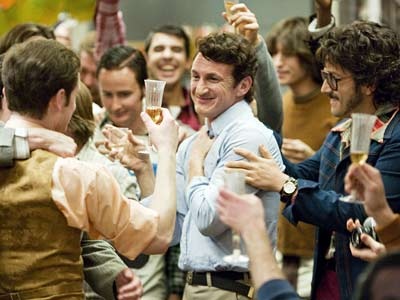
Milk represents a return to a more mainstream aesthetic for auteur Gus Van Sant after his experimental run of indie features - including Gerry, Elephant (perhaps the finest of his recent work), Last Days and the better of his two 2008 releases, Paranoid Park. A supremely conventional if largely entertaining biopic, Van Sant's Milk succeeds in gently highlighting the genuine injustices experienced by the pre-equal protection-era homosexual community. Then again, at least according to the Guardian's Mark Simpson, Milk whitewashes its eponymous hero's promiscuity, which would have at once made Van Sant's film less conventional, and counter-productive to the current debates surrounding the merits of gay marriage. In this regard, Milk's original appearance as implicitly political is shown to be inaccurate; Milk's historical revisionism serves an express legislative purpose. Sean Penn and Emile Hirsch are particularly memorable in their lead and supporting roles.

While sharing its 1970s world of politics setting with Milk, Frost/Nixon nevertheless manages to be the most sociologically current of this year's selections. (Aesthetically, the honor might go to Fincher's purely digital world, while Milk's release on the heals of the Proposition 8 defeat suggests its political currency.) Indeed, Frost/Nixon's subject feels perfectly in tune with Hollywood attitudes at the end of the Bush years: a lightweight celebrity learns to become politically engaged in the process of taking down - symbolically, of course - a Republican pol. No doubt Frost's surrogate trial was for director Ron Howard (lightweight celebrity anyone?) and screenwriter Peter Morgan a virtual indictment of the previous GOP administration; is it any wonder Frost/Nixon managed a nomination from Hollywood's elite body? Morgan's script, however, like his previous work on 2006's excellent The Queen, finds plenty of sympathy for this most unsympathetic of former leaders of the free world. Frank Langella's strong work also helps in this respect.

Presumptive 'Best Picture' favorite Slumdog Millionaire, directed by similarly favored Danny Boyle, seems to have connected with mainstream American critics and audiences in spite of its extraordinary intellectual simplicity and implausibility. Do we really need a series of vignettes to explain how the film's central "Slumdog" (a term that was very problematically invented by the film's makers, as it happens) came to learn a series of not-so-little-known facts? Of course, Boyle manages to equal his screenplay's triteness with moments of extraordinary grotesqueness and sadism: from a child's sewer bath to secure an Amitabh Bachchan autograph - so he does know who India's biggest celebrity is... I was wondering how he could! - to the blinding of a young beggar child to the female lead's implied rape. Uplifting to say the least... at least the slums produced a millionaire to gloss over these many invented injustices. Suffice it to say that 2008 was not Hollywood's most inspiring year.

Like one of 2008's best-reviewed films, the seemingly never-on-the-Oscar-radar Wendy and Lucy, Stephen Daldry's (justifiably) critically ignored The Reader centers on an implausible, unexplained characterization: in its case - spoiler - that its former Nazi female lead is illiterate. Of course, The Reader's narrative twist, excessively telegraphed by Daldry, provides cover (and potentially exculpation, as Ron Rosenbaum notes) for the serious question of individual complicity in Germany's Nazi war crimes. Daldry instead shoots for a dishonest moral equivocation in which we are led to have sympathy for the former prison guard (while Daldry assures us that we need not feel bad for one of her victims who, after all, has become wealthy in America). This year's Munich, The Reader is (to be overly generous) all about securing Oscar hardware - which it seems it will for Kate Winslet - by pairing the unconscionably fashionable combination of moral equivalence and Nazi sex. That Hollywood does not see how disgusting this film is indicates a fundamental lack of intelligence in its elite class.

While 2008 was a disappointing year for the American cinema, there were a handful of bright spots beyond Benjamin Button, even if Hollywood did not quite produce a great film as it has the past few years. To me, a better collection of 'Best Picture' choices, however improbable the majority are, would include, in alphabetical order: Be Kind Rewind (Michel Gondry), Gran Torino (Clint Eastwood), Momma's Man (Azazel Jacobs), Redbelt (David Mamet), and The Wrestler (Darren Aronofsky). This motley assemblage of termite art, populating the most minor of genres, reflects Hollywood cinema at its latter-day best - works of the first-person that reflect meaningfully on themselves and on their culturally-invisible working class subjects, living as they do in America's rarely projected rundown urban centers and anonymous first-ring suburban margins. Then again, Hollywood has always been at its best when being similarly disreputable.

Note: In the first draft of this post four and five were reversed. In thinking more of my order, however, a reversal seems imperative (as much as I detested the original #5). It is simply that The Reader is so reprehensible that giving any indication it was better than another film feels unjustified - as bad as that other film was.

Saturday, January 31, 2009

New Film: Of Time and the City

Of Time and the City represents both writer-director Terence Davies's first foray into documentary filmmaking and the Liverpudlian auteur's return to a non-fiction first-person after his obversely objective 2000 pinnacle The House of Mirth. Following more than a decade-and-a-half after his pair of autobiographical masterpieces, Distant Voices, Still Lives (1988) and The Long Day Closes (1992) - the former ranking as the finest British film since at least that nation's 1940s golden age, and the latter, the best of the rest - Of Time and the City likewise charts the pocked terrain of Davies's younger years, articulating his formative discontent via a jarringly emphatic first-person voice-over and the film's constituent found footage.

Davies's latest reveals a devout young Catholic whose faith never crystallized, transforming itself in the process to the "born-again" atheism that the director professes today. In this use of terminology, Davies marks his kinship with fellow UK northerner Morrissey, who twice used the phrase in early nineties tracks "Black-Eyed Susan" and "Nobody Loves Us." Of course, the similarities between the two extend well beyond this militant anti-religion: first, there is each's homosexuality, which to take the testimony of either has more often than not been experienced as loneliness; second, there is the remarkable directness of both Davies's and Morrissey's art; third, there is the miserablism that this candor takes in both instances; fourth, there is Davies's and Morrissey's related taste for the witty, well-constructed pop song, in supposed contradistinction to the bête noire's of the film director, The Beatles; and fifth, there is the romance of each for Britain's war-restricted, proletarian past, much more of which, it must be said, Davies lived through (the director was born in 1945 and the singer in 1959).

This last point of contact can be seen in the songwriter's referenced taste for the British kitchen-sink realism of Saturday Night and Sunday Morning (Karl Reisz, 1960) and This Sporting Life (Lindsay Anderson, 1963), which was a milieu it seems that Davies was raised in. Much of Of Time and the City's content in fact is concerned with the life of the factory houses of an older Liverpool that have since been raised (pictured) to be replaced by the depressing tower blocks that have come to define international skylines in the post-1960s world. Davies, like so many others, manages to romanticize these older working poor residences, in spite of the often unhappy childhood he spent there - and in spite of even the choking, polluted skies that his images showcase. In an originary critique of modernist architecture, the alienated vertical arrangement of flats disallows communal, empathetic existence. By comparison, the factory houses of Davies's youth promise a familial existence introduced by the under-class romances of Peggy Lee's "The Folks who Live on the Hill" (a perfectly selected piece of pop music for Of Time and the City) and Morrissey's "double bed, and a stalwart lover for sure" in his "I Want the One I Can't Have." All that remains now is the detritus and spray paint decorating the already decaying tower-flat walls.

Ultimately, there is a conservatism - and even according to Lisa K. Broad a classicism (beyond his stated taste for classical music) - to Davies's art, which can be seen not only in his nostalgia, but in the fludity of his montage. Namely, Of Time and the City, in spite of its compendium format, does not read as fragmentary, but rather as a continuous flow of an evanesced time that clearly suits the film's Proustian narration (Davies has long been singularly indebted to the French writer). In fact, as Broad continues, Of Time and the City lacks the epistemic skepticism of the modernist, archival documentary: this is a Liverpool he knows, and which he will endeavor actively to reconstruct. It is by the same measure no My Winnipeg (Guy Maddin, 2007) - again, Davies is far too concerned with lived experienced, unmediated by a surreal counter-reality. In sum, one can see in Of Time and the City how Liverpool, already the stuff of fiction, made Davies, whereas My Winnipeg shows a city remade in Maddin's perverse, Freudian preoccupations.

Returning to Davies film alone, the succession of images in Of Time and the City does not, at least in this writer's first viewing of the work, sustain the perfect organic progressions established in say Humphrey Jennings and Stewart McAllister's Listen to Britain (1942). Rather, in somewhat less impressive fashion, Davies models his latest after the more impressionistic editing of the Jennings's nonetheless striking London Can Take It! (1940) and Words for Battle (1941), with which it shares an overtly poetic soundtrack. Indeed, though Davies has since his Distant Voices... earned the status as the British cinema's new Humphrey Jennings - which is to say its greatest active poet - it is only with Of Time and the City that this inheritence has been made explicit. Thus, if Of Time and the City is not quite another Davies masterpiece, it is nonetheless central to the art of Britain's leading living director.

Saturday, January 17, 2009

New Film: The Wrestler

Darren Aronofsky's The Wrestler, from a Robert D. Siegel screenplay, provides the past year's most intelligent - and unexpected - use of a cinematic inter-text: Mel Gibson's The Passion of the Christ (2004). Quoting from the prophet Isaiah (chapt. 53), Marisa Tomei's stripper Cassidy compares Micky Rourke's eponymous Randy "The Ram" Robinson to the Messiah: "he was pierced for our transgressions, he was crushed for our iniquities, the punishment that brought us peace was upon him, and by his wounds we are healed." Significantly, Cassidy closes the quote by citing the Gibson film rather than the Biblical text, thus positioning The Wrestler as an inheritor of The Passion's particular exegesis - namely, that Christ's suffering (for mankind's sin) is the fault of all persons - as well as to its disfiguring violence. The Wrestler demands a similar, however secular, accounting of its spectators complicity in 'The Ram's' physical degeneration. With extreme caution, this line might be extended to Rourke's real-life decay in the public eye; regardless, the effects of the performer's lifestyle secure the film's unmistakable authenticity.

A second, implicit point-of-reference can be found in the similiarities shared between The Wrestler and the works of Jean-Pierre and Luc Dardenne.^ Most directly, Aronofsky and cinematographer Maryse Alberti's behind-the-shoulder camera work recalls the Dardenne brothers' 2002 The Son, which needless to say procured a Christian allegory of its own. The Wrestler's highly-identificatory mise-en-scène emphathetically showcases the everyday physical effects of the title activity and years of drug use (both professionally-enhancing and not) for Randy, as well as the bodily stress of the shoot and the self-medicating again for Rourke. Like his 2000 Requium for a Dream, Aronofsky has succeeded in creating an almost unimaginably mimetic art. While in both cases the films can be difficult to watch, even if The Wrestler does not even come close to Requium... in this regard, the director's latest separates itself once again for its thoughtful self-positioning within the aforesaid cinematic traditions.

The Wrestler likewise manages to artfully externalize its protagonist's physical and emotional distress. Like 'The Ram's' time-ravaged physique, Aronofsky's locations secure the same sense of a life ending, with their mid-winter, treeless settings: chief among these is the New Jersey trailer park in which Randy lives (which happens to recall another of the Dardenne's films, 1999's Cannes-prize winner Rosetta). Of course, this late year setting does form a background for one of the film's most winning passages - namely, the deserted NJ boardwalk where Randy and his estranged daughter (Evan Rachel Wood) return to the location of many of the pair's all-too-rare shared memories. In a tightly-framed medium close-up, Randy delivers an urgent, and truly heart-breaking monologue to the daughter, whom he admits he tried to forget. At least momentarily, The Wrestler shows itself to be among the most hopeful of this year's films. This scene's opening also shows the picture's, as well as 'The Ram's wit, in his choice of belated gifts for his daughter.

Of course, Aronofsky and Siegel deny us this happy ending. Randy is much too far degraded (in every respect) to achieve permanent reconciliation and restoration. While his 'performance' at his new deli-counter job again showcases his humor and hints at redemptive possibilities - Randy demonstrates a real aptitude with his customers that Arnofosky compares to the wrestling ring (with its back-stage passageway and the filmmakers' use of non-diegetic crowd cues) - a subsequent strip-club encounter with Cassidy deflates the newly rejuvenated Randy, setting off the course of events that will bring 'The Ram' back to the ring one last time.

The film's conclusive match reunites 'The Ram' with 1980s era-opponent 'The Ayatollah' in an unmissable reference to former WWF heavy The Iron Sheik, who famously (among former wrestling aficionados, as this writer was in his childhood) lost his title to Hulk Hogan. Indeed, local color is also supplied with a title credit sequence that includes magazine covers - including industry standard Pro Wrestling Illustrated - and by the participation of real-life grapplers, who really do experience a wear-and-tear in the ring, thanks to the razor blades and chair backs that bring the 'fake' sport to life. Among the film's most harrowing set-pieces is an autograph signing where Randy's compatriots - who it should be added never fail to act warmly towards the aging champion - wait for a very small number of fans, as they sit in their wheel chairs or with their catheters drooping below their pant legs'.

While Rourke does not in reality belong to this world in the same way, his Randy 'The Ram' Robinson is a flawlessly drawn and instantiated entry into their universe. In other words, Rourke deserves all the many accolades he has received for his extraordinary performance. Tomei's still beautiful, though similarly-near retirement Cassidy holds the screen with the former, in no small measure thanks to the actress's physical performance - which is to say her topless dancing. She is every bit as convincing in this role as Rourke is as a worn 1980s legend. (The film's 1980 period detail, including a perfectly placed Guns-N-Roses standard, does much to enchance The Wrestler's authentic characterizations.) Indeed, Arnofosky and Siegel's narrative, structured on its parrallelisms - their jobs, children and so on (she is the much better preserved) - is very much their story.

While there can be no denying the centrality of Rourke's epic performance in carrying the film, The Wrestler is nonetheless more than the sum or his or even their performances (Wood too is of note). Indeed, by virtue of its smart assimilation of sources and its mimetic formal articulation of content, Aronofsky's work is among best American films of the previous year, making the film very deserving of a 'Best Picture' nomination (certainly above frontrunners Slumdog Millionaire, The Curious Case of Benjamin Button and Milk) in addition to its sure-thing acting nominations.

^ It has been brought to my attention that Todd McCarthy makes the same comparison. If I noticed this after reading McCarthy (I cannot remember now if I did) I would like to cite the Variety critic. If I did not, then there really must be something to this convergence.

Monday, January 12, 2009

New Film: Wendy and Lucy

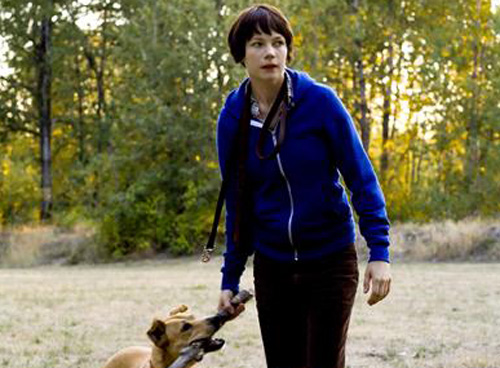
Kelly Reichardt's Wendy and Lucy, from a Jonathan Raymond story, commences with a credit sequence of freight trains arriving at a rail yard, followed by the eponymous Wendy (Michelle Williams) walking her companion Lucy (a yellow retriever mix) across an Oregon meadow. Reichardt's camera maintains an exceptional distance from her protagonists, signaling Wendy and Lucy's ensuing visual objectivity over an exceedingly long take. A woman's hum (subsequently revealed to be Wendy's) counters the image track. Following the film's title card, Lucy escapes into the woods, providing the first of two master-pet separations. Shortly, Wendy finds her canine amid a group of drifters, fireside, with whom she shares her plans to move to Alaska.

Wendy, like this briefly-glimpsed collective, exists on society's margins. Living with Lucy in her 1988 Honda, Wendy very carefully tabulates her relatively meager savings as she journeys to Ketchikan. After being woken the next morning by an insistent, if apologetic security guard (Wally Dalton), Wendy discovers that her car has stopped running. (As she correctly, later instructs her mechanic, her serpentine belt has cracked.) After pushing her vehicle onto the street, and discovering that she has little dog food remaining, Wendy sets off into the ditches where she begins to pick up discarded cans. In line to convert her findings into cash, Wendy willingly gives her bag to a crippled gent who likewise waits outside the can collection machine. (Indeed, a second act of charity will reinforce this emphasis.) As such, Reichardt establishes the same charity-oriented social vision that she introduced similarly at the conclusion of 2006's Old Joy.

With little cash in hand, Wendy thereafter proceeds to shoplift in a nearby supermarket. Catching the protagonist in the act, a straight-laced young employee (John Robinson) drags Wendy into his supervisor's office, where he piously offers that a person who cannot afford to care for a dog should not have one. Persuaded by the young man's screed, the said supervisor has Wendy arrested, leading to a long morning and afternoon in a local jail - and an unhelpful (to say the least) $50 fine. Returning to the scene of the crime, where she tied Lucy up before entering, Wendy finds her pet missing once again, setting off a frantic search that will occupy much of the brief 80-minute picture's remaining duration. Accordingly, Wendy and Lucy directly adopts Umberto D.'s (Vittorio De Sica, 1952) narrative conceit, with which it shares the lost dog plot-point.

Reichardt also summons the memory of De Sica's Bicycle Thieves (1948), and particularly the economic precariousness of that film's protagonists, which is undermined likewise with the loss of its income earner's loss of their primary means of transportation. However, Reichardt's De Sica retread makes no effort to explain how Wendy came to be in the position she is in, given her organizational abilities, the fact that she does not seem to have a substance-abuse problem, and yes, her physical beauty. If the situation in postwar Italy, as described by De Sica and Zavattini, can be considered at least somewhat normative - or at least plausible to the modern American spectator - Wendy's is another matter. While it might be clear enough that there are such economically marginal - and susceptible - figures, especially in this newly-minted recession-era US, making Wendy and Lucy particularly timely to be sure, the question of how such persons are made remains (apart from the very brief suggestion that she is lacking a familial safety net).

Ultimately, Williams's Wendy is a particularly implausible instantiation of the economically at-risk young American. While Reichardt might be afforded some latitude for her casting choice, given Williams's strong performance, her failure to explain how this outlier came into being does weaken the impact of her narrative diagnosis. This leaves the film's viewer wondering how rather than fully allowing for their empathetic participation. In other words, Wendy and Lucy suffers from its unwavering anchoring in Wendy's present, its objectivity in some sense, which is equally the film's aesthetic virtue. Nevertheless, Reichardt, in building on the socially-engaged point-of-view displayed in Old Joy, continues to show herself to be a genuine auteur of the twenty-first century American independent cinema.

Wednesday, January 7, 2009

New Film: Summer Hours / L'Heure d'été (Co- written by Michael J. Anderson & Lisa K. Broad)

Warning: the following post contains spoilers.

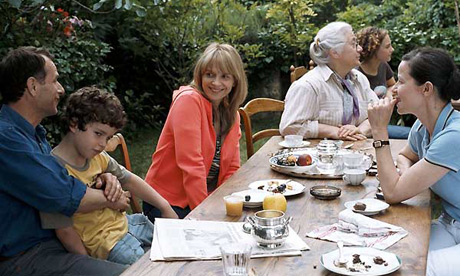
Writer-director Olivier Assayas's Summer Hours (L'Heure d'été, 2008), the second in a series of films commissioned by the Musee d'Orsay, opens on a group of children as they scurry through an emerald country estate. The eponymous season is rendered with exacting precision. Assayas and cinematographer Eric Gautier's exceedingly mobile camera pans between multiple figures as it searches for a narrative subject. On the macro level, the film's principle theme becomes immediately clear: the life of the three generations that have congregated to celebrate matriarch Hélène's (Edith Scob) birthday. Among these are her two sons, Frédéric (Charles Berling) and Jérémie (Jérémie Renier), and daughter Adrienne (Juliette Binoche). The latter two no longer live in France, with Jérémie in China and Adrienne in New York. Thus, when the question of the estate's sale comes up subsequently, the younger two siblings side with selling (as the family home no longer possesses a utility).

But back to the film's opening. Here, Assayas presents the first of three passages centering on the country home. Each of these focuses on one of the family's three generations, with Hélène the first emphasis and her grandchildren the last. After opening gifts from her children, she consults with Frédéric on how she wishes he will manage her estate after she passes. Much of the still striking seventy-five year-old's wealth derives from the art collected by her long-deceased artist uncle Paul Berthier, which includes a pair of Corot's that grace one of the residence's hallways. That Hélène shows a greater attachment to his art is not only a matter of her closer familial relation; as we learn subsequently, she was his last great love.

Yet, this skeleton is not entirely consequential to Summer Hours. Rather, Assayas's film is at its core a work of familial disintegration precipitated by Hélène's death. (Summer Hours resonates directly with the director's fine 1998 Late August, Early September, in both its emphasis on death and its seasonal precision.) With Hélène's passing, once again, Jérémie and Adrienne each opt for their financial gain, as reasonable as it is in their circumstances, over preserving the estate as a family retreat. In this way, Assayas traces the transition from a communal (family-centered) mode existence shared by Hélène's contemporaries to the more individualistic drive maintained by her children, whose lives are otherwise absent, contained in the film's many ellipses. The second generation's country home set-piece, following a heated discussion with the family's tax attorney in which Assayas's mise-en-scène divides into a confrontational shot/reverse-shot chain, and a subsequent brotherly reconciliation in which we discover details of their late father's life, depicts their preparation of the estate for sale. Assayas and Gautier maintain the low-key, interior lighting of the opening passage in this instance, though it is now the detritus of the homestead rather than Hélène's embodied presence, bathed in a deep cyan, and her implied recollections - in addition to a remarked upon Taiwanese flavor, Assayas's film showcases the influence of Andrei Tarkovsky and particularly The Mirror (1975) - that has become the camera's content.

The film's final generation moves into view with the revelation that Frédéric's eldest daughter has been arrested for shoplifting (in addition to her possession of a small quantity of pot). Again this dramatic peak comes to very little in the narrative, though it does serve to shift the film's focus. Shortly thereafter, Frédéric's two children hold a party in their soon-to-be-vacated family estate. With Summer Hours's camera once again mobilized and frequently shifting its human subjects, Assayas not only procures another communal life but concisely references his own masterful Cold Water (1994) - which here is updated in Summer Hour's shift into the present, with the incumbent new musical styles to match. Yet, Assayas also recognizes that there is sadness, at least for Frédéric's daughter, underwriting the conviviality. In an intimate conversation with her boyfriend, she notes teary-eyed that her grandmother once remarked that she would bring her children to this place. The liquidation of her family's heritage will indeed have consequences.

These consequences also include Frédéric and his wife's uncanny experience of their family art in the Musee d'Orsay. Though as his wife notes there are positive social values that derive from their bequeathing the art, its experience loses the personal dimension that it held in the family home. (In part, this passage seems to fulfill the film's commission, along with the behind-the-scenes documentation in which we see a miraculous restoration of a shattered Degas.) Much to Assayas's credit, we feel this loss as the pair look on at an art nouveau desk. In the end, Summer Hour's strength is precisely his articulation of such feelings, and of the details of a family life that extend well beyond the limits of the frame, beneath the film's surface representations and well into Hélène's past. Like A Christmas Tale (Arnaud Desplechin, 2008), with which Summer Hours forms a diptych of sorts (as each centers on the return of family members to their parental home) Summer Hours brings a family into vivid existence.

Of course, Summer Hours's differences with A Christmas Tale are far more instructive than its similarities: Assayas's film is all subtlety, refinement, economy and silence; it refuses temporal disjunction and stylistic disunity. To contrast, A Christmas Tale possesses the impulse to tell everything; the narrative is constantly moving beyond itself in its many acts of digression. Yet in both cases, this is contemporary French cinema at its very best. One film recommends itself above the other primarily on the basis of one's aesthetic inclinations, on their feelings toward stylistic unity/disunity, freedom/control, and so on. Consequently, this piece's two writers split on their preferences with Anderson inclining slightly toward the Assayas and Broad in favor of the Desplechin. Yet we agree wholeheartedly that Summer Hours is Assayas at his absolute peak.

IFC Films will distribute Summer Hours theatrically in 2009. In the meantime, the film is available on an Artificial Eye, region 2 [UK] DVD.