Thursday, March 13, 2008

More than a Glimmer of Hope: The Consequences of Love (2004)

Warning: the following post contains partial spoilers.

Perhaps no other national cinema to have ever reached the heights of the Italian industry has thereafter experienced a decline comparable to Italy's. The story hardly demands repeating: from the rise of neorealismo in the immediate aftermath of the Second World War to the deaths of Pier Paolo Pasolini, Luchino Visconti and Roberto Rossellini in the mid-to-late 1970s, the Italian cinema was among the world's most notable. And since? Italy's most recognizable cinematic accomplishments, apart from a handful of relatively minor works from aging masters Michelangelo Antonioni and Federico Fellini, have included Nanni Moretti's critically-lauded, if narcissistic film treatises - such as Caro Diario (1993) and The Son's Room (2001) - as well as the occasional exploration of the nation's previous century, from veteran director Francesco Rosi's Three Brothers (1981) to Marco Tuillo Giordana's The Best of Youth (2003). (A less generous accounting might also point to Cinema Paradiso [1988] or the films of Roberto Begnini, which together represent the best known Italian film art of the past two decades.) If Moretti has served as the leading international figure of the era, the source of the crisis is clear enough: Italy has not found artists to fill the enormous gaps left by its now departed masters.

The first decade of the twenty-first century, however, has provided a glimmer of hope in this otherwise depressing filmic landscape. In addition to Giordana's aforementioned The Best of Youth, a male weepy to stand beside the best of De Sica, the 2000s has brought world cinema Italy's first new major filmmaker in ages, writer-director Paolo Sorrentino. Sorrentino's strong 2006 release, The Family Friend (L'Amico di famiglia), which screened last spring at Walter Reade, demostrated an affinity with Fellini, though one that had been filtered through American maestro David Lynch. However, it is the director's more Antonioniesque 2004 title, The Consequences of Love (Le Conseguenze dell'amore), which truly reveals the extraordinary talent of the Naples native. The Consequences of Love opens with a wide-angle, oblique framing of a moving walkway and the neon lighting over head. A figure moves slowly toward the foreground in this extreme long take that Sorrentino has chosen to score with electronic music, as he has much of his film. With the camera reframing to capture the male subject getting off the walkway - with the music eliminated - Sorrentino joins the image with the excessively loud sound of his suitcase being drug across the steel boundary delimiting the rubber path and the adjacent floor. In other words, Sorrentino creates a wry punch-line out of this sudden change in figure movement and the accompanying audio.

The figure presented in this first sequence will be shortly confirmed as the picture's protagonist - through his authorship of the subsequent voice over. As his monologues commence, he tells us that "the worst thing for a man who spends a lot of time alone is a lack of imagination," and hence, that "I am not a frivolous man; the only frivolous thing about me is my name, Titta di Girolamo." Titta (played by Toni Servillo) may well lack imagination, but as it will become clear, it is his shyness that is his larger flaw. Not that he is otherwise without his shortcomings: as another bit of voice over will indicate, his one vice is the use of heroin once a week - and only once a week, always at the same Wednesday morning hour - for the past twenty-four years. Likewise, as will take even longer to make clear, his business involves delivering suitcases of mafia money to backrooms - a job that requires that he hold but not use a pistol. There will be one pivotal exception to both his use of firearms and also his weekly consumption of narcotics later in the picture.

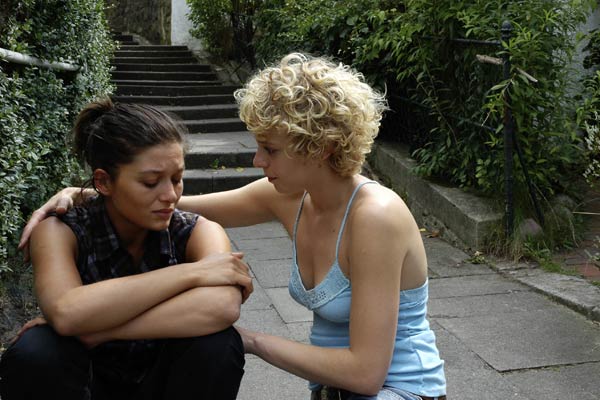
But first to the ultimate cause of each: Sofia (the exceedingly beautiful Olivia Magnani, granddaughter of Anna). Sofia is employed as a bar waitress at the hotel in which Titta has resided for the previous eight years. At the conclusion of her shift, she wishes "arrivederci" to the intractable male lead who invariably fails to respond to the gorgeous brunette. Rather he simply watches her leave, through the large sidewalk-facing windows, in the driver's seat of an automobile with an unidentified - for the moment, at least - male. But he, and Sorrentino's camera take notice, with the latter panning in slow-motion from her lips down to her legs, or subsequently sneaking a peak of the beauty topless as she changes following her shift. Titta, for his part, finally works up the courage to at least sit across from her at the bar, an act that he describes as the most "dangerous" of his life.

This existential act follows the arrival and departure of Titta's brother, nineteen years his younger, who shallowly chats up the same woman that the former can not even greet in passing. Sitting with his brother in the same seat he always occupies, Titta's brother witnesses Titta's poor treatment of the woman, who in the presence of both complains that the older gentleman does not even notice or respect her enough to return her daily goodbyes. Obviously this is far from the case for the lead who is already contemplating the "consequences of love." Thus, with this confrontation and his subsequent successful encounter with the lady, Titta becomes emboldened, leading the gentleman to plunder a large denomination of mob money for the express purchase of buying the woman a gift - which she correctly interprets as an attempt to buy her love. It goes without saying that there will be consequences for this act, but indeed it will be a second shortfall that prompts greater problems with the syndicate.

The resolution for both plot lines will rely on a formal strategy unique to The Consequences of Love: namely, of the temporary withholding of details germane to the narrative, only to be revealed thereafter in an explanatory manner. With respect to the romantic resolution of sorts, Sorrentino temporarily suppresses a piece of recent action in order to inhabit Titta's psychology (and to create suspense) at the decisive juncture. With regard to his encounter with the mafioso bigs, Sorrentino hides a key plot point until the confrontation occurs, in this case divorcing spectatorial knowledge from that of his protagonist - again in order to magnify the suspense of the situation. Sequence is repeatedly suspended for the sake of suspense, whether at these key moments or in less dramatic passages, where the technique is effectively used for the sake of explanation.

Apart from the film's remixing of sequence, it is the director's jarring use of soundtrack - with an unmistakable taste for both moody electronic and pulsating house styles - juxtaposed with the film's continually mobile visual track that marks Sorrentino's disctinctive, and one might even argue post-modern aesthetic. Post-modern, or post-modernist, less for either of the above than for Sorrentino's ironic world view, emphasized in his glib sense of humor (other great example include a figure walking into a pole in a silent bird's-eye view, cross-cutting that provides ironic commentary and his pitch-black culminating inversion of The Family Friend's opening) and his all-permeating taste for the cool. We might also see his post-modern qualities in his engagement with the mafia generic tradition and finally his signposting of national cinematic traditions - and particularly his relationship to Antonioni, not only in his adoption of that director's erotic subject matter twined to matters of commerce (The Consequences of Love refracts the master's L'eclisse, 1962) but also in the cranes that loom over the post-industrial landscape. The Consequences of Love, like The Family of Friend, is a work that responds and indeed even adds to the tradition of the Italian cinema. There is more than a glimmer of hope here.

Both The Consequences of Love and The Family Friend are available on Artificial Eye Region 2 DVDs.

Monday, March 10, 2008

New Film: Be Kind Rewind (by, Lisa K. Broad & Michael J. Anderson)

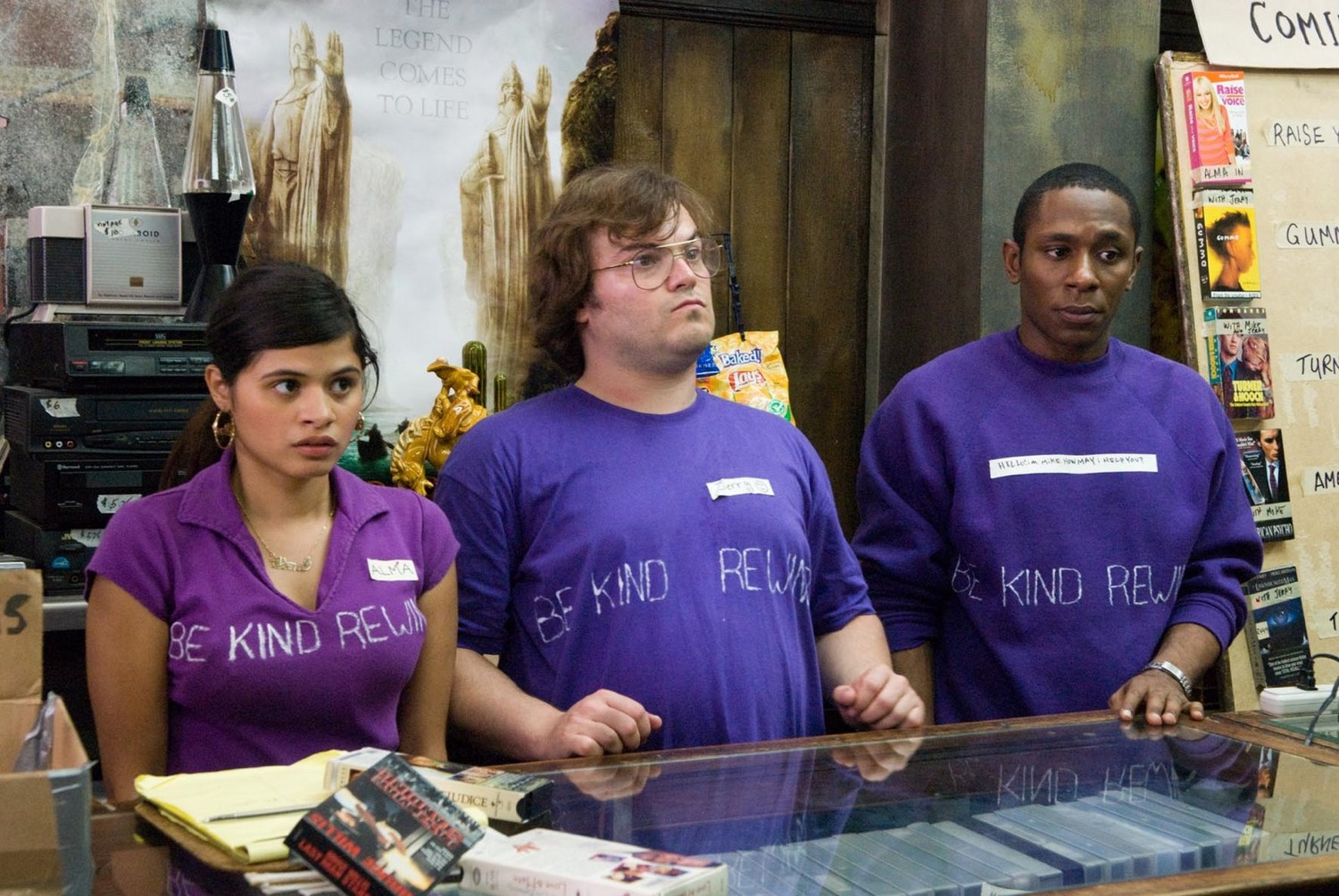
Never lacking in the esoteric, the cinema of writer-director Michel Gondry has established itself as a intellectual node for the concerns of contemporary film theory, from the storage-retrieval allegory of Eternal Sunshine of the Spotless Mind (2004) to the film/museum interface of The Science of Sleep (2006). While Be Kind Rewind is no less attuned to either film theory as a discipline or to the current horizons of the visual art world - in the case of the latter to Bourriaud's Relational Aesthetics and its engineering of social relations - the director's latest emerges primarily as a hymn to the cinephile of the very recent past. Located in a Passaic, New Jersey video store that anachronistically rents only video tapes - at the bargain price of $1 per day - Be Kind Rewind proceeds following a more extravagantly-outdated science fiction scenario involving the erasure of the shop's entire collection at their exposure to a magnetized Jack Black. With one of the shop's more loyal patrons (Mia Farrow) requesting their copy of Ghostbusters, while holding its nostalgically-tattered black box, Black and store clerk Mos Def are ultimately forced into reshooting (on camcorder, of course, over the blank tape) the video-era staple, with the latter as Bill Murray and Black as everyone else - though a third, late middle-aged African American male compatriot will subsequently play Sigourney Weaver (who will make a cameo later in the film). Remarkably, their post-production edit-free gorilla remake finds a receptive public among Farrow's gang-banger nephew and his friends who themselves demand copies of their own preferences, including another mid-1980s mainstream genre classic Robocop.

From the humble location beginnings of Ghostbusters to their no less humble subsequent productions of Rush Hour 2, The Lion King, 2001: A Space Odyssey, The Umbrellas of Cherbourg, et al., Black, Mos Def and third-party Latina participant Melonie Diaz forge something of b (or z)-film local studio using their Passaic neighbors as the bit players in their never less than ingenious - and inaccurate - re-stagings of the aforesaid video store axioms. In other words, Gondry grafts an allegory for early film production's rationalization onto the film's overarching metaphor of video's displacement by DVD. In fact, to speak of the film's early film references, Be Kind Rewind does contain an original production, on supposed Passaic native, jazzman Fats Waller - screened for the neighborhood on a white sheet (rather than on a destroyed television set; Gondry's film also, importantly, bemoans the loss of a public sphere in the video and now digital eras) that utilizes black-and-white celluloid and inventive production techniques to similuate lower projection rates and the scratches of old film stock. And then there is the filmmaker's ingenuity, which mirrors no one so much as cinema's original magician Méliès himself.

Apart from the meta-text's early film and video-era points of departure (another obvious nod is to Back to the Future, 1985) it is Spike Lee's cinema that account for many of the most direct film-specific references, from that director's Do the Right Thing (1989) and store-owner Danny Glover's implorations to the police to avoid a riot by allowing a screening of the aforesaid original production - as well as in Black and Mos Def's comical brick-through-the-window set piece - to Glover's gentle, inaudible rebuke of Black after the latter shows up to a casting in black face (cf. Bamboozled, 2000). Like Lee's earlier work in particular, Be Kind Rewind is very much concerned with the growing pains of its economically depressed, though communally-tight locale, which in the case of Gondry's picture is beset by a culturally euthanizing process of gentrification. To extend the metaphor, this is a film concerned with cinema's analogous gentrification.

So too its globalization. If there is a societal villain in Be Kind Rewind, it is the Hollywood and Blockbuster-styled West Coast Video with its multiple copies of a very limited selection of action-adventures and comedies, the only two forms that remain in the DVD age outlet. In contradistinction, Gondry's DIY fan-inflected remakes provide an antidote to these toothless blockbusters, in much the same way that his own work operates within the system: that is as products for a small, but devoted following connected not by Passaic's community ties but by the virtual network of cinephilia. Obviously, this new configuration is no replacement for the dystopian Passaic utopia imagined (though rendered impossible) by Gondry.

The above piece, as the title makes clear, represents a collaboration between my wife Lisa and I - with Lisa receiving top-billing not because of any chivalrous feelings on my part, but rather due to the simple fact that most of the best ideas were hers. For more wife and husband reviews, please check out our friends Maggie and Mike Lyon who have begun each writing reviews on the large number of films they see. If you do, you may notice the preponderance of films from 1978. The reason? The Lyon's have begun research to each construct their annual ten favorite films - I wonder where they got such a marvelous idea? - beginning with Mr. Lyon's year of birth and moving toward the present. With so much original content from two very talented film scholars, you won't want to miss any of it.

Wednesday, February 20, 2008

New Film: The Edge of Heaven (Auf der anderen Seite)

Warning: the following post contains spoliers.

Fatih Akin's German-Turkish co-production The Edge of Heaven (Auf der anderen Seite), from a script by the director, received a well-deserved best screenplay citation at last year's Cannes international film festival - well-deserved not simply for the impressive acrobatics of its plot, but by virtue of the fact that Akin's writing does the majority of the work in The Edge of Heaven. Following a short, geographically and temporally undefined prologue that will be repeated later in the work, Akin introduces the first section, stipulating the death of someone named Yeter, whom we soon learn is a Turkish prostitute in Germany (played by Nursel Köse). After a couple of meetings, Ali (Tuncel Kurtiz) invites Yeter to live with him, to which she consents after being menaced by a pair of Turkish men on the train. (The disquieting subtext, surely, is the spectre of the possible future establishment of sharia law in Europe.) Following Yeter's death, Ali's son Nejat (Baki Davrak) returns to his and Yeter's native Turkey in search of the latter's estranged daughter.

Part two commences with a similar title reading "Lotte's death." Following the same pattern, we are shortly introduced to the namesake of this second title (with Patrycia Ziolkowska in the role). Yet her presence in the narrative is preceded by the introduction of Yeter's aforementioned daughter, Ayten (Nurgül Yesilçay). The latter comes into contact with Lotte only after she is forced to flee Turkey following the compromise of her radical identity to the state's police. In Germany her initial search for her mother proves unsuccessful, though she does move in with Lotte and the latter's mother (Rainer Werner Fassbinder's axiom Hanna Schygulla). Here, the two young women sleep together before the latter is deported following a traffic stop. This incident prompts Lotte to travel to Turkey to seek the now imprisoned Ayten's release. However, before she can complete the task, the film's second intertitle is fulfilled.

The third and final part, introduced with the film's title, witnesses Schygulla's trip to Istanbul following her daughter's death. In this section we have the further convergence of the two plots, which have already coincided not only in the identities of the characters, but even in a single shot featuring mother and daughter unwittingly and unknowingly within the same frame. Hence, part two does not follow the first chronologically, as it at first seems, but rather overlaps, positioning the film within the tradition of European master Krzysztof Kieslowski. Indeed, like many films in the Polish director's corpus - from Blind Chance (1981) through The Double Life of Veronique (1991) and the 'Three Colors' trilogy (1993-4) - chance encounters and near misses structure Akin's narrative.

Unlike Kieslowski's baroque cinema, however, Akin's mise-en-scène does not find (or even search for) a visual metaphor for its thematic content. Rather, The Edge of Heaven systematically utilizes wide-angle lenses, staging in depth and longer than average takes to record the film's script. Admittedly, this visual rhetoric can itself be defined as baroque - in the fashion of post-Toland Hollywood filmmaking - as can the picture's relatively circular structure and its open ending. (Perhaps the film's most visually distinct moment - and its most pronounced break from the prior matrix - is likely a series of overhead framings that render Schygulla in the process of grief; though somewhat novel, this passage may be among the film's weakest moments given its award-pandering foregrounding of performance.)

Still it is less Kieslowski who serves as the principle inspiration for The Edge of Heaven than it is Akin's European countryman R. W. Fassbinder. Indeed, each of the film's two parts decisively reference the director's well-known 1970s corpus, as does obviously Schygulla's presence. In part one, and to some extent in part three, Fear Eats the Soul (1973) provides the primary referent - each contains a Muslim immigrant named Ali in a relationship with a woman. Unlike Fassbinder's film however, where it is a German woman and the racial other, The Edge of Heaven represents a Germany that is increasingly defined by its Islamic minority. In the case of part two, on the other hand, the clearest point of reference seems the director's lesbian themed The Bitter Tears of Petra von Kant (1972) with its blonde (Schygulla) and brunette leads - and a third party, which in this case is filled by Fassbinder's frequent performer.

Once again, it should be repeated, Fassbinder's inspiration finds its expression less in the film's visuals, as striking as the late director's mise-en-scène often is, than it procures a template for the picture's narrative, which again is the picture's greatest strength. Surely, like The Lives of Others from the previous year (which as with The Edge of Heaven was chosen as Germany's entry for the Academy's best foreign language prize), Akin's film represents high-level mainstream art filmmaking, manifesting high production values, exceptional performances and a strong script. While it may not be the equal of the best German productions of the past couple of years - namely Valeska Grisebach's Longing , Stefan Krohmer's Summer '04 (both 2006) and even Christian Petzold's Yella (2007; in its case less for its writing than for the Petzold's "slow-burn" direction) - The Edge of Heaven remains noteworthy cinema nonetheless, which is no small feat given its essentially middle-brow ethos.

In sum, The Edge of Heaven marks a respectable mainstream art cinema to parallel Germany's rich independent (or if not independent at least smaller scale) vein of filmmaking; there really seems to be a "new wave" here.

Monday, February 18, 2008

New to DVD: The Assassination of Jesse James by the Coward Robert Ford + Best Picture Preferences

Writer-director Andrew Dominik's The Assassination of Jesse James by the Coward Robert Ford extends both its generic model - the revisionist Western as exemplified by Sam Peckinpah's 1962 masterpiece Ride the High the Country - and also the early twenty-first century's preoccupation with proto-cinematic media (cf. Neil Burger's 2006 The Illusionist, among others). With respect to the former, the picture's near ubiquitous situation within the winter months alone (as compared to Ride the High Country's autumnal setting) locates the film after the Western, to the extent that is that Ride the High Country represents the symbolic end of the form and the director's subsequent The Wild Bunch (1969) is the supposed last Western. Indeed, The Assassination of Jesse James... figures not only a tradition that is already over (the Western), but also an era that has similarly concluded, a hero whose career (as robber) finishes shortly after the film's beginning and most obviously of all, whose life, the title tells us, will soon cease. The Assassination of Jesse James... does not preside over the death of a form; it lives after the Western's death.

Which leads one to Dominik's film's obsession with the proto-cinematic and all things nineteenth century - at a time that many of the earlier era's inventions are being displaced by newer (digital) technologies. In fact, The Assassination of Jesse James... exhibits frequent digital manipulation to simulate the visuals of the earlier period: i.e. with the edges of the frame blurring to intimate similar effects in the daguerreotype or on early film stock; and with monochromatic visuals that suggest the tinting of a pre-Technicolor era. Moreover, with the assassination complete, the eponymous Ford (Casey Affleck), himself a collector of Jesse James dime novels, reproduces the incident on stage. In sum, The Assassination of Jesse James... seeks the recreation of not only Jesse James's (Brad Pitt) last days but of the formal preconditions for cinema itself - again at a time when it is being transformed under the digital sign.

Nevertheless, The Assassination of Jesse James... may be less notable for its allegorical and generic valences, as noteworthy as Dominik's interventions may be, than for Roger Deakins's cinematography and for Affleck's performance - both of whom have secured well deserved Academy nominations. Regarding Dominik and Deakins's visuals, The Assassination of Jesse James... features a large share of the year's most unforgettable imagery, from the arrival of the train during the picture's first act robbery - a bright incandescent light glows in the distance with the wide-hooded thieves waiting in the fore; the robbers subsequently cross through the golden hued, claustrophic interior of the night train - to the frequent time-elapse skyscapes that decorate the work. To be sure, this is a work of the imagistic and of visual ornamentation (style here is certainly an add-on) though it is also rhetorically cognizant of its form's past and particularly to the equally image-oriented John Ford - and to that director's shadow-cast foregrounds with well-lit landscapes framed beyond.

And then there are the film's performances whether it is Pitt's stabilizing star-turn or Affleck's squeaking, fidgety Robert Ford, whose villainy this picture largely refutes on the basis of his sympathetically pathetic portrayal. Ford is the original celeb-worshipper who happens to be as at home in our age as he seems appropriately suited to the era of James. It is a performance of astonishing singularity to Pitt's notable abstraction (in the words of film scholar Lisa Broad).

All of the above should have made The Assassination of Jesse James by Robert Ford, in a perfect world, worthy of a best picture nomination. At the very least, this writer would argue that The Assassination of Jesse James... is clearly superior to three of this year's selections - Joe Wright's Atonement, Jason Reitman's Juno and Tony Gilroy's Michael Clayton - as good as each of these films might be, and is every bit the equal of a fourth, Paul Thomas Anderson's impressive if somewhat overrated There Will Be Blood. (Making a film that feels like one's sources - namely Kubrick's Barry Lyndon or Terrence Malick's Days of Heaven, which is itself a key point of reference for Dominik's picture - does not assure a film's greatness, even when it does demonstrate its maker's considerable talent.) However, in its effortless combination of Western and horror syntaxes and noir semantics, No Country for Old Men remains the cream of this year's best picture crop.

Apart from No Country for Old Men and The Assassination of Jesse James..., the aforementioned perfect year might have also included nominations for Wes Anderson's significantly underrated The Darjeeling Limited, David Cronenberg's English-language film of the year, Eastern Promises, and David Fincher's career-peak, Zodiac. Still, these personal preferences aside, 2007 proved a uniquely strong year in the American cinema, and even among those pictures cited by the Academy. Thankfully no Crash's or Little Miss Sunshine's in the lot, regardless of what Juno's most fervent detractors might believe.

Saturday, February 9, 2008

Correspondences from 1989: No, or the Vainglory of Command

This is the first in a series of posts devoted to Yale University's 1989: Film Culture and the Fall of the Wall film festival, which screened February 7th through the 9th in New Haven, CT. Please note the following piece contains spoilers.

Manoel de Oliveira's No, or the Vainglory of Command (1990, 'Non', ou A Vã Glória de Mandar), from a P. João Marques text with dialogues added by Oliveira, is said to have marked an "international breakthrough" for the Portuguese master, whose first directorial credits included the silent 1931 short Douro, Faina Fluvial and the filmmaker's superlative 1942 feature debut Aniki Bóbó. It would be twenty-one years until Oliveira's next full-length feature, the 1963 passion-play Rite of Spring, and yet another decade-plus before the director would work continually in the cinema. However, as the well-known story goes, Oliveira has not only remained active since the late 1970s, but has indeed increased his output in recent years, releasing an average of at least one film per year since No, or the Vainglory of Command. The fact that the still working Oliveira will turn 100 this coming December makes the above narrative nothing short of miraculous. That Oliveira's output from the early 1990s has proven the most continuously experimental and inventive corpus in the European cinema exceeds all hyperbole.

No, or the Vainglory of Command represents the director at his finest and in very familiar territory: the history of his Portuguese homeland. Briefly, it is worth noting that following No,... the director expanded his subject to discuss the broader parameters of European civilization, as for instance in his supreme 1993 masterwork Abraham's Valley, and also in his exceedingly topical, small-scale 2003 opus A Talking Picture. Of course, the latter refers to a trans-European identity that has remained current in the era of the EU and particularly in the period following the installation of the Euro. In other words, the director has retained his interest in his sovereign homeland, whatever the current dividing lines might be.

The 1990 work, set at the brink of the 1974 revolution that ultimately dethroned Salazaar, centers on a group of soldiers in the midst of transport in Angola. Oliveira depicts his human subjects initially back-to-back on the flatbed of a truck and later seated in a circle in a small clearing. In both locations, the soldiers wax on the their nation's military history and on the philosophical implications of the state. Beginning with the region's first anti-Rome insurgents and continuing into the early modern era, the discussion of specific figures (Viriato) and battles (Alcácer) initiate flashbacks that complete the stories begun by the modern soldiers. In many cases, the actors in these earlier eras are played by those same gentlemen who are narrating the story: Luís Miguel Cintra, for example, serves not only as Ens. Cabrita, but also as Viriato and Don João de Portugal. Hence, the modern day narrators' role in forging the fiction is highlighted in the overlapping casting of these historical moments. This is a history being told, not merely one that is shown.

In this respect, No,... belongs to a traditional of theatrical filmmaking dating to Sacha Guitry's 1930s canon, and particularly to that filmmaker's 1936 The Story of a Cheat. Though not precisely equaling Guitry's distain for the cinema, Oliveira nonetheless has persisted in questioning the medium's ontological individuality, arguing that 'cinema does not exist,' only theatre does. With No,... cinema's theatrical antecedent - or in Oliveira's frame, its fundamental nature - is made manifest in the picture's extended passages of dialogue in which the speakers are often framed frontally and are removed from their spatial setting (as for instance on the back of the flatbed). In fact, this is a film that not only isolates and emphasizes the speaker, but one that makes the content of their dialogues cardinal to the narrative. The sequences of action serve - they illustrate - the narrative's conversations.

The picture's lone break from this pattern of straight-forward illustration occurs with the arrival of Vasco de Gama (Paulo Matos) in a native - read virginal - land. Here, the arrival of the explorers, previously named the one positive of Portuguese imperialism, is met by naked young male cupids, and voluptuous nude nymphs. Consequently, Oliveira shifts registers to that of allegory (and fantasy) figuring the settlement of new worlds in the imagined coupling of European explorer and virgin body. Soft focus to intimate this fantastic setting has replaced the hard lighting of other passages - as for instance in the palace settings of the Iberian empire segment.

Nevertheless, this allegorical valence is largely absent in No, or the Vainglory of Command. Rather, once again, the film's breaks from its frequent, extended passages of conversation to depict various losing military campaigns and other instances of historical irony that contribute to the film's thesis: something to the effect that imperial ambition has always been to the ruin of the Portugese people. Therefore, No,...'s primary purpose seems less the narration of the nation's history alone than it is the elucidation of a thesis specific to that nation's experience. In this way, Oliveira's film follows in the tradition of Sergei Eisenstein's 1928 October.

Moreover in its particular theatrical method of narration and address, No,... might further be said to connote a third form of cinematic modernism beyond those of the 1920s visual arts avant-garde (Ballet Mechanique, et al.) and the postwar literary modernism exemplified by Michelangelo Antonioni (eg L'Avventura; and to some extent picked up by Oliveira in his subsequent Abraham's Valley). Rather than exemplifying modernity in an abstraction of visual forms or in the novelistic rendering of ennui, No... represents the form of Brechtian history lesson, shot in discrete segments of an ever-shifting proscenium.

Saturday, January 26, 2008

New to DVD: The Naked Prey (1966)

Actor-director Cornel Wilde's The Naked Prey (1966, Paramount), from a Clint Johnson and Don Peters screenplay, seems to have introduced a revisionist ethos into the adventure picture's postwar safari cycle. Wilde's film followed four years after the safari form's ultimate masterpiece, Howard Hawks's Hatari! (1962, Paramount), which itself was released after a near decade gap in the production of A-pictures of the type - namely, of such pictures as King Solomon's Mines (Compton Bennett and Andrew Marton, 1950, MGM), The African Queen (John Huston, 1951, United Artists), The Snows of Kilimanjaro (Henry King, 1952, Fox) and Mogambo (John Ford, 1953, MGM). While Hatari! effectively fulfills the earlier tradition, finding solutions to a number of the form's ongoing problems - not the least of which was the issue of how to show its actors in the same spaces as its African wildlife, i.e. how to show its stars in real or at least plausible danger; Hawks did exactly this by using his performers as their own stunt people - The Naked Prey retreats from Hatari!'s literal safari experience toward a form closer to the picture's 1950's era touchstones.

The Naked Prey relies on two ontologically-differentiated registers, documentary and non-documentary, that rarely converge within the picture. When we do see the film's director-star in the same space as the wildlife, he occupies a plane far removed from those in which we see an elephant or a giraffe, for example. (The one exception to this rule seems to be snakes with which Wilde on a couple of occasions comes into close contact.) In this respect The Naked Prey renews the mixed nature of the 1950's period work that Hatari! and its filmmaking as a safari mode did much to overcome. In other words, the lack of realism that the earlier pictures worked so hard to minimize is again manifest in the 1966 picture.

Backing up, The Naked Prey treats a safari guide's (Wilde's) attempt to escape from and subsequently outrun a band of African tribesmen after his employer - a wholly unsympathetic figure who incredibly professes a desire to go into the slave trade - needlessly runs afoul of the aforesaid tribe. In this regard, The Naked Prey might be regarded less as a safari film than as an adventure picture which uses occasional safari footage as does The African Queen for instance. Either way, The Naked Prey, like Huston's picture, features the same problem that all 'A' safari pictures share - again how to believably combine documentary and non-documentary footage to simulate a single diegesis. In its case, the fact that Wilde shot on location in South Africa mediates the visual differences prompted from a combination of location and studio settings found in such pictures as The African Queen or The Snows of Kilimanjaro. Here, it is simply that the footage is sutured by its traditional shot/reverse-shot pairing of images.

If in terms of its style The Naked Prey does not exactly figure an intervention into its genre, the work's narrative structure and certain of its dramatic details nevertheless indicate a true revision of form. (Hatari! on the other hand is all dialogue; Hawks's picture, along with its 1959 sibling Rio Bravo, provides nothing short of a model for the cinemas of such word-obsessed auteurs as Eric Rohmer and Quentin Tarantino.) For one, this is a film that features very little dialogue following Wilde's initial escape from the tribesmen. Once on his own, nearly all of the conversations we hear are those of the Africans' which Wilde has chosen not to translate. In these instances, the English-speaking viewer is forced into a position of 'other,' prevented the experience of knowing what is being said - in comparison to an imagined South African public (speakers of the unnamed dialect) who would receive a much different dramatic experience. Likewise, the picture's overarching narrative, of a man silent and on his own in the African veldt, procures an effect fundamentally dissimilar to those secured in most adventure films: this is an anti-adventure film of a sort. Far from the visceral experience of John Wayne and company in speeding trucks on the trail of real African game, Wilde's picture gives us the anti-spectacle of his character hunting a small lizard with a spear (which we see in an extended-duration long shot).

This is not to say that The Naked Prey entirely lacks action. During the initial capture of the white safari-goers, for instance, Wilde treats us to their ritual torture in a series of graphic set-pieces that reaffirm the period's violent turn. Likewise, in true exploitation fashion (we also see many topless female natives during the same scene) our protagonist is forced to kill a number of his pursuers one by one. If The Naked Prey does not therefore connote a revolution in visual form inasmuch as we are given shots and their reverse angles throughout the majority of the picture, Wilde's film nonetheless signals the most graphic entry into the safari tradition: not only in terms of its human violence, but in that of the animal world as well, which Wilde includes to allegorize the human savagery depicted on screen.

In the end, The Naked Prey emblematizes a key direction in the post-classical Hollywood cinema: namely, of a revisionist cinema that supported a new permisiveness in content and narrative experimentation, while largely retaining the shot/reverse-shot armature of the classical mode. While the latter choice does not entail a value judgement in its own right, the effect of this technique in a work following Hatari's spatial integration of performers within a wild context - which itself relied on a formal revision of classical decoupage in the form of a greater density of multi-figure, extended duration shots - marks a regression in the safari picture's historical development as a form with its own unique set of problems. Apart from these aesthetic concerns, however, The Naked Prey emerges as an important node in the history of the adventure picture.

The Naked Prey is currently available on Criterion DVD and will be broadcast on TCM February 1st at 4:00 PM.

Monday, January 21, 2008

Film in New Haven: Ernie Gehr's Eureka (co-written with Lisa K. Broad)

Ernie Gehr's Eureka (1974-1979), which screened in 16mm last night at Yale University's Whitney Humanity Center, constitutes a synthesis of two of the more noteworthy trends in the North American avant-garde cinema of the late 1960s: of the ontologically-inflected long-take structuralism of Michael Snow's Wavelength (1967) on the one hand, and of the rephotographed interrogation of the silent image in Ken Jacobs's Tom, Tom, the Piper's Son (1969) on the other. In Eureka, the Milwaukee-born experimental filmmaker has re-photographed a 1905 phantom-ride newsreel of San Francisco's Market Street, multiplying each frame eight times. With the picture's 16fps projection, Gehr has stretched the original five minute film into a new thirty-eight minute form.

Following in the tradition of Snow, and prefiguring the latter-day structuralist cinema of James Benning (Ten Skies and 13 Lakes, both 2004), this extended duration is comprised of a limited number of takes that will conclude at an immediately discernible juncture - in its case, when the phantom-ride reaches a skyscraper at the end of Market Street. Like Tom, Tom, the Piper's Son, Gehr's work reuses an early film source for new conceptual ends; however, unlike Jacobs's painstaking horizontal analysis which organizes a swarm of detail into set of discreet events, Eureka emphasizes the vertical flow of continually changing images. In other words, Jacobs's film explores simultaneous movement within the frame, while Gehr's privileges sequential movement between frames.

Indeed, Eureka, in greatly slowing the visceral five-minute document, has nevertheless retained the experience of the unexpected that accompanies the mobile newsreel in the urban environment. It is very much this experience of the unexpected that recommends Eureka and accounts for its aesthetic interest. Like the Benning films noted above, Eureka plays on audience distraction throughout the majority of the film's thirty-plus minutes (save for the spectators' increased intensity as the skyscraper nears) utilizing our inevitable drift and subsequent renewed focus to make what passes exceedingly slowly before our eyes exceptional and even exciting. That is, after loosing focus, we take a look at the film again and what we see is surprisingly different than our last vantage. For instance, as the intensity of the natural light source wanes, the bleached image is replaced with a more nuanced mise-en-scène that discloses the brick paving unexpectedly, relatively late in the film's run-time.

However, it is often less the effects of light and shadow on the original picture's high contrast stock than it is the effects procured by the slowed motion that secures the picture's substantial aesthetic interest. In particular, with automobiles and streetcars passing surprisingly close to the image, we are not only made to experience the breathtaking pace of turn-of-the-century urban life as is undoubtedly manifest in the original, but are also forced to consider precisely where the camera is located vis-à-vis the oncoming traffic. That is, with cars seemingly breaching the space of the appartus, the (focal) distance between the camera and the world depicted is underlined. We are made re-aware of the camera's location in space and of the world that we never get in reverse.

Eureka yields infinitely more information than is at first clear. With the camera moving slowly forward, stretching out the image's frontal spatial field, pools of light and new corners of interest open themselves up with each successive frame. What we have is a cinematic Zeno's paradox, where the sense of of expanding space seems to cancel our movement toward the distant terminus, while a hightened awarness of the still frame brings the medium's fundamental stasis is back into view.

Further works by Ernie Gehr, curated by Richard Suchenski, will be screened at Yale University's 212 York St. facility on February 6th at 7:00 PM. The series will include Serene Velocity (1970, 16mm, 23 min.) Untitled (1977, 16mm, 4 min.) Signal - Germany on the Air (1982-1985, 16mm, 35 min.) Side/Walk/Shuttle (1991, 16mm, 41 min.) and Passage (2003, 16mm, 15 min). The total running time for the five films is 118 minutes.