Sixty-Eight! Europe, Cinema, Revolution?
A Film Festival and Conference at Yale University
Thursday, February 15 to Saturday, February 17, 2007
Whitney Humanities Center, 53 Wall St., New Haven, CT
Sixty-Eight! Europe, Cinema, Revolution? will focus on the New Wave cinemas of Eastern and Western Europe leading up to and in the aftermath of the political showdowns of 1968. The European Studies Council, along with the Film Studies Program and the Department of the History of Art, has organized the festival around a wide variety of films from many countries, from little-known gems and avant-garde shorts to recognized cinematic classics. The festival will interlace feature films, documentaries, and experimental films with introductions by scholars and critics from a range of disciplines, and informal panels and open discussions. A complete list of participants and details may be found at http://www.yale.edu/macmillan/europeanstudies/1968
Thursday, February 15
7:00pm Far From Vietnam (Jean-Luc Godard, Joris Ivens, William Klein, Claude Lelouch, Chris Marker, Alain Resnais and Agnes Varda, France, 1967, 16mm)
9:30pm I Am Curious - Yellow (Vilgot Sjoman, Sweden, 1967, 35mm)
Friday, February 16
9:00am Cinegiornali liberi (Cesare Zavattini et al., Italy, 1968, 16mm)
Classe de lutte (Les Groupes Medvedkine de Besancon, France, 1968, 16mm)
La reprise du travail aux usines Wonder (Etats generaux du cinema, France, 1968, DVD)
10:45am Discussion: Giorgio De Vincenti (Universita di Roma-III), Michael Denning (Yale), Annette Michelson (Tisch School of the Arts, NYU), Jennifer Stob (Yale)
11:45am: Metrum (Ivan Balad'a, Czechoslovakia, 1967, DVD)
Forest (Ivan Balad'a, Czechoslovakia, 1969, DVD)
Silence (Milan Peer, Czechoslovakia, 1969, 35mm)
2:00pm: Birds, Orphans and Fools (Juraj Jakubisko, Czechoslovakia, 1969, 35mm)
The Red and the White (Miklos Jancso, Hungary, 1967, 35mm)
5:00pm Discussion: Katerina Clark, Laura Engelstein, Alice Lovejoy, John MacKay (all from Yale)
7:00pm: The Words of the Chairman (Harun Farocki, West Germany, 1968, 16mm)
La Chinoise (Jean-Luc Godard, France, 1967, 35mm)
8:45pm Discussion: Francesco Casetti (Universita Cattolica, Milan), Kristin Ross (NYU), Sally Shafto (Big Muddy Film Festival, Southern Illinois University)
9:30pm: China is Near (Marco Bellocchio, Italy, 1967, 35mm)
Saturday, February 17
9:00am: The Chronicle of Anna Magdalena Bach (Jean-Marie Straub and Daniele Huillet, West Germany, 1968, 35mm)
Alaska (Dore O, West Germany, 1968, 16mm)
Jum-Jum (Werner Nekes, West Germany, 1968, 16mm)
Raw Film (W. and B. Hein, West Germany, 16mm)
12:00pm Discussion: Thomas Elsaesser (University of Amsterdam), Terri Francis (Yale), Gundula Kreuzer (Yale)
2:00pm: Artists Under the Big Top: Perplexed (Alexander Kluge, West Germany, 1968, 16mm)
4:00pm: Notes for a Film about India (Pier Paolo Pasolini, Italy, 1968, DVD)
Black Panthers (Agnes Varda, USA, 1968, 16mm)
5:30pm Discussion: Hazel Carby (Yale), Kathleen Cleaver (Yale), Anita Trivelli (l'Università "Gabriele d'Annunzio", Chieti-Pescara)
7:30pm: Le Revelateur (Philippe Garrel, France, 1967, DVD)
La revolution n'est qu'un debut: continuons le combat (Pierre Clementi, France, 1968, DVD)
9:30pm: The Structure of Crystal (Krzysztof Zanussi, Poland, 1969, 35mm)
For those of my readers who might be in the New Haven area this weekend, Yale will be hosting a film festival and conference focusing on of the most politically-contentious years in the postwar era: 1968. As a point of reference, it is important to note that this is the third such conference hosted at the university, with the first two focusing upon the years 1945 and 1956 respectively. In other words, 1968, with all its connotations, is not the sole purpose behind the conference. This is first the opportunity to screen a number of European films that emerged from the same zeitgeist. While I myself would have preferred a less shall we say "obvious" year -- and one richer in film art -- such as say 1962 or especially 1967 (which you will notice is the year of many of the films screened for the conference anyway), the opportunity to see so many rare works is indeed tantalizing, and not to be missed if you're anywhere close to New Haven. So too will be the discussions that include a number of my former and current professors and colleagues including NYU emeritus faculty Annette Michelson. For those outside the area, I will do my best to blog as much of the event as is possible -- one could say correspondences from the front.
Thursday, February 15, 2007

Monday, February 12, 2007
Something Old & Something New
 To those who are new to Tativille, one of the noteworthy, on-going features of the site, in the opinion of its creator, are the annual "ten best lists" stretching from the beginning of the sound era in 1930 to the present (available here). While I could feign modesty when discussing the purpose behind these lists, truly the idea is to construct a canon of the best in world cinema, making as few allowances as possible for anything other than what I would argue is (controversially, of course) their objective quality. Obviously, limitations abound -- not the least of which are the relative availability (or unavailability) of certain national cinemas, periods and auteurs. As an example, I still have not seen anything by Lino Brocka or from the Filipino cinema generally, which from the reputations of each, I suspect, would alter the make-up of a number of the lists. Then again, the point of these lists is to give recommendations of excellent film art, which a blindspot here or there I would argue does not militate. Indeed, it is for this reason that I am committed to changing the lists whenever I see something worthy of inclusion, which believe me happens less than one might think. (In future, I am considering highlighting new inclusions in bold so that my readers can follow the evolution of the lists. For instance, I will be seeing L. Shepitko's The Ascent (1976) and a number of 1968-era films for Yale's 1968 conference during the coming week, so look for changes in these two spots in particular.)
 As to recent alterations to my entries, I have just added my 'ten best' English-language films from the years 1990 to 1994. To do so, I vetted a number of films from the era that I had not seen before -- Michael Tolkin's The Rapture made it, for example, and Oliver Stone's JFK (both 1991) most certainly did not -- while rewatching others for which I could not trust my prior judgement: to this end, I am finally on the Pulp Fiction (1994) bandwagon that every one else climbed aboard a dozen years ago. (It really just occurred to me that Pulp Fiction anticipates everything else Tarantino has done since, in much the same way Paisan [1946] fulfills a similar position in Roberto Rossellini's corpus. This is to say that it has the heart of the underrated, second-best Tarantion feature, Jackie Brown [1997].)
The point behind including specifically English-language lists (from 1990-present, available here, and for each year since 2000, in the annual entries accessible on the site's right side bar) is that for many of my readers, a number of the international titles I have selected for each year are simply unavailable, in addition to the fact that I, again like most of my readers, see more films in the English language annually -- especially among newer films -- than I do in any other language. I guess you could say that the purpose behind these separate lists is to give additional recommendations which are available to the bulk of my readership.
That should be enough explanation concerning that feature of the site. In closing, let me direct your attention to Scarlett Cinema, whose first post was, as it happens, earlier this afternoon. The all-female film criticism site's genesis, according to co-founder Pamela Kerpius (of Seen Film notoriety), was as follows: "The idea for the blog began over a year ago as I spoke with a friend who was frustrated, like me, with being talked over or ignored when in
 conversation with certain men." I really hope they weren't talking about me -- which hopefully my status among their links of "A Few Good Men" (not one of my choices for 1992, though still fairly good, if memory serves) confirms. Either way, I wish them the best of luck and look forward to their contributions to the film blogosphere. Who knows, maybe they'll have something to say about An Angel at My Table (English-language #1, 1990), Ruby in Paradise (English-language #6, 1993) or Little Women (English-language #4, 1994), let alone Pulp Fiction, The Ascent and Lino Brocka?
Thursday, February 8, 2007
Bollywood on Tativille: Shree 420 (1955)

Raj Kapoor possesses a number of claims to fame: he is the Indian popular cinema's Charlie Chaplin, both for the discernible social conscious of his entertainments, and also due to his status as a comedic actor-director (who happens to play a version of Chaplin's Tramp in a number of films); he directed one of the era's most critically-heralded and popular works, Awaara (Vagabond, 1951), which both cemented his reputation at home, and made the director a star in the Soviet Union as well; he formed perhaps the best-known and most highly esteemed actor-actress pairing in the history of the industry with the legendary star of Mother India (1957) and future member of parliament, Nargis; and so on. The point is, Raj Kapoor is one of the essential figures of Bollywood's "golden age," and deserves to be known by anyone with a passion for cinema as art, no less than say this web site's namesake.
While the aforementioned Awaara is the natural starting point for an appreciation of Kapoor both as an actor and also a director, each of the three remaining collaborations between Nargis and Kapoor as writer-director -- Aag (Fire, 1948), Barsaat (Rain, 1949) and Shree 420 (Shri 420, 1955) -- rate as classics of Bollywood's heyday, to varying degrees (Aag being the least of the three, though even it displays a certain expressionistic artistry). Among these, Shree 420 in particular fits within the framework expressed above, and specifically, the director's debt to Chaplin. In fact, the picture opens with Kapoor running down a country road toward the camera, pantomiming in his tramp garb. Here, as in many of the passages that compose the first half of the picture, Kapoor speeds up the film stock to imitate that staple of silent comedy. Further, while Kapoor's Raj is not beyond certain petty deceptions, such as in lying in the middle of the road so that a wealthy driver picks him up, he is comparable to Chaplin's noble clown in that he is a man of integrity: as he tells us early on "speaking the truth you suffer."
After being tossed out of the first car, where we also meet underworld tycoon Seth Sonachand (Nemo) who will become Raj's employer in the film's second half, the protagonist soon finds his way to Bombay. In the process, Kapoor articulates a nationalism that he will later give a decidedly socialist inflection later on -- for now, suffice it to say that at least his heart is "Hindustani." In Bombay, Kapoor again makes use of fast-motion to indicate the disorientation that his bumpkin feels; here he is immediately warned that if he looks for a job, he'll never find one, though if he cheats and steals, he will find find 420 ways to succeed. (As a point of reference, "420" is a term for petty thieves, and is mentioned in a number of the film's contexts including an earlier road sign that reads "Bombay 420.") At the same time, Raj is not without his charms which he makes use of to secure a banana -- and later, a place to sleep -- from Lalita Pawar's street vendor. Then again, he does arrive exceedingly naive, prompting a group of card players to take advantage of the gentleman as soon as he sells his orphanage honesty medal (a rather explicit symbol for one of the film's primary subjects -- the selling, and indeed abdication of honesty).
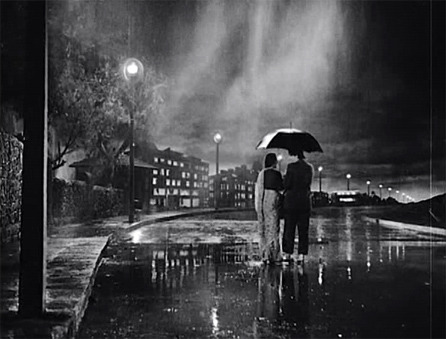
At the pawnbroker's, Raj first spots Nargis's Vidya, whom we soon learn is a teacher and the daughter of an impoverished, paralyzed school master. Raj quickly ingratiates himself into her life -- not without the requisite resistance on the part of the beyond-reproach Vidya -- in no small measure by charming the young woman's father. Vidya, however, remains apprehensive of the sly Raj who uses a populist speech to sell tooth powder to a clan of the city's poor. Aware of his want of respectability, Raj obtains a job as a launderer; with this display of integrity, Vidya's enchantment with Raj becomes love, which will provide the framework for the picture's most famous musical number -- a duet between the principles during a rain shower. Specifically, the opening of the heavens brings the pair together under the woman's umbrella, which allows for their mutual display of their passions in song. That is, in their sudden proximity and the consequent flaming of their respective desires, Kapoor clearly offers a distention of the moment in this omni-present feature of the popular cinema.
Thus, with the formulation of the couple tentatively complete, Kapoor's narrative introduces Raj to the world of wealth and luxury that his honest life with Nargis will necessarily exclude. In his capacity as launderer, Raj encounters the sultry Maya (Nadira) who glimpses Kapoor's conjurer's touch with playing cards. Leveraging his tenuous work status, Maya convinces Raj to accompany her to a casino, where donning a tuxedo, he'll play the role of 'Raj,' which is to say 'prince.' As such, Kapoor makes explicit an earlier observation that "fine clothes are more important than human sentiment." In this new world of opulence that he finds himself thrown into, Raj is instantly respected, whereas his earlier tramp's garb generated nothing but contempt or at times pity from his social better's. Suffice it say that Raj is smitten with his new role, though not enough to help Maya again after she refuses him a cut of his winnings. However, his ultimate victim in the casino, the previously mentioned Seth, soon secures his services, seeing the talent in Kapoor's character.
At this point, it is worth noting a key shift that has occurred in Kapoor's narrative. Absent are the frequent slapstick elements, and specifically the sped-up film stock that dominate the first half. In their place, Kapoor's narrative emphasizes his new world of luxury, instantiated inside the casinos, which on more than one occasion are compared to Monte Carlo. Indeed, it is as if Kapoor's film has switched off its Chaplin influence and on that of Erich von Stroheim's masterpiece Foolish Wives (1922), which of course likewise depicts a fake prince in the world of Monte Carlo's casinos. Apropos of his character's transition from a clown (who's mask "is the best way to hide one's suffering") to that of a prince, Raj declares: "I will remove one mask and replace it with another." So too has Kapoor replaced one genre with another -- not uncommon for Bollywood, to be sure, but rarely so explicit.
Similarly unique its explicitness, in a subsequent song number where Nargis proclaims her broken heart, Kapoor shows an apparition of the actress's character step out of the body of his lead. This figure approaches Raj while the corporeal Vidya stands impassive in the distance. While, as the performance in the rain listed above should demonstrate, music in Indian popular cinema often suggests the interiority of its singers, rarely has this precise relationship been so clearly indicated -- that is, it is uncommon for a director to tell us that his characters simply feel this way and are not actually performing thusly in time and space as Kapoor does here. It is again as if he is literalizing and therefore defining the codes of Indian popular cinema.
Of course, Raj's criminal turn does not last, as any spectator of classical Bollywood cinema will have already anticipated. Obviously, Raj and Nargis will end up together, though in keeping with the director's insistence on the mutual exclusivity of material success and integrity, not on the terms for which Raj may have hoped. It is likewise worth stating that with his resolution, Kapoor's narrative reverts to its first generic form, slapstick, in keeping with the masks worn by his lead (while also adopting direct-address for a speech on collective action; in other words, Kapoor evokes The Great Dictator [1940] as well).
Before concluding, a word or two should also be said on behalf of the performances of the lead couple: in summary, they deserve their elevated position in the pantheon of film couples. As always, Nargis projects dignity and integrity in this warm-up for her subsequent Mother India, while Kapoor's Raj demonstrates a subtlety that the opening passages might suggest are far from his capacities as an actor. The truth is, Kapoor is just as capable of under-playing a scene, which he does in portions of the von Stroheim-inspired second part, where he wears the mask of deceiver, as he is of fulfilling the Chaplin-esque role of "tramp." Indeed, Kapoor's artistry as an actor in many way assures the successful generic transformations that distinguish Shree 420.
Monday, January 29, 2007
The 79th Annual Academy Awards: Monster House & Dreamgirls

At this point, it might be worth noting that Monster House utilizes motion capture technology (cf. Zemeckis' The Polar Express, 2004), where the animation is layered over live performances. Indeed, in moments such as D.J.'s attempt to step lightly as he crosses the "monster house," the benefits of the technology over traditional animation become clear -- we see the light pressure that the boy puts on the ball of his foot. Then again, Monster House, as its title should make obvious, very much trades on animation's ability to make the impossible possible, bringing to life the titular structure in a picture that might be best described as Mon Oncle meets The Goonies, with more than a touch of The Incredibles (2004) thrown in.
 Of course, in Kenan's hands, Monster House is far more than high-concept 3D animation; Monster House is first rate Hollywood pop filmmaking, manifesting a highly creative manipulation of a classical point-of-view structure. Among other highlights, one of the most inventive examples is D.J.'s point-of-view as he is felled by Mr. Nebbercracker, who collapses as he is choking the boy. Likewise, Kenan's introduction of the house as a malevolent creature also represents a moment of acute directorial skill: the boy collapses on his bed in the left side of the frame, beside a window overlooking the house. Slowly, we see a black spectral sheet seep through the window before the room turns to crimson.
Monster House also includes moments of exceeding tension, many of which are quite frightening -- for instance, D.J. perilously swinging on a cable over the carnivorous house. Indeed, Monster House is not exactly a children's movie -- especially when one considers the sophisticated humor -- even as its presumed target audience (my guess boys around ten years of age give or take a year or two) might not be so quick to see animation of this sort. Nevertheless, Monster House deserves a wider audience than its relatively underwhelming $73 million box office tally indicates (fellow nominees Happy Feet and Cars have grossed two-and-a-half and three and-a-half times that number respectively). Whether a nomination will deliver greater popularity in home video -- particularly among adults -- remains to be seen.

Obviously, Dreamgirls circa 1985 would not have included the startlingly beautiful Beyoncé Knowles and her occasional attempts at emoting or the Oprah-orgasmic performance of Jennifer Hudson (who remains the prohibitive favorite to walk away with an Oscar statuette next month) though perhaps Eddie Murphy could still have been cajoled. Nevertheless, what we have is a film that is fabulous for about the fifteen minutes of back-to-back-to-back musical numbers, before Condon's televisual handling of the material really becomes apparent. Ultimately, Dreamgirls was made for an Oscar telecast montage of high points, which the film's failure to secure a 'best picture' nomination has eliminated. In that format, Dreamgirls would have been tough to beat. As a feature-length film, less so.
Sunday, January 28, 2007
Ivan's Childhood: For Beauty In The War Film

To introduce this year's Slate Movie Club, critic Dana Stevens felt the need to proclaim her dislike of the war film. That she would frame the argument in this fashion confirms the genre's centrality to current assessments of the state of cinema, and particularly its activist value. Indeed, in the present environment, anti-war films secure automatic vitality; they speak to us in recognizable slogans that most aficionados of "cinema" (as opposed to "movies" or heaven help us "flicks") readily endorse. War is hell. War wreaks devastation. War effects the poor, the weak, women, children and the elderly unduly.
Of course, with this rhetoric comes a visual imperative to show this hell, this devastation and this collateral impact. For contemporary combat films, Saving Private Ryan (1998) has become the template, satisfying the above through a style that mimics the photographic record of the Second World War, while offering a simulation of the visceral experience of war that makes extensive use of CGI. Saving Private Ryan and its followers are in short war films in the image of video games.
 I am a fan of neither Saving Private Ryan nor of combat (or really any, save for golf) video games, so in this respect I would side with Ms. Stevens. Where I depart somewhat is in my appreciation of a second tradition in the war film genre, which I will admit is far from a major one: the war film as platform for transcendental or universal themes. Among films that belong to this sub-type, the major recent example is certainly Terrence Malick's The Thin Red Line, the other great war film from 1998. (For my money, of course, The Thin Red Line is the only great war film of 1998, and indeed one of the finest American pictures of the decade.)
In a similar mode, I recently caught up with Andrei Tarkovsky's Ivan's Childhood (1962), which establishes, along with The Thin Red Line, the possibility of beauty in this ugliest of genres. While let me say now that there is a place for ugliness in the arts surely -- what would painting be without Grunewäld, Goya or Picasso's Guernica, after all -- a genre precluding beauty would strike me as a limitation. Not so for either Malick or Tarkovsky's films, which incorporate the beautiful through digressions from the generic topic of combat. In The Thin Red Line, it is the author's contemplation of the violence in nature that yields the beauty in nature above or against the ugliness in combat, whereas Tarkovsky establishes beauty through the subjective fantasies of the child protagonist.
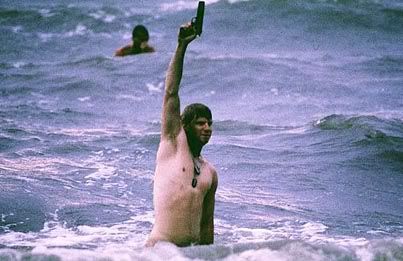
 Among these, one of the most startling is a sequence featuring the child Ivan (Nikolai Burlyayev) in an apple cart with a pretty young girl -- they are both what has come to be called "tweens." Tarkovsky shows the pair besieged by rain, before an obvious back-projection photographic negative image, thus confirming the distance between the sequence and the reality of the wartime Soviet Union. Further, Tarkovsky adds clear Biblical connotations to the scene -- that is of a prelapsarian Adam and Eve. However, Ivan will not live long enough to sample the experiences that this sequence prefigures. Tarkovsky, in other words, suggests the tragedy of war through the poetry and beauty of these images. In fact, he will return to this conflation of the water motif and Ivan's lost childhood in a sequence where we see the child cavorting with other kids on the beach, before he chases and then surpasses his girlfriend as they sprint through a stretch of extremely low water. In short, while there may not be any metaphoric meaning to the water, it serves to connect the scenes thematically. It is analogical, which is to say poetic, and as such essentially Tarkovsky-ian.
Of course this watery theme reoccurs in the indelible marshes through which the young Ivan passes in his work as a war spy, and in the puddling that surrounds a series of ruins that is likewise distilled in an image of a free-standing door and frame. With respect to the former, Tarkovsky again produces images of exceeding beauty, particularly when we see the reflections of the flares traced on the water's dark surface. These landscapes, it is worth noting, confirm the picture's Belorussian setting, as do the similarly gorgeous birch wood forests, which more specifically act as a symbol for Mother Russia.
 In the final marshland scene, where Ivan and his two adult companions must cross the swamps without the Germans noticing, Tarkovsky eliminates all light, which significantly refuses the spectator any clear view of what is happening on screen. In other words, we cannot see whether or not Ivan is safe, and yet, in the irony of Tarkovsky's mise-en-scene, this cover of darkness protects our protagonists. In other words, we don't want to see our hero as this would make the boy visible to the Germans as well. Thus, Tarkovsky takes away the substance of his art and we as spectators are grateful.
As such, Tarkovsky has transformed his form according to the desires of his spectators. More often, however, Tarkovsky's style adheres to a baroque program: time and again, we see a figure blocked in the foreground, in medium close-up, who sets off additional figures behind he or she in the middle and deep distances. In many of these scenes, the director places his camera below eye-level with large visible shadows. In short, this is not yet the director who looks down on his subjects from a God's-eye view as Chris Marker noted in his 2000 documentary One Day in the Life of Andrei Arsenevitch. Then again, in the film's utilization of Biblical imagery, to say nothing of the situation of much of the film within a ruined church, Tarkovsky's Christianity is already apparent. As such, it becomes clear that Ivan's Childhood is about more than the devastation of war -- it is at once a condemnation of Stalin's ambivalence toward the loss of life in World War II (not exactly controversial at the time) and also a critique of the violence done to the religious life in the Soviet Union.
Friday, January 12, 2007
New Film: Pan's Labyrinth & The Science of Sleep
 Continuing 2006's general lack of critical consensus, Guillermo del Toro's Pan's Labyrinth was named the year's best film last week by The National Society of Film Critics, the country's highest regarded critical organization. Representing only the second victory for a foreign-language film in the past twenty years -- the previous victor was 2000's Yi Yi, still one of the decade's finest films -- the selection of Pan's Labyrinth makes obvious sense as one of the year's most visceral popular entertainments. Of course, Pan's Labyrinth is not simply The Lord of the Rings Mexican redux, though it is an elaboration of the cycle exemplified by Peter Jackson's trilogy and continued in The Chronicles of Narnia.
In fact, like these sources, del Toro's picture is essentially Christian allegory: when 12-year-old Ofelia (Ivana Baquero in a marvelous performance) sneaks a couple of grapes, she is prevented from finishing the three tasks set before her, and thus from receiving "eternal life." However, Ofelia is subsequently offered a second chance to complete the final task, wherein the titular faun Pan demands that she sacrifice the life of an innocent. Suffice it to say that Ofelia is this, though she isn't so fast to comply with the faun. Indeed, her family's housekeeper Mercedes (Maribel Verdú) warns her too be wary of these creatures, though she earlier tells Ofelia that she no longer believes in many of the things she did as a child. (The film presents a double focalization structure through both Ofelia and Mercedes.)
This prior admonition is particularly significant as its establishes the film's self-conscious logic: Pan's Labyrinth is a fairy-tale created expressly for adults, compelling its spectator to accept the veracity of a series of fantastic creatures. Importantly, del Toro's narrative refuses to delineate those sequences featuring these fictional beings and separate passages which resolutely occupy the real world. In other words, the adult spectator of Pan's Labyrinth does not need to rationalize their existence in the film, but rather to accept that as a narrative, as a fairy-tale, fairies, fauns and various other monsters are all permitted. Magic is real in the world of the film.
Ultimately, del Toro's narrative does affirm a separation between reality and fantasy, however, as Pan's Labyrinth is very much concerned with representing the truth of the world. That del Toro situates his narrative in Spain 1944 confirms his belief that reality is crueler than anything we could ever dream up. As such, Ofelia's fascist step-father is a far more terrifying villain than any of the creatures which populate her parallel world -- in our introduction to the scope of his brutality, Captain Vidal smashes a hunters face in with a bottle before executing both the gentleman and his father on screen. To be sure, Pan's Labyrinth features more than its share of sadistic violence, with the worst of it perpetrated outside the girl's fantasy world. For this reviewer at least, Pan's Labyrinth is superior to 2006's other high-profile torture pic, Jean-Pierre Melville's 1969 Army of Shadows.
In the end, Pan's Labyrinth represents not only a reflexive continuation of the epic fantasy genre and a straight-forward Christian allegory (completed by the Princess's reign in her father's kingdom -- the redemption for the cruelty of this world) but also a note of caution for its adult spectators: that they not blindly follow authority, be it the Captain or Pan. Del Toro presents this message in an essentially classical popular form notable for its masterful use of invisible wipes that along with the director's ever-mobile camera work, secures the fluidity of his hybrid world.
 Likewise committed to a representation of fantasy that eschews any clear demarcation between reality and fiction, Michel Gondry's The Science of Sleep is in turns exceedingly romantic, heart-breaking, irritating and finally hopeful. With the exceptional Gael García Bernal and Charlotte Rampling as its star-crossed couple, Gondry's picture demonstrates a greater interest in -- and indeed a closer affinity with -- the visual arts' current specificity than does any semi-commercial film in a very long time. The fantasies of García Bernal 's Stéphane Miroux (a clear reference to surrealist master Joan Miro) take the form of a video art instillation, while the picture's comedy speaks to a Dadaist inspiration. In short, The Science of Sleep reminds us just how far cinema remains from the visual arts, for better or for worse.
Monday, January 1, 2007
New Film: Children of Men & Night at the Museum

Alfonso Cuarón's Children of Men has becoming something of a cause celeb among art-focused film critics, who see its current award season neglect as inexplicable, particularly when one considers the buzz generated by such middle brow fare as Babel and Little Children. Indeed, the title for J. Hoberman's review of the film summarizes the current sentiment perfectly: "Don't Believe the (Lack of) Hype." This is a film, as it defenders might argue, that has original aesthetics ideas -- which are virtually unprecedented in studio (Universal) filmmaking -- that attempts to reinvent its dystopian generic sources and that contains vital political commentary. In other words, Children of Men is precisely the sort of filmmaking for which the art-minded branch of the liberal humanist film criticism establishment has been waiting throughout the Bush administration. As Hoberman puts it, quoting an unnamed acquaintance, Children of Men is a "disaster film for NPR subscribers."
And indeed, it is not only in these latter terms, but indeed as a work of formal invention and experimentation that Chidren of Men succeeds. Specifically, Cuarón and cinematographer Emmanuel Lubezki's (Y tu mamá también and The New World) technique of using long tracking shots brings an element of international art cinema that is typically foreign to studio filmmaking. In perhaps the film's best set piece, Clive Owen's protagonist must push his escape vehicle down a gentle incline as he and his pregnant charge flee from the radicals who are set on using the latter for political purposes. (To summarize, Children of Men depicts a world where the world's women have become mysteriously barren, until a young immigrant woman magically finds herself with child.) As such, Cuarón and Lubezki have reinterpreted action-oriented science fiction not only through the use of mobile long takes, but even in slowing down the chase to the measure that technology fails the protagonists. In this way, then, Children of Men follows in the tradition of Jean-Luc Godard's Alphaville (1965), wherein the past is figured in the future as technology has come to show its age, while reproducing the long take aesthetic of Andrei Tarkovsky and Solaris (1972) and Stalker (1979).

However, unlike Tarkovsky's work in particular, Children of Men does not produce a cogent allegory. To be sure, Children of Men often references contemporary European and American politics: immigration is curtailed in the picture (an important theme for both spheres, and a natural subject for a Mexican director working outside his country of origin); child birth, again, has disappeared (while the situation is not quite this dire in Europe, many nations do remain well below the replacement rate); Abu Ghraib is directly reference in the prison camp that the protagonists break into; proto-fascism is ascendant; etc. Thus, while Cuarón suggests that we are to read the present into his 2027 setting, few if any of these themes are worked out to effectively rend allegorical meaning. Why do these women stop having children -- is it a consequence of some unnamed ecological disaster? Does it figure a world at war? What is to be made of the pregnant immigrant woman Kee (Claire-Hope Ashitey) -- is Cuarón suggesting that there would be no children without these populations? What of its quasi-religious connotations? (Also in evidence is the film's anti-war sentiment, which is clearest in the sequence where Owen, the mother and her child pass through a sea of soldiers who are transfixed by the miracle of life; implicitly, Cuarón argues that if only we would understand this very miracle, then war would be rendered obsolete.)
Ultimately, Children of Men operates therefore on the basis of anxiety, suggesting the possibility of a dystopian future without exactly showing why such a future might come into being. (Some might say that this makes it open ended and certainly, most of its advocates may be able to cite reasons why the world is headed in this direction.) In other words, Cuarón suggests a reading of the present without factoring the implications of his themes. Interestingly enough, the director's previous studio blockbuster, Harry Potter and the Prisoner of Azkaban (2004) represents a fully-formed allegory. In that work, thematically consistent with the director's highly-praised Y tu mamá también (2001), Cuarón formulates an allegory of tolerance towards homosexuality instantiated in the figure Professor Lupin (David Thewlis) that does not simply connote but indeed makes an argument. In this respect, Harry Potter is the more politically coherent work, though its visual style, while dazzlingly baroque for an installment in the series, does not even suggest the ambitions of the later film. Perhaps some of this progression is the product of Lubezki's maturation as an artist (he did not collaborate on the Potter film, for what its worth). As with The New World (2005) there can be no disputing the flamboyance of the cinematographer's artistry, though also like that film, it is not exactly clear what if any meaning derives from those visuals.

There is no similar problem with Shawn Levy's Night at the Museum, which to be fair has neither visual élan nor does it make any attempt at allegory beyond the generic contours of the children's film. It is a kid's film pure and simple, where the comedy derives from things being bigger or smaller than they are in real life, though one with supporting performances that should resonate more with its adult spectators: Ricky Gervais effectively reprises his vocabulary-challenged David Brent as the museum director, while the not-dead Mickey Rooney appears as a recently-terminated night watchman, fond of using such words as "butterscotch" as put-downs. For their performances alone, to say nothing of the spectacle of Ben Stiller fighting with a monkey -- which he slaps... tisk, tisk -- Night at the Museum rates as above average studio fare, and a welcome box office champion during this holiday season. With respect to said performances, moreover, Night at the Museum may be preferable to Children of Men for some viewers (though I can't quite say that I am such a spectator): that is for those who might not look favorably upon Michael Caine's hippie shtick. In my view at least, what's the good of a dystopian future if hippie potheads can survive twenty years of world war? I suppose this is what makes it dystopian.
Subscribe to:
Posts (Atom)