Monday, March 27, 2006

New Film: Inside Man


Or, How I Learned to Stop Worrying and Love (no, not love; let's say like or even like a lot, if we must) Spike Lee.

It is interesting that Inside Man represents one of those archetypical instances of a director, seemingly under contract for a fairly straight exercise in genre, which might as well have been crafted for him or her in advance. Then again, it is precisely in these sorts of works that the merits of the auteur theory become clearest: it is, after all, a theory that defines the status of the director as an artist, not simply an advocation of autobiographical filmmaking. And there can be no denying Lee's imprint on Inside Man, in spite of the fact that it may well be one of the director's least personal pictures.

At the level of technique, Lee's stylistic elan is apparent from the opening shot: Clive Owen's bank robber addresses the camera, telling us his name, profession and location (a cell, though significantly, not a prison cell). The director proceeds to adopt Hitchcock's technique -- from Vertigo -- wherein a tracking shot is accompanined by a zoom. The effect (also used spectacularly by Scorsese in Goodfellas' diner scene) brings us closer to the character, even as the space behind the figure is reconstituted. It is, in other words, a signifier of a baroque style, as is for instance Lee's frontal tracking shot, in which Denzel Washington's fluid movement seems to suggest that he is standing on top a scooter or cart of some sort. These moments of excess, within the broader framework of generally terse direction, indicate the same flamboyant stylist who translated the American baroque of Welles and Scorsese to Brooklyn's Bed-Stuy neighborhood in his exceptional Do the Right Thing (1989).


Yet, it is that terseness, the film's economy, which truly recommends Inside Man. Much of this quality can be attributed to Russell Gewirtz's exceptional screenplay, though even in the film's dialogue Lee's voice is unmistakable -- particularly in the race-baiting that has been transformed from politically-militant axiom to politically-correct satire. Indeed, Lee's rhetoric seems to be in the process of softening, especially since his 2002 standout, 25th Hour, which encapsulates America's post-9/11 feeling that "we are all New Yorkers" better than any other film I know. Inside Man shares with that earlier pinnacle an ethnographic description of five boroughs life, as well as its referencing of incarcaration (though it stops short of making fear of anal rape a structuring motif, as is the case with 25th Hour, which itself might just portend the director's willingness to bait groups other than racial or ethnic in their orientation; here, Washington is allowed a single quip).

Returning for the moment to the narrative structure, Lee and Gerwitz encourage us to hope that Owen can get away with his crime -- a large portion of the heist genre's pleasures, after all, pertain to the intelligence and dexterity of the crimes committed; and from the opening monologue, Lee affirms his position within this tradition. It helps that Lee skillfully discloses and conceals many of the details of the caper, creating objects of suspense beyond the simple will they or won't they get away with it axiom. One of the best early examples of this is Lee's refusal to re-enter the space of the bank after being introduced to Washington's negotiator, for an extended duration. While we already know the anti-heroes, we are little more cued into what the protagonist is facing at this moment than he is himself. In this way, Lee shows himself to be a bravura manipulator of narrative information, as he will throughout the remainder of the film. I'm tempted to make a comparison to Bryan Singer's modern classic, The Usual Suspects (1995), though I would do so only with the caveat that Lee's twists don't entirely reach for that same epistemological vertigo.

Friday, March 10, 2006

New Film: Battle in Heaven & Old Joy

Carlos Reygadas' Battle in Heaven (Batalla en el cielo, 2005) opens and closes with a comely young light-skinned Mexican woman performing fellatio on an obese, unattractive, middle-aged mestizo gentleman, whom we later discover has been the girl's driver since childhood. That Reygadas would choose to begin his film with so graphic an image surely underscores his desire to incite. Then again, it quickly becomes evident that this selection does not serve as mere provocation alone, but rather provides a formal matrix through which the remainder of his film can be understood. Moreover, that he likewise concludes his film in this same fashion allows the director to crystallize the film's principle discourses, namely of cinematic representation, class conflict and religious belief. And all in a blow-job.

Following the shocking opener, Reygadas introduces us to his hero Marcos, whom we soon learn -- in an almost off-handed off-camera revelation -- has just been involved in the kidnapping of a baby who tragically died during the affair. This point, however, garners far less narrative time than the fellatio or than Reygadas' seemingly ethnographic interest in the Mexico City subway tunnels where Marcos' wife sells her wares. However, it is not a third-world tourist impulse that animates Reygadas in so precisely detailing the latter, but it is rather social commentary, particularly when Marcos' subsequent experiences are compared to those of his female employer, Ana, as he drives the young woman home from the airport, through the tree-lined boulevards of her leafy suburb. Importantly, Reygadas lingers on both the public space of the metro system and the private space of the automobile to convey the sense in which the dead time for the country's working poor is characteristically chaotic, whereas comfort defines these moments for the rich.

In a telling moment of social incongruity, Ana asks Marcos a question and then quickly interrupts him once her boyfriend is free again to speak with her on her cell phone. Yet, if Ana does treat Marcos as an employee who is of less importance than even the most trivial incidents in her own life, she does seem to maintain a certain fondness for and trust in Marcos, whom she asks to take her to a brothel where evidently she works in secret. There, Marcos, refuses the pleasures of a young prostitute insisting that Ana forced him to come. Ana then interrogates Marcos about his feelings for her, but drops it when it becomes clear how he feels.

At this point, the opening salvo increasingly looks as if it may exist outside the time of the film narrative altogether, be it as a representation of his fantasy, or more compellingly, as a purveyor of formal and social meaning, at once illuminating Reygadas' post-Kiarostami tendency to constrict the visual field while creating an expansive aural space, even as his lowly mestizo character is pleasured by a woman of higher social standing whom we assume would never do something like this in real life. In other words, Reygadas uses his fellatio as a socially-leveling device. There is indeed something intriguing to this latter reading, even if Reygadas does have the pair engage in intercourse later in the film. Then again, this simulated sexual act is presented on screen in long take, whereas Reygadas masks this same activity between Marcos and his equally unattractive wife.

Speaking of this latter sex act, when it concludes, Reygadas moves his camera to disclose an image of Christ over the couple's bed, even as their heavy-breathing continues. This apparent visual joke, far from a throw away, in fact distills a key component of the director's vision: the idea of ecstasy (as in Bernini's St. Theresa). Following the pilgrimage that Marcos ultimately joins, seemingly in a desperate search for forgiveness, Reygadas closes his film with the second fellatio scene, which in this case shows Marcos grinning for the first time and hovering over Ana in a position of power. As such, Reygadas conflates the transcendence inherent in both religious devotion and sexual fulfillment, in a fashion that one could see as congruent with the noted trend in baroque figuration. Moreover, the pilgrimage itself follows a definitive conflation of sex and violence that seems to situate Reygadas in a tradition in Mexican filmmaking that also includes two of its most accomplished directors, Luis Buñuel and Arturo Ripstein.

However, it is not simply these themes that find their way into these concluding gestures -- both the violence and the sex act -- but it is moreover Reygadas' arguably radical view of a reconstituted Mexican society. The intimation may be that a violent overthrow of class structures is required, but in the universe of Battle in Heaven a little fellatio would seem to suffice.

Kelly Reichardt's Rotterdam prize-winner Old Joy, which will play at New York's Walter Reade theatre as part of their 'New Directors' series on March 21st (and which should manage some form of distribution thereafter, one would hope), begins with the image of a bird perched on a gutter followed by a series of shots of a man, covered in ants, meditating in the grass. In other words, its opening passage is a whisper to Reygadas' scream, even if similarities abound elsewhere. For one, both films share a documentarian concern for the non-fictional locations of their narratives.
In the case of Old Joy, this is (lower-middle class) Portland and its mountainous environs: roadsides and passing storm cloud formations seem to attract nearly as much attention as the strained interaction of the two 'old friend' leads, Mark (Daniel London) and Kurt (Palace Music frontman Will Oldham).

Backtracking for the moment, the spare narrative of Old Joy concerns Mark and Kurt's overnight camping trip, with a visit to a local hot springs to follow the next day. Throw in Mark's pregnant partner, an avowedly liberal radio talk show, and a diner visit in the morning and one has the totality of Old Joy's narrative. Nevertheless, Reichardt's narrative demands nothing further as she needs little more than a quick shoulder rub and an arm dropping into the hot spring water to say everything that we would ever need to know about the past, present and future of their friendship. Old Joy demonstrates an admirable economy, which along with its contemplative tone distinguishes it from the vast majority of "indie" cinema.

Then again it is not these qualities alone that recommend Reichart's film, even if she does mildly contaminate the film's understated poignancy with a final gesture consistent with the film's liberal humanist rhetoric. Old Joy importantly manifests a genuine nostalgia for Gen X's heyday -- the Slacker to Reality Bites years -- making it (along with the undeniably elegiac Before Sunset [2005]) as one of the first works to long for this not-so-long ago 'golden age.' However, what makes this film particularly significant on this front, given the liberal values espoused by Kurt and the left-wing, call-in talk show that Mark listens to, is the speed in which this impression has been reached by Generation X's left-of-center constituency (which importantly was always far smaller than their parents'). Evidently an era that made Eddie Vedder its mouthpiece wasn't entirely successful at changing the world after all? All kidding aside, Old Joy represents an important next step in 'Gen X' cinema.

Monday, March 6, 2006

The 2006 Oscars: Triumph of the Fatuous

If you are in any sense a critic of Hollywood, last night was your night. Not only did the Academy choose a film of almost unfathomable stupidity and aesthetic bankruptcy as its best picture of the year (Crash) but last night's telecast also managed the distinction of being at once one of the most banal, profane and sanctimonious three-and-a-half hours of network television in American history. (Academy, can't you stick to destroying the integrity of your own medium?) When we were not being treated to one of the countless montage pieces (since when does the restaurant scene in Five Easy Pieces demonstrate social consciousness in cinema ?) or the unspeakably vulgar interpretative dance segments -- yes, that dancer was being fingered behind Katherine "Bird" York, reenacting one of the worst moments in contemporary Hollywood cinema... FCC do your job! -- we were being lectured to by a Hollywood that has the temerity to explain to us how it is an organ of great social progress. Way to honor Hattie's portrayal of a sycophantic slave, Academy! And way to point it out George Clooney!

Then again, for all the hand-wringing this morning -- my friend Matthew's piece at Termite Art is the best I've read that takes this perspective, though I would disagree with some of his analysis inasmuch as I suspect voters skipped over Matt Dillon (and reward it as an ensemble instead) in order to spread the hardware around, given that it was such a luck-luster year -- mind-numbing retardation is nothing new for the AMPAS. After all, the Academy did choose Marty rather than Night of the Hunter in 1955, Around the World in 80 Days rather than The Searchers in 1956, and Gigi rather than Vertigo or Touch of Evil two years later (I will be posting my ten best lists for the '50s later today, hence the focus on that decade, which coincidentally do not include a single best picture winner among each year's top ten). The point is the AMPAS does not, and perhaps hasn't ever signified quality in the American cinema. Unfortunately, it has rarely succumbed to such fatuousness.

Sunday, February 26, 2006

Current Exhibitions: Goya's Last Works & Edvard Munch: The Modern Life of the Soul

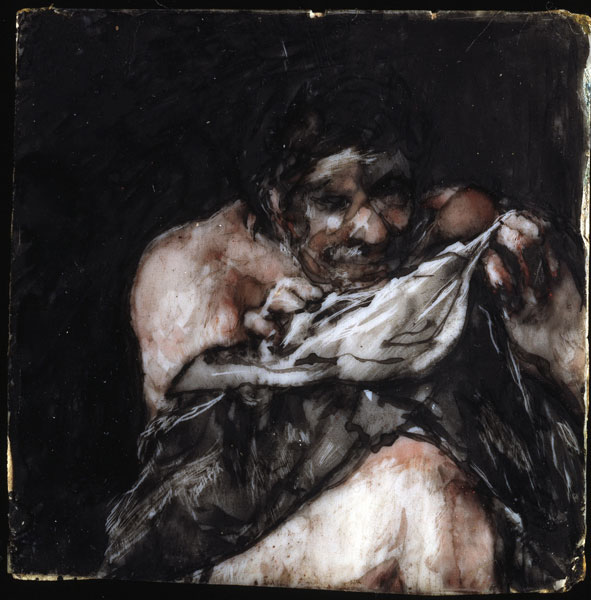
Goya's Last Works, running now through May 14th at the Frick on New York's Upper East Side, is the first exhibition in this country to focus exclusively on the final phase of Francisco de Goya y Lucientes' career, and particularly on the work he did while in exile in Bordeaux, France during the mid-1820s. This is to say that the work on display largely follows his famed Black Paintings-cycle, wherein the characteristic grotesqueness and violent spirit of his work comes into sharpest relief (as in the signature "Saturn") -- given the spare settings and the unrepentant horror of these creeping later masterworks. The Bordeaux cycle, to be sure, particularly picks up on the latter characteristic, especially in the crayon sketches featured at the Frick, which showcase the genuinely humane dimension of the artist's vision, as his retinue of beasts, convicts, lunatics, witches, the infirmed and the elderly gain not only representation but indeed humanity in spite of their ugliness (such as with the "Man Looking for Fleas in His Shirt"; 1824-5, water color on ivory). Of course there is still social critique (as in "Man Killing Monk," c.1824-8) and perverse humor ("To Eat a Lot," also c. 1824-8, which portrays a gentleman crapping) evident in these remarkable sketches.

Visually, Goya's paintings of this period (which, for this exhibition, include the wonderful "Self-Portrait with Dr. Arreita" [1820] on loan from the Minneapolis Institute of the Arts) eschew spatial depth in the same fashion as the Black Paintings, though few match the chromatic darkness of that marginally-earlier cycle. If there is a key to the portraits that Goya limned in southwestern France, it would seem to be (as my girlfriend Lisa Broad, a film scholar as it happens, observed) in his individual depictions of their mouths -- just as the key to Rembrandt's portraiture is in his handling of his subject's eyes. In both, it is possible for us to perceive an entire internal universe, though one might say in Goya's case it is more personality whereas with the Dutch master that universe is the soul.

Regardless, whenever one has the opportunity to see a large number of Goya's -- even in smaller shows such as the Frick's -- it is hard not to conclude that Goya was indeed the most purely talented painter to emerge between Vermeer (if not Velazquez and Rembrandt) and Cezanne. His was an art that looked to Velazquez in particular, but which imprinted his own internal tumult and social vision on an art that humanized often the most inhuman of subjects. As his friend Antonio Brugada once said of him, "[he] had never been able to imitate anyone," and by the time of this final phase, "he was too old to begin."

In contrast to Goya's unique idiom, the picture of Edvard Munch that emerges from the Museum of Modern Art's Edvard Munch: The Modern Life of the Soul is of a deft imitator who conveyed a singular vision only in the interstices of his lengthy career.
A cursory survey of the MoMA's expansive showcase would seem to indicate that Norway's most famous painter borrowed extensively from Manet, Whistler, Seurat, Sargent, Klimt, Gauguin, Ensor and Van Gogh (in particular), among others. Yet, Munch was capable of distinguishing himself as a gifted depicter of fin-de-siecle unease, anguish and even despair, as with his Death in the Sick Rooms-cycle, and with such masterpieces as the aptly-titled "Despair" (1892), "Moonlight" (1893) and especially the singular "The Storm" (1893; from the MoMA's permanent collection) where a gale-wind messes with a bride, hands to face, and the formless figures of her bridal party who imitate her gesture. It is in pieces like these that Munch's perspective is clearest, finding its formal expression particularly in their pale quality of light, their insistence of hard, mannered gesture and the indistinct duplication of human features that mark these works. If, in the end, we see works like these -- and the exhibition's structuring absence, "The Scream" -- as exceptions rather than the rule for Munch, then the importance of a show like the MoMA's can be easily interpreted: in portraying Munch as the artist he actually was, not in the artist a few spare masterpieces would have led us to believe.

Tuesday, February 21, 2006

Best Picture Nominees

The past couple of years, the Academy of Motion Picture Arts and Science has done a better than average job selecting those films which will compete for a 'best picture' Oscar. In 2003, remarkably, the AMPAS chose five relatively deserving titles, including my favorite for that year Clint Eastwood's Mystic River. Last year, they nearly duplicated that mark, selecting only one not-so-good title, Ray, alongside four more-or-less deserving films (with the year's best picture, Eastwood's Million Dollar Baby, actually winning top honors, for once).

Anyway, the AMPAS has demonstrated over the past couple of years that they do in fact have some insight -- some as they did chose the terrible A Beautiful Mind (2001) and Chicago (2002) as best pictures for their respective years. With their nominees for 2005, however, it is back to that earlier dark age -- even if they mercifully passed on Ron Howard and Rob Marshall's 2005 banalities. Okay, so two of the five films nominated are of above average quality, while numbers three through five are different shades of bad.

What follows are my brief assessments of the five titles, listed in descending order of preference. Beneath these is a second list of ten films which I would prefer to any of the five titles selected by the AMPAS to compete for the best picture Oscar, including the least offensive of this year's spate, Capote.


Bennett Miller's Capote is sustained by this year's flashiest (and to my mind best) male performance, Philip Seymour Hoffman as Southern novelist, wit and raconteur Truman Capote. Miller films the script's über-tight exposition in a startlingly unfussy, classically-sound manner, which at the same time offers some sense of the elegance of the film's predominantly Midwestern landscapes. But again, the performance is the thing here, as is the admirable complexity with which Miller paints his often un-heroic lead.

George Clooney's Good Night, and Good Luck. is easily the most visually flamboyant of the five nominees, shooting the Edward R. Murrow biopic in the sort of gorgeous high-contrast black-and-white that one is more likely to associate with the previous decade of American cinema. Never mind this, Clooney actually demonstrates an interest in style which is nearly approximated by the graceful cool of his performers, particularly by David Strathairn as Murrow himself, in a performance worthy of the actor's nomination. If Good Night, and Good Luck. doesn't quite match Capote in the former's ambiguity (if not integrity) with which the subject is depicted -- Clooney doesn't hesitate to canonize his hero -- the film's evocation of atmosphere (in the very broadest sense) nearly makes up for this shortcoming.

Ang Lee's Brokeback Mountain may well walk away with the hardware this year, as much one suspects for what its defenders would like it to say rather than for what it actually says or how it says it. This is not entirely the fault of Brokeback Mountain, which whatever happens on Oscar night, will remain a missed opportunity in genre revisionism (not that anything more should be expected of professional opportunist Lee). Ultimately, Lee's film is little more than a visually-flaccid examination of half-baked sexual pathologies, notable less for their supposed emotional depth than for the incomprehensibility of the structuring relationship. If Lee was indeed so keen on profaining the American Western, he should have attended more to its semantics.

Steven Spielberg's Munich should give the director's more vehement bashers enough ammunition for the rest of their natural lifetimes. How any thinking person could believe that this will do anything to heal the Israeli-Palestinian rift -- which Spielberg claimed on-record -- is unimaginable.
To do so, they would have to digest the morals of a narrative that builds its case upon the psychology of a hired assassin whose internal state has been willfully perverted for precisely this narratological reason (as Eric Bana's character is improbably wracked with guilt while he attends to the business of avenging the cold-blooded murder of his countrymen). Of course, human psychology does not exactly seem to be Spielberg's strong-suit, what with his ascribing of post-tramatic event syndrome to a character that didn't experience said occassion (most spectacularly, moreover, during one of the worst sex scenes in recent memory). Add to this the year's most heavy-handed -- and cloying -- conclusion and Spielberg would seem hard to beat in the category of worst 'best picture' nominee of 2005.

But for Paul Haggis' Crash, which is not only the worst of the five nominated films, but also the worst American film I have seen in the past twelve months. Granted, I am generally successful in avoiding contenders for honors such as this, but that said, there is something truly awe-inspiring to Crash's atrociousness. If you've seen Munich, think of the absence of any subtlty in the final scene and then apply it to an entire script and you begin to approach what Haggis is doing in Crash. That's just part of what you get with Crash, which when its not trading on this or that racial stereotype, offers such moments of understated elegance as Matt Dillon's Oscar-nominated black-hating cop who ends up rescuing the same African American woman from a burning car that he had molested earlier in the film; Sandra Bullock's perpetually angry white woman, who is helped after a terrible fall by the same minority maid who up to this point had been quite often the object of her tyrades; and most astonishing of all, the Islamic store owner who targets the wrong Hispanic gentleman for vandlizing his store and in the process shoots the latter's daughter... who nonetheless survives because of the forsight of the store owner's older daughter. That a film this bad could be under consideration for the title of the year's best invalidates any organization that would make this case -- as it seems to validate the auteur theory: surely Million Dollar Baby (which Haggis scripted) is Eastwood's genius after all.

Had the AMPAS been interested in recognizing truly deserving work,
they would have cited any one of the following ten films above the five they did in fact choose: Christopher Nolan's Batman Begins (deserving of its cinematography nomination); Andrew Adamson's The Chronicles of Narnia: The Lion, the Witch and the Wardrobe; David Cronenberg's A History of Violence (easily the year's best English language film); Harold Ramis' The Ice Harvest; Phil Morrison's Junebug (Amy Adams should win in her supporting category); Woody Allen's Match Point; Robert Rodriguez and Frank Miller's Sin City; Noah Baumbach's The Squid and the Whale (hopefully will walk away with the best original screenplay trophy); Tommy Lee Jones' The Three Burials of Melquiades Estrada; and David Dobkin's Wedding Crashers.

Thursday, January 26, 2006

Shigehiko Hasumi: An Appreciation

The first time I encountered Shigehiko Hasumi's writing was in a volume on Japanese master Mikio Naruse, which he co-edited for the Filmoteca Espanol, on the occasion of an exhaustive retrospective of the director's work at the San Sebastian film festival. The volume, half in Spanish, half in English became something of a sacred text to me, having just discovered Naruse's work through the writings of Philip Lopate. As much as I owe to the latter for the discovery, it was Hasumi's glorious prose however which helped me to appraise Naruse as one of the cinema's very best directors. Hasumi's approach in this writing might be best understood as disclosing a matrix for viewing the auteur's cinema that conformed to much larger questions of medium specificity. In Naruse's case, Hasumi traced a lineage of simplicity from Griffith through Ford and Godard: the first posited that cinema was comprised of a man, a woman and a gun; the second, a man, a woman and a horse; Godard, a man, a woman and a car; and finally with Naruse, cinema had reached its base of simplicity with a man and a woman, or more accurately, a man, a woman and light. It thus became Hasumi's task to illustrate those moments which reveal this essential state in cinema throughout Naruse's work. (For this reason he found particular value in 1940s curiosity, The Song Lantern).

My second encounter with Mr. Hasumi -- actually that's professor, and not only professor, but dean of Tokyo University; indeed, a number of his students have gone on to become great directors such as Kiyoshi Kurosawa -- was for a panel discussion on the art of Yasujiro Ozu for the director's centenary in 2003. At this event, which also featured Robin Wood, Tom Gunning and a number of other film studies big shots, Hasumi gave one of the most compelling and off-beat presentations as he examined Ozu's women through the gesture of tossing down articles of clothing (and particularly their husband's). In so doing, he revisited the opinion that his was a socially conservative cinema, while delving into a concern central to the medium's particularity: namely, the gesture.

Interestingly enough, Prof. Hasumi returns to the throwing gesture in his latest Rouge essay "John Ford, or The Eloquence of Gesture". Here, he supposes that the essence of that master can be found in that same gesture, while again enlivening his auteur study with a deeper theoretical inquiry into the essence of the art. This is the best film essay that I've read in a very long time; it is indeed the sort of prose and analysis that should serve as a model for all aspiring film scholars and critics -- I know it will for me. In simply reading it, I found my own avocation elevated to a level which it rarely attains.

Monday, January 23, 2006

New Film: Looking for Comedy in the Muslim World & Match Point

I am an Albert Brooks fan. A big Albert Brooks fan. To me, Modern Romance (1981), Lost in America (1985) and Defending Your Life (1991) each rate among the best American comedies of their era, with Real Life (1979) and Mother (1996) not far behind. The lone dud in his corpus is his 1999 Sharon Stone-vehicle The Muse, which even I will concede doesn't qualify as a good film, quote-endquote.

After seeing the trailer for Brooks's latest, Looking for Comedy in the Muslim World, and learning of Warner Brother's unceremonious dumping of the picture onto its independent label, I worried that Brooks perhaps had made something roughly equivalent to his earlier failure. I am pleased to report that Looking for Comedy... isn't the unmitigated disaster I had feared. Okay, so it isn't a great film either, but all things considered, Looking for Comedy... is a minor success for a director whom many would seem prepared to toss on the ash heap of film history. Sure, Looking for Comedy in the Muslim World is minor Brooks. But the mere fact that it is still an ambitious, intelligent comedy while holding that distinction confirms Brooks as a major American film artist, in spite of his small output. In other words, even minor Brooks can be quite good.

The premise of Looking for Comedy... is compelling enough: an American council, headed by Fred Dalton Thompson, has selected Albert Brooks to travel to India and Pakistan in order to learn what it is that makes Muslims laugh (as a first step in developing an understanding of that Byzantine culture). Okay, so he wasn't exactly their first choice, but they did eventually chose him -- and with the inducement of the "Medal of Freedom," for which Brooks is more than a little excited, he's sold. Plus, it's not exactly like Brooks has been working a lot lately.

In fact, Looking for Comedy... trades on this suggestion that Brooks is a has-been, who is now best-known for voicing Nemo, not for his brilliant directorial work. Having said that, Brooks's work in Looking for Comedy... remains nothing if not ambitious, as he challenges the new orthodoxy of our overtly-political present: is the US's problem that it does not better understand the Muslim world? Ostensibly, Brooks's answer seems to be that for better or worse, any cursory attempts at such an understanding cannot yield the intended results -- leading the film to its clever concluding punchline. Indeed, it is in this final bit of humor that Brooks's concerns coalesce as we are instructed on the political implications of his post 9-11 endeavors (speaking of both the film and the project depicted by the film).

Yet, it is often less the political issues that guide Brooks in Looking for Comedy... than it is the autobiographical elements of the persona that he has once again resurrected for the screen. That his project goes so horribly awry indicates not his self-pity but rather his self-deprecating humor, which it should be remembered largely separates Brooks from his East Coast counterpart, Woody Allen, and the latter's competing screen personality. Typically the punchline to many of his own jokes, here Brooks trots out his thirty year-old stage act to a confused New Delhi public, which hasn't nearly the familiarity with his smart takes on improv and ventriloquist routines that his jokes obviously demand. As a matter of fact, a companion of his later points this out to an affronted Brooks, who as always remains confident of his comedy's (and crowd's) intelligence.

Indeed, what we get yet again is an Albert Brooks unwilling to compromise his art -- he is offered an al Jeezera sitcom in which he would play the "Jew" in a Muslim apartment complex, to which he reiterates his refusal to do t.v. -- even if this means making a comedy which isn't always that funny. One might even say there is a certain avant-garde quality to Looking for Comedy... provided Brooks's willingness to describe himself on-screen as a has-been with comedy that is thirty years out-of-date. Then again, Brooks shows himself to be on the vanguard when it comes to addressing post-9/11 reality. In this, Looking for Comedy... hardly seems minor.

As I have mentioned, Brooks's natural filmmaking double has long been Woody Allen, whom I admire a good deal less, customarily.


Consequently, I found myself rather skeptical when I heard all the praise surrounding Allen's latest, Match Point. Having ultimately succumbed to the hype, let me just say that this is indeed Allen's best in quite some time -- perhaps the last equivalent work is his 1992 Husbands and Wives, which of course shares a mutual interest in marital infidelity and Ingmar Bergman. Without elaborating in too much detail or giving away too much of the plot, suffice it to say that Allen successfully weaves his operative metaphor (the tennis ball that could go over the net or fall back on one's own side in equal measure) into the narrative in an organic and I would say surprising way. Sure, he is tempted by his characteristic heavy-handedness here -- but so was his primary source for the film, Bergman, almost to a film -- but ultimately this sporadic failing detracts very little from what is ultimately an expertly narrated crime drama. If last year's atrocious Melinda and Melinda made me want to forget Allen's existence entirely, Match Point is a reminder that he can be a very good director -- even when his dialogue is hopelessly dated and his lead, Scarlet Johansson, is a black hole when it comes to charisma. What is really on display here is exceptional story-telling structure coupled with a clean, classical technique. Given the converging elements of Allen's pacing and plotting, the other player's uniformly strong performances and Johansson's rotten one, Match Point truly made me hope for its male lead's happiness, whatever that might mean -- think of Hitchcock's Frenzy (1972). What I will not give it credit for is an avant-garde, cringe-producing performance equaling Brooks's intentionally bad comedy. With that said, Match Point marks one of those rare occasions when Allen has been unmistakably better than Brooks. I guess that goes to show what he can still do when he stays out of the film and away from comedy.